StanCompliance: OTC Compliance for Fiat-Backed Stablecoins

StanCompliance: OTC Compliance for Fiat-Backed Stablecoins
Fiat-backed stablecoins are now practical instruments for OTC flows, corporate treasury, and cross-border settlement. The regulatory picture is clearer too. In the US, the SEC has clarified that certain “covered” USD stablecoins are not securities and that issuance/redemption activities don’t require SEC registration. It has also signalled that USD-pegged stablecoins with guaranteed redemption could be treated as cash equivalents for accounting. In Hong Kong, authorities are tightening AML/CFT controls around custodial wallets and unhosted wallets, while openly encouraging licensed stablecoin pilots, including for potential government payment use cases.
If you operate an OTC desk in or serving Hong Kong, this changes how you design onboarding, wallet operations, liquidity, and accounting.
What’s changed and why it matters
- U.S. accounting and classification: New SEC staff guidance (as reported by Bloomberg and The Block) suggests USD-pegged stablecoins with guaranteed redemption mechanisms can be classified as cash equivalents. This can materially affect your treasury reporting and capital buffers. However, you’ll need robust documentation of redemption rights, settlement timelines, and reserve quality.
- Securities treatment: The SEC clarified that “covered” USD stablecoins are not deemed securities and that issuance/redemption handling does not require SEC registration. That reduces one major U.S. regulatory overhang for cross-border desks, though state money transmission and other rules still apply.
- Hong Kong AML perimeter: Hong Kong’s consultation conclusions emphasize: (i) FIs/VASPs providing custodial wallets for stablecoin holders are squarely in scope for AML/CFT, and (ii) there must be additional controls to mitigate the risks of unhosted wallets. Some FATF members even require identification and verification of any stablecoin holder at framework launch. Expect similar conservatism in HK implementation.
- Policy direction: Hong Kong’s Policy Statement 2.0 invites market-led pilots and use cases for licensed stablecoins, including potential efficiency gains in government payment rails. That’s a clear signal to build, but build with controls.
OTC implications: where the rubber meets the road
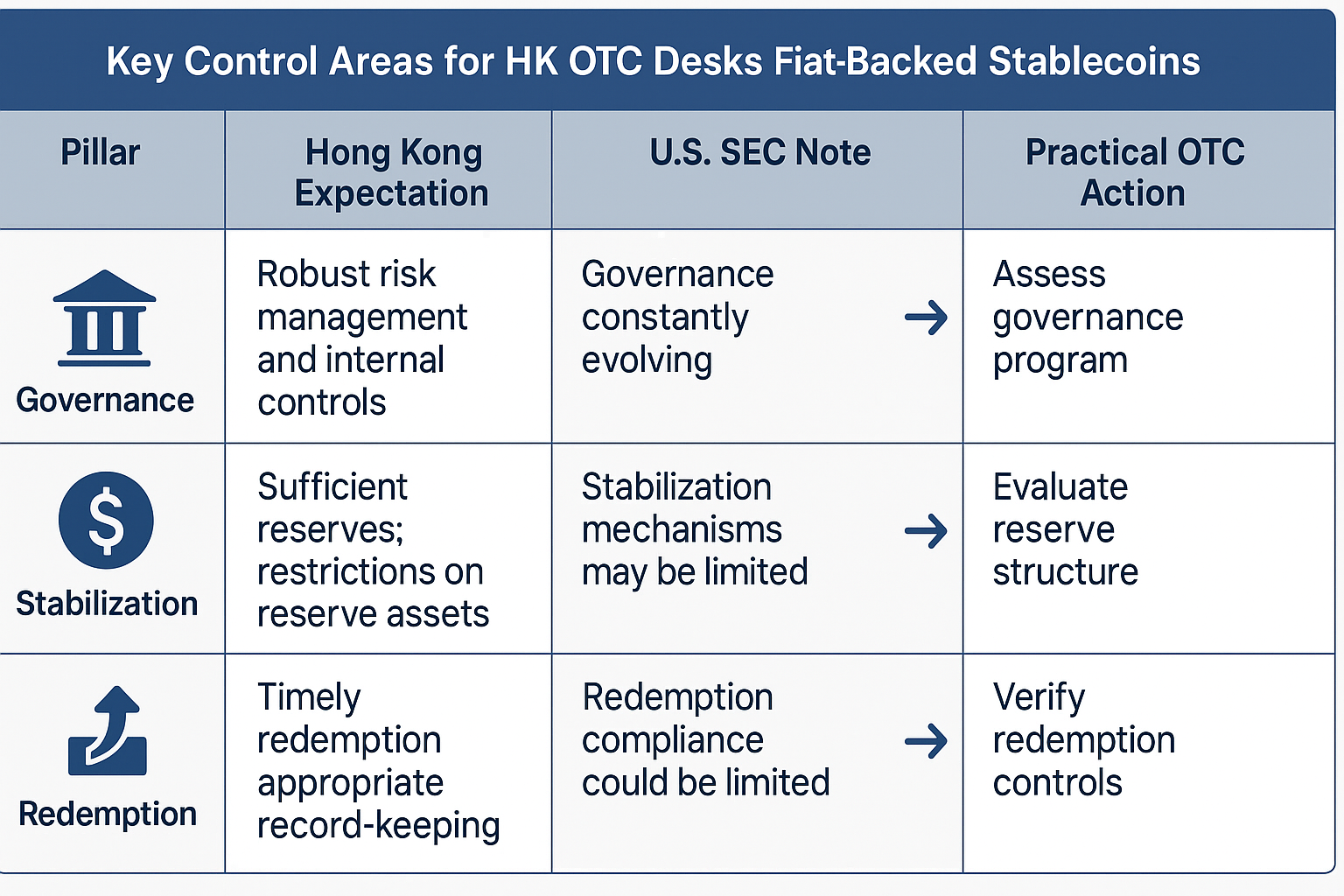
| Pillar | Hong Kong expectation | U.S. SEC note | Practical OTC action |
|---|---|---|---|
| Custodial wallets | Treated like FI/VASP activity; full AML/CFT obligations | N/A | If you custody client stablecoins, implement segregation, daily reconciliations, incident playbooks, and audited controls. |
| Unhosted wallets | “Additional controls” required | N/A | Collect counterparty wallet attestations, perform blockchain analytics, risk-rate wallets, and set higher EDD thresholds. |
| KYC scope | Broad—expect ID&V even for smaller tickets in early phase | N/A | Consider universal KYC on both sides for all OTC stablecoin trades to align with conservative expectations. |
| Instrument selection | Prefer “licensed/covered” fiat-backed with clear redemption | Cash-equivalent possible if guaranteed redemption | Maintain an approved list and concentration limits (e.g., max 30% exposure per issuer—illustrative). |
| Accounting | N/A (local GAAP/IFRS apply) | Cash-equivalent classification contingent on mechanics | Prepare an accounting memo with auditors covering redemption terms, T+ settlement, reserve audits, and de-peg response. |
A simple operating model that works
- Onboarding: Universal KYC/KYB. For unhosted wallets, capture ownership attestations, screen addresses, and require proof-of-control (e.g., signed message) for higher-risk cases.
- Trading: Only quote “covered” USD stablecoins with disclosed reserves and same-day redemption channels. Set issuer-limits and live de-peg alerts (e.g., 0.98–1.02 price bands trigger review).
- Settlement: For custodial flows, segregate client assets and reconcile at least daily; for non-custodial flows, require on-chain confirmations before fiat leg release.
- Recordkeeping: Store tx hashes, wallet risk scores, and counterparties’ attestations with immutable timestamps. Retain 7 years in HK.
- Treasury/accounting: Seek cash-equivalent classification only where redemption is contractually guaranteed and historically observed. Document at least 3–6 months of redemption tests (illustrative) and issuer attestations.
What to do in the next 90 days
- Define your perimeter: Will you hold client stablecoins (custodial) or only arrange settlement (non-custodial)? The answer drives licensing and controls in Hong Kong.
- Approve instruments: Whitelist 2–3 fiat-backed stablecoins with daily reserve disclosures and guaranteed redemption; set exposure caps and stress-test de-peg scenarios.
- Upgrade unhosted wallet controls: Add ownership attestations, analytics screening, and tiered EDD for large tickets (e.g., > USD 50,000—illustrative).
- Align finance: Draft an accounting position paper on cash-equivalent treatment with your auditor, referencing redemption SLAs and reserve quality.
- Pilot compliantly: Explore participation in Hong Kong licensed stablecoin pilots to build a regulatory track record while testing real payment use cases.
One last point.
Regulators are giving you green lights with guardrails. Use both.
References and further reading
- SEC staff guidance coverage on stablecoin accounting and classification (Bloomberg via The Block): https://www.theblock.co/
- Hong Kong Policy Statement 2.0 on Digital Assets: https://www.info.gov.hk/
- Hong Kong AML/CFT consultation conclusions on stablecoins (custodial/unhosted wallet controls): https://www.hkma.gov.hk/
Need a quick perimeter assessment or control design for your OTC desk? StanCompliance advises Hong Kong OTCs, VASPs, and payment firms on stablecoin selection, unhosted wallet controls, and cash-equivalent accounting memos.