
StanCOMP: KYT for DeFi and Stablecoins in Hong Kong

StanCOMP: KYT for DeFi and Stablecoins in Hong Kong
If you touch stablecoins or DeFi in Hong Kong, your primary AML/CTF exposure is no longer KYC. It’s Know Your Transaction.
Why this matters now
- Hong Kong is moving to implement a dedicated stablecoin regime, with consultation conclusions highlighting that institutions involved in a stablecoin transfer should exchange essential information for monitoring, sanctions screening, and risk mitigation. This aligns with FATF Recommendation 16 (the Travel Rule) for virtual assets and the SFC’s AML/CTF expectations for VASPs.
- Global bodies are on the same page. The Bank for International Settlements has flagged stablecoins’ vulnerabilities for ML/TF and sanctions evasion, while the FATF has documented heightened risks from unhosted (self-custodial) wallets due to anonymity and mobility.
- Several FATF members have started conservatively, even requiring identification and verification of any stablecoin holder at rollout. Hong Kong’s direction is clear: stronger due diligence on custodial wallet providers and additional controls for unhosted wallets.
DeFi + stablecoins: what “good KYT” looks like KYT is the operational spine that connects your KYC files to on-chain behavior. For Hong Kong FIs and VASPs, a robust KYT stack should cover:
- Sanctions and high-risk exposure
- Screen all addresses in the path: customer wallet, DeFi contracts (DEX, lending pools, routers), bridges, and counterparties.
- Check UN sanctions (Cap. 537) and, as a business decision, major overseas lists (e.g., OFAC) to reduce downstream de-risking.
- Watch issuer-level blocks and freezes on stablecoins (e.g., blacklisting mechanics).
- Smart contract and protocol controls
- Maintain an allowlist of approved DeFi protocols by chain. Block interaction with mixers, sanctioned protocols, and materially hacked contracts.
- Apply contract-level risk scoring and rate-limit first-time exposures.
- Travel Rule across VASP touchpoints
- For VASP-to-VASP legs, exchange originator/beneficiary information at or above the applicable threshold under Hong Kong law, using an interoperable standard such as IVMS101. Validate the counterparty VASP’s license status and Travel Rule readiness.
- If the other side is an FI or stablecoin issuer engaged in redemption, perform due diligence on the custodial wallet provider, as contemplated in the consultation conclusions.
- Unhosted wallet risk mitigation
- Collect ownership proofs (message signing, micro-transaction verification) and source-of-funds/source-of-stablecoin evidence.
- Apply behavioral analytics: peel chains, cluster analysis, cross-chain hops, and recent proximity to illicit tags.
- Escalate controls for first-time or high-risk jurisdictions. Some flows should require pre-funding review before execution.
- Cross-chain and redemption visibility
- Tag bridges and track chain-of-custody across hops. Stablecoin “face value” does not equal clean provenance.
- For redemption/mint events, tie the transaction to a verified custodial wallet provider and refresh due diligence at defined volumes or frequency.
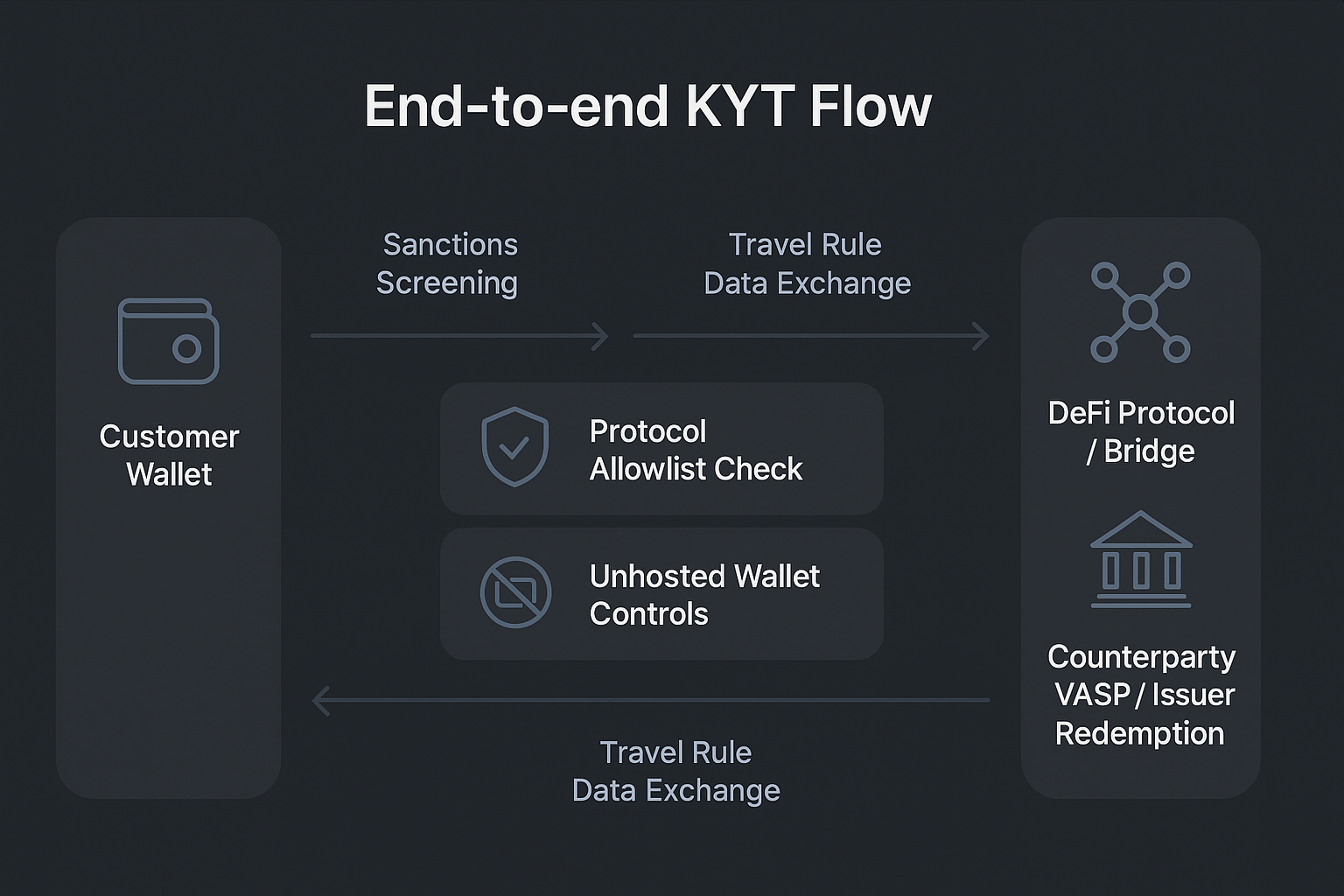
A practical control map
| Scenario | Key risks | Required controls (illustrative) |
|---|---|---|
| Customer swaps USDT→USDC via DEX from self-custody | Unhosted wallet; protocol risk | Address proof, SOF/SOW attestations, protocol allowlist, sanctions/path screening |
| Cross-chain bridge into Ethereum | Mixer adjacency; bridge exploits | Bridge allowlist, hop analysis, time-based cooling-off, enhanced review if illicit proximity |
| Incoming from high-risk protocol to custodial wallet | Sanctions evasion | Auto-quarantine, analyst review, potential return-of-funds or SAR filing |
| Redemption to fiat via issuer or FI | Counterparty FI/VASP risk | Due diligence on custodial wallet provider; Travel Rule data where applicable; name-screening alignment |
Implementation in 60–90 days
- Weeks 1–2: Define risk appetite; approve chain/protocol allowlist; adopt IVMS101 for Travel Rule; document unhosted wallet playbook.
- Weeks 3–6: Integrate a KYT vendor for real-time screening; build sanctions and path-risk rules; enable message-signing ownership checks.
- Weeks 7–10: Pilot on two chains and two stablecoins; tune thresholds; run adversarial tests on bridges/mixers; train analysts on escalation.
- Weeks 11–12: Roll out to production; add monitoring KPIs: alert rate, false positives, time-to-clear, and % flows with complete Travel Rule data.
Governance and audit
- Keep immutable evidence: screening snapshots, Travel Rule payloads, ownership proofs, and decision logs. This is what examiners ask for.
- Review effectiveness quarterly. If more than 10–15% of DeFi alerts are false positives (illustrative), refine the allowlist and heuristics.
What this means KYT is how you make stablecoin and DeFi flows bankable in Hong Kong—without overblocking legitimate activity. Start with sanctions, protocol allowlists, Travel Rule interoperability, and unhosted wallet controls. Expand from there, measure everything, and keep the paper trail.
Helpful references:
- Hong Kong AML/CTF for VASPs: SFC AML/CTF resources (https://www.sfc.hk/en/Rules-and-standards/Anti-money-laundering)
- FATF on VA/VASP and Travel Rule: https://www.fatf-gafi.org/en/publications/Virtual-assets.html
- IVMS101 data standard: https://intervasp.org/ivms101/
- BIS on stablecoin vulnerabilities: https://www.bis.org/
If you want a second set of eyes on your KYT rules before the next regulator visit, StanCOMP can help you benchmark, tune, and document them in under two weeks.


