
StanCOMP: HK VASP Onboarding Risk Matrix & Registration

Hong Kong VASP onboarding doesn’t fail on day one. It fails months earlier when risk isn’t quantified clearly. Here’s how we’re advising clients in 2025 to structure an onboarding risk matrix that aligns with the AMLO, the SFC’s VATP expectations, and the Government’s consultation proposals for VA custodians and VA OTCs.
Why this matters now
- VA custodians: The Government proposes licensing/registration with AML/CFT obligations under Schedule 2 to the AMLO, explicit record‑keeping, cybersecurity commensurate with business scale/complexity, and ongoing information/notification duties (including wallet address inventories used in business). See FSTB’s virtual assets policy page.
- VA OTC services: The proposed regime borrows from VATP and MSO rules, including the appointment of a competent Compliance Officer and full AML/CTF obligations. Consultation materials emphasise controls for systems failures and security breaches.
- Stablecoins: Consultation conclusions highlight alignment with international standards on transparency and traceability.
If you onboard without a defensible risk matrix, you’ll struggle to justify risk decisions, prove proportional controls, or meet future notification asks.
The onboarding risk matrix (StanCOMP “Standard Compliance” baseline) Use this as a defensible, regulator‑facing scoring tool. Scores are illustrative.
| Risk Factor | Low (1) | Medium (3) | High (5) | Required Controls (examples) |
|---|---|---|---|---|
| Customer type | Retail with simple use-case | SME/proprietary trader | VA intermediary, OTC broker, or custodian | Enhanced CDD, source of wealth, senior sign-off |
| Geography | HK/low-risk FATF members | Mixed exposure | Sanctions/high-risk or uncooperative jurisdictions | Sanctions screening hit resolution, onboarding committee |
| Source of funds/wealth | Verifiable salary/business income | Mixed crypto/fiat | Heavily VA‑derived with obfuscation tools | On‑chain tracing, proof sets, adverse media deep dive |
| Product/service | Simple spot trading | OTC spot, limited custody | Omnibus custody, lending, or complex flows | Segregated wallets, daily reconciliations, exit triggers |
| Delivery channel | Face‑to‑face/verified digital KYC | Introduced business | Non‑face‑to‑face, third‑country KYC | Video KYC + liveness, independent QA |
| Wallet risk | Known self‑custody wallet | New wallet with limited history | Mixers, bridges, DEFI protocols exposure | Travel Rule, screening thresholds, hold periods |
| Transaction pattern | Small/consistent | Variable | Large, rapid in/out, structuring | Tiered limits, manual review, SAR triggers |
| PEP/sanctions | None | Domestic PEP | Foreign PEP/sanctions proximity | Senior approval, periodic refresh ≤ 12 months |
Scoring and actions (illustrative):
- Total score ≤ 14: Standard onboarding. Annual refresh, 5‑year record retention under AMLO Schedule 2.
- 15–24: Enhanced due diligence. Senior CO sign-off, refresh every 6–12 months.
- ≥ 25: Decline or onboard only with specific mitigants and onboarding committee approval.
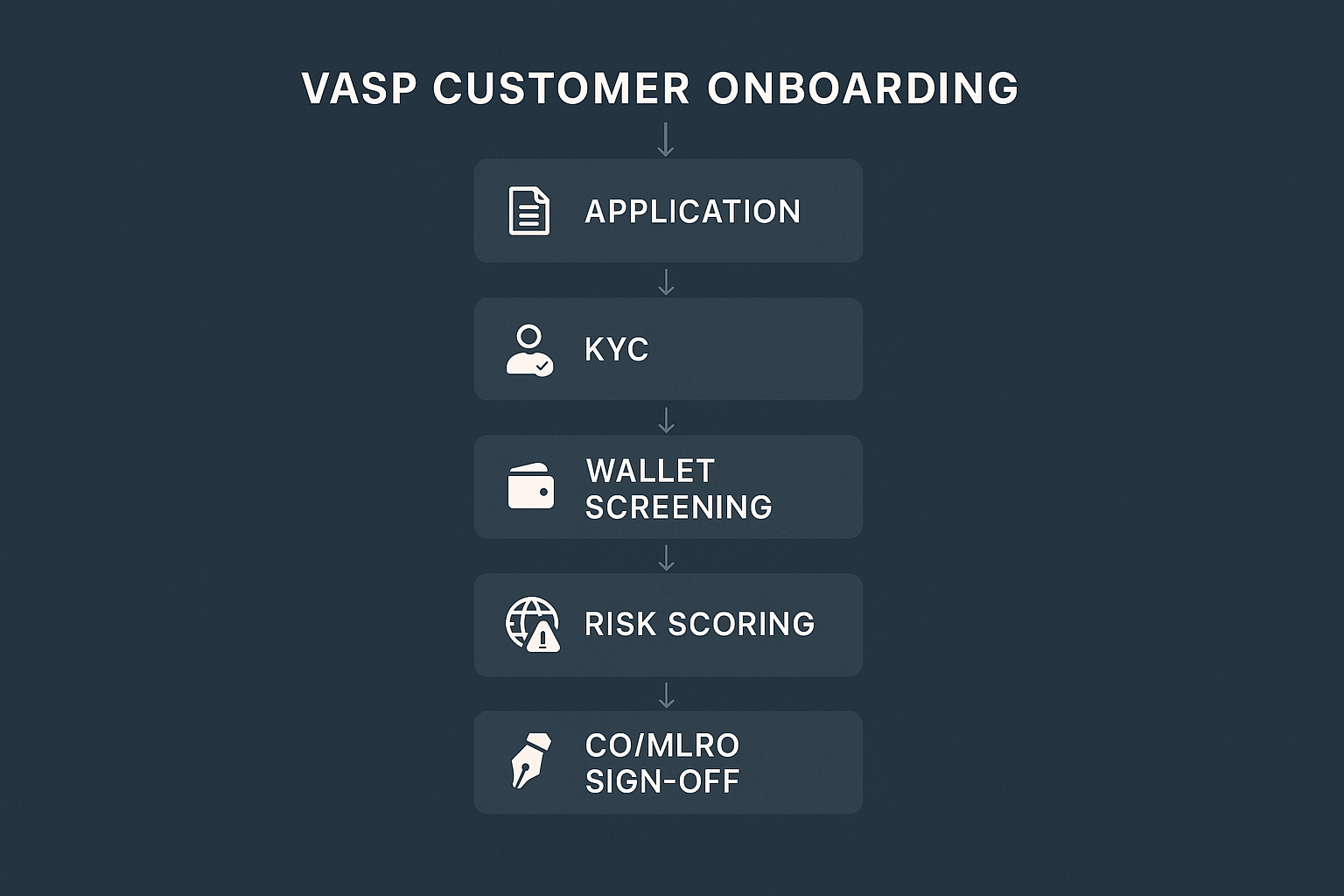
What regulators expect operationally
- AML/CFT and record‑keeping: Apply Schedule 2 to AMLO; retain CDD and transaction records for at least 5 years. Keep auditable inventories of wallet addresses used in business, consistent with the custodian proposal. Link: AMLO (Cap. 615).
- Cybersecurity proportionality: Controls must match business scale/complexity. At minimum for VA custodians/OTCs: HSM-backed key management, multi‑sig, hot/cold segregation, four‑eyes key ceremonies, privileged access monitoring, incident/BCP testing, and documented RTO/RPO. Evidence matters.
- Information and notifications: Be ready to submit scope-of-business, wallet address details, and notify material incidents (system failures, security breaches) promptly as proposed in consultations.
- Compliance Officer requirements: Appoint a competent CO (and MLRO) with clear independence, direct Board access, and documented KPIs. The VA OTC proposal mirrors VATP/MSO expectations.
Registration playbook (VASP, custodian, OTC)
- VATP licence (SFC): Expect rigorous fitness & properness, custody architecture reviews, market integrity controls, and financial resources. Plan for a multi‑month process; pre‑filing meetings help. Link: SFC VATP Licensing.
- VA custodian (proposed): Start readiness now—segregation of client assets, independent reconciliations, incident reporting runbooks, and wallet address governance to match the consultation proposals.
- VA OTC (proposed): Build MSO‑grade AML now—CO/MLRO appointments, Travel Rule capability, transaction monitoring with on‑chain analytics, and a policy to halt mixers/obfuscation flows.
Quick wins this quarter
- Adopt the risk matrix above and embed it in your onboarding system.
- Create a wallet address register with ownership attestation and screening results.
- Run a 2‑hour incident notification drill that traces data from detection to regulator report.
- Document your CO authority and escalation pathway.
It’s not box‑ticking. Done well, the matrix becomes your shield when an incident hits.
References and resources
- FSTB Virtual Assets policy page: https://www.fstb.gov.hk/en/financial-services/policy-virtual-assets.html
- SFC VATP Licensing: https://www.sfc.hk/en/Regulatory-functions/Intermediaries/Licensing/Virtual-asset-trading-platforms
- AMLO (Cap. 615): https://www.elegislation.gov.hk/hk/cap615
- HKMA on virtual assets and stablecoins: https://www.hkma.gov.hk/eng/key-functions/international-financial-centre/virtual-assets-and-stablecoins/


