
StanCOMP HK: VA Custody Licence, CBDC & Asset-Backed Tokens

Hong Kong’s next VA chapter: custody, CBDC and asset-backed tokens are converging. If you touch private keys, stablecoins or tokenized real-world assets (RWA), the bar is rising — fast.
Why this matters now Hong Kong’s policy stance has shifted from exchange-only oversight to a full-stack regime: VA dealing, VA custody, stablecoin issuance, wallet control, OTC flows and VA-linked financial services are all coming under a unified compliance lens. The Government’s consultation on a VA custodian regime focuses squarely on safeguarding private keys and client asset security, while requiring custodians to meet AML/CFT standards under Schedule 2 to the AMLO. The stablecoin AML consultation conclusions also flagged obligations for FIs/VASPs operating custodial wallets for stablecoin holders and the need for additional controls around unhosted wallets. In parallel, the HKMA is progressing the e‑HKD pilot and wholesale CBDC (Project mBridge), pushing custody and payments infrastructure closer together.
What a Hong Kong VA custody licence will demand Expect the future licence to look and feel like a prudentially aware, controls-heavy permission. The direction is clear in the consultation materials and official remarks:
- Key safekeeping as a first principle: Governance, dual/multi‑sig, HSMs, attack surface minimization, and incident playbooks oriented to key compromise.
- AML/CFT under AMLO Schedule 2: CDD, ongoing monitoring, record‑keeping, and suspicious transaction reporting as for other financial institutions.
- Forensics-by-default: Adoption of blockchain analytics to track assets/wallets and flag potentially suspicious flows.
- Unhosted wallet risk controls: Additional screening and risk‑based frictions when transacting with self‑custody addresses.
- Transitional pathway: A defined period to come into the net once legislation commences, but not a grace to operate weak controls.
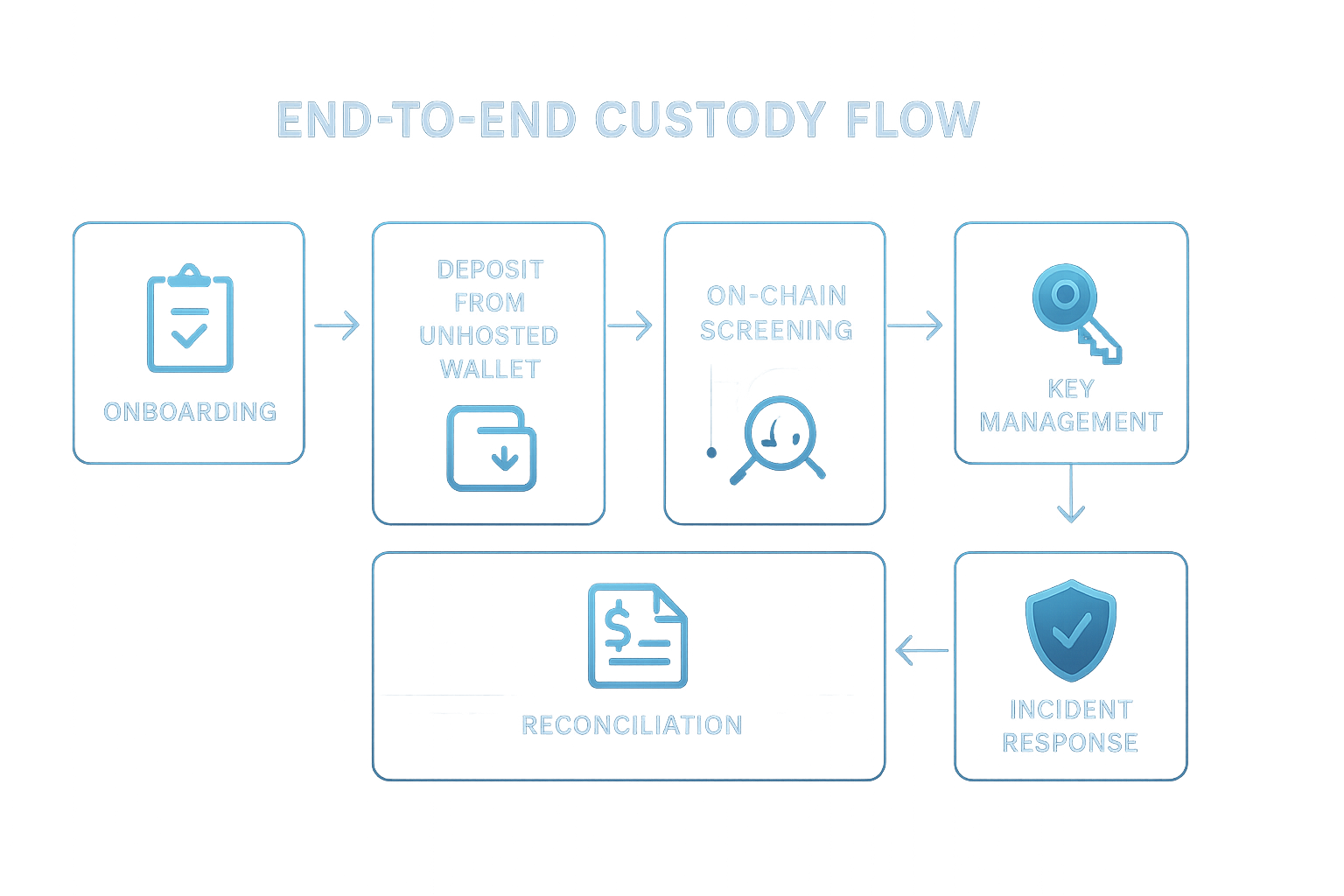
Quick reference: core expectations for custodians
| Area | What regulators have signalled |
|---|---|
| Client asset safety | Focus on private key safekeeping and segregation of client assets |
| AML/CFT | Full Schedule 2 AMLO compliance (CDD, monitoring, record‑keeping) |
| Analytics | Use blockchain tools to track VAs, addresses, and suspicious activity |
| Stablecoin custody | FI/VASP duties apply where you provide custodial wallets for stablecoin holders |
| Unhosted wallets | Extra controls to mitigate risks on deposits/withdrawals from self‑custody |
| Transition | Licensing process with a transitional period once the regime starts |
CBDC: custody meets payments
- e‑HKD pilots: The HKMA’s programme explores programmability, escrow and tokenized settlement. Custodians should plan for e‑HKD wallet connectivity, API‑driven controls, and policy‑enforced transfers (e.g., whitelists/limits). See HKMA’s e‑HKD updates and pilot details: https://www.hkma.gov.hk/eng/key-functions/digital-currency/e-hkd/
- Wholesale CBDC (mBridge): Cross‑border settlement rails will expect high‑assurance wallet controls and travel‑rule‑compatible data flows. Custodians serving institutional clients should design for CBDC/RWA atomic delivery‑versus‑payment.
Asset‑backed tokens and stablecoin custody Tokenized gold, funds and receivables are moving from proofs‑of‑concept to limited production. If you custody them, your risk is not “just holding coins.” It spans issuer quality, oracle dependencies, redemption mechanics and legal title. On the stablecoin side, where you run custodial wallets for customers, you are in scope for AML/CFT controls — and must apply additional measures for unhosted wallet interactions. Tie this back to formal obligations under the AMLO and keep an eye on stablecoin legislation progress. Relevant official materials:
- AMLO (Cap. 615) and Schedule 2: https://www.elegislation.gov.hk/hk/cap615
- HKMA CBDC resources: https://www.hkma.gov.hk/eng/key-functions/digital-currency/
- Government consultation on VA custodians (FSTB): https://www.fstb.gov.hk/en/financial-sector/index.html
What to do in the next 90 days
- Map custody flows: Hot/warm/cold, MPC/HSM boundaries, key ceremonies, access reviews, and disaster recovery.
- Implement analytics: Screen source/destination addresses, set risk scores, and tune rules for unhosted wallets; evidence disposition decisions.
- Tighten stablecoin controls: Define issuer lists, reserve disclosures you accept, and stress exit/redemption scenarios.
- Upgrade AML under Schedule 2: Refresh KYC/KYB for VA clients, add on‑chain risk indicators to ongoing monitoring, and harden record‑keeping.
- Prepare for licence filing: Draft custody policies, incident/compensation arrangements, and board‑level risk oversight. Validate with independent testing.
The takeaway Hong Kong’s custody licence, CBDC pilots and asset‑backed tokenisation aren’t separate stories. They’re the same story: trusted digital finance. Build for that standard now — or retrofit at higher cost later. If you want a readiness review or a mock supervisory walkthrough, StanCOMP can help you benchmark and close the gaps before the regime lands.


