
StanCOMP: HK Tokenised Funds Compliance & OECD CARF

StanCOMP: HK Tokenised Funds Compliance & OECD CARF
Hong Kong just made its intentions clear: tokenisation isn’t a pilot anymore; it’s moving into regular market practice. Policy Statement 2.0 flags a legal and regulatory review on tokenisation, regularised issuance of tokenised government bonds, and alignment with the OECD’s Crypto-Asset Reporting Framework (CARF) for tax transparency. If you’re structuring a tokenised fund or distributing tokenised units in Hong Kong, your compliance stack now spans SFC fund rules, AML/CTF expectations, and cross‑border tax reporting readiness.
Why this matters now
- Policy direction is explicit. Government will “regularise the issuance of tokenised Government bonds” and is conducting a “framework review” starting with bonds to “shed light on tokenisation of other RWAs and financial instruments.” That includes funds.
- CARF is coming. Hong Kong has signalled adoption for tax transparency. Expect convergence with updated CRS to avoid gaps between traditional and tokenised holdings.
- SFC is open but demanding. Tokenised products are allowed on a case‑by‑case basis with “same activity, same risk, same rules.” See the SFC’s Circular on tokenised securities–related activities and Circular to intermediaries on tokenised investment products.
CARF basics for tokenised funds in HK CARF requires reporting by “Reporting Crypto‑Asset Service Providers” (RCASPs) that effect exchanges or transfers of in‑scope crypto‑assets. Whether a tokenised fund unit is reported under CARF or CRS depends on structure and who holds custody.
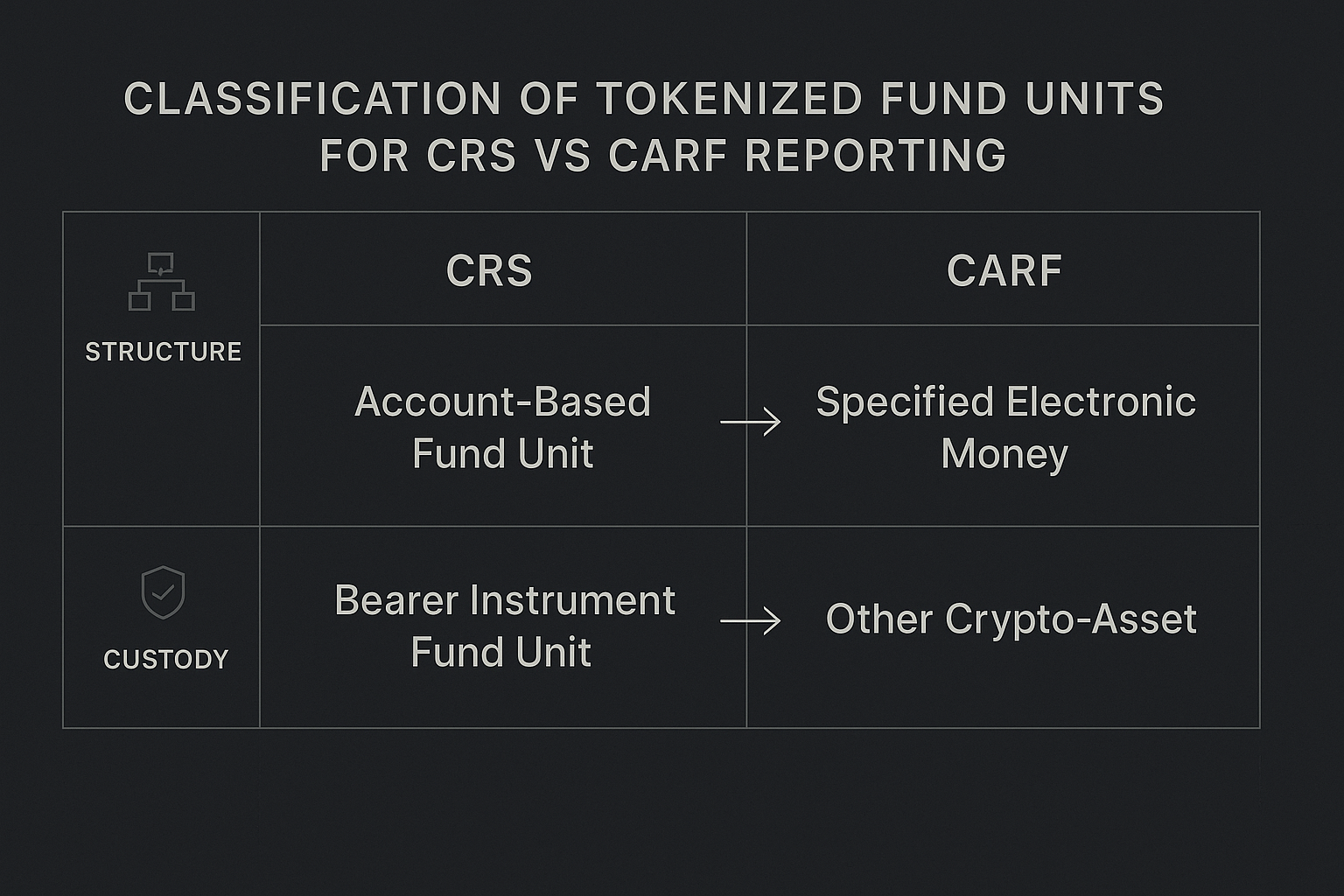
- Structure: Token represents units/shares of an SFC‑authorised (or Type 9‑managed) fund
- Held via a licensed custodian/registrar with on‑book records → Typically CRS (traditional FI reporting)
- Held/traded via a VA exchange or wallet provider executing transfers on‑chain → CARF may apply to the RCASP
- Structure: Purely on‑chain units with whitelisted wallets and no FI custody
- Transfers mediated by a provider → CARF likely in scope for that provider
- Self‑hosted wallet to self‑hosted wallet → No RCASP reporting, but FI touchpoints (fiat on/off‑ramp, custodial bridges) may still trigger CARF
Two practical takeaways:
- If you keep the registrar and NAV books in the fund/administrator’s system and treat the token as a digital wrapper, you often stay in CRS.
- If you let VA platforms handle token issuance, transfer, or secondary trading, map CARF obligations early.
The tokenised fund compliance stack (HK)
- Licensing and product
- Manager: Type 9 (asset management); distributors: Type 1; advisors: Type 4.
- For SFC‑authorised public funds, tokenisation does not relax product codes. Same disclosure, valuation, liquidity, and custody outcomes.
- Technology and controls
- Smart contracts: audit, upgradability governance, emergency pause, and clear admin key policies.
- Transfer controls: whitelist/blacklist mechanics to enforce eligible investor and sanctions rules.
- Chain choice: document rationale (finality, MEV risk, uptime, custody tooling).
- Oracle and NAV: no circular dependencies; administrator remains system of record with reconciliation to chain events.
- Custody: segregation at address level, key management (HSM/MPC), SOC2/ISO control coverage, and tested disaster recovery.
- Record‑keeping
- On‑chain ≠ books and records. Keep golden source registers, time‑stamped reconciliations, and immutable logs of corporate actions.
- Disclosures
- New tech risks, cyber, forks, airdrops, gas fee handling, and settlement finality. Plain English.
AML/CTF and CRA (Customer Risk Assessment)
- Expand your CRA to token‑specific factors: wallet provenance (chain analytics), cross‑chain bridges used, source of VA funds, and jurisdiction risk of counterparties.
- Ongoing monitoring: set transaction‑level alerts for unusual token movements relative to investor profile (e.g., rapid subscribe‑redeem patterns on‑chain).
- Sanctions and travel rule: if transfers touch VA intermediaries, ensure Travel Rule compliance and screened wallet addresses.
CARF/CRS data readiness
- Collect at onboarding: tax residence, TIN, date of birth, controlling persons (for entities), plus wallet identifiers linked to the investor.
- Reporting fields (illustrative): aggregate proceeds from redemptions/exchanges, fair market value at period end, and gross transfers mediated by the provider.
- Governance: assign a CARF/CRS reporting owner, maintain classification memos, and test data extraction with your admin and any VA platform.
What to do this quarter
- Map the flow: who issues, who holds keys, who effects transfers, who keeps the register. Then decide CRS vs CARF per flow.
- Run a “token risk addendum” to your Type 9 compliance manual covering tech audits, forks, incident response, and disclosure triggers.
- Pre‑clear service providers: VA platforms, custodians, and chain analytics vendors. Paper the SLAs and right‑to‑audit.
- Engage the SFC early for authorised funds. Bring your token mechanics, custody model, audits, and investor communications.
This isn’t about chasing hype. It’s about building a tokenised fund that can pass an SFC file review and survive a tax audit.
References
- Policy Statement 2.0 on the Development of Digital Assets in Hong Kong (legal/regulatory streamlining; bond market focus; RWA tokenisation; CARF for tax transparency)
- OECD: Crypto‑Asset Reporting Framework and amendments to CRS
- SFC: Circular on tokenised securities‑related activities and Circular to intermediaries on tokenised investment products


