
StanCOMP: ESG Tokens, KYT & HKMA Stablecoin Regime

Across 2025, Hong Kong’s policy stance on digital assets has shifted from “experimentation” to “execution.” With the HKMA’s stablecoin regime going live on 1 August 2025 and Policy Statement 2.0 calling for unified regulation, tokenised government bonds, and payments use cases, founders now have a clearer path to ship ESG-aligned tokens and payment-grade stablecoins—without tripping AML/CFT wires.
What follows is the practical playbook we’re deploying with clients at StanCOMP.
HKMA stablecoin regime: what matters on day one Policy Statement 2.0 frames a licensing regime for stablecoin issuers built on reserve asset management, stabilisation mechanisms, redemption processes, and prudential risk management, commencing 1 August 2025. The HKMA’s 26 May 2025 consultation sets out AML/CFT expectations for licensees (customer due diligence, sanctions screening, travel rule, ongoing monitoring). One nuance many miss: under the Government’s custodian proposal, an HKMA‑licensed issuer that only custodies its own stablecoins for its clients is exempt from separate virtual asset custodian licensing—because the HKMA already supervises that activity.
Links for context:
- Hong Kong Monetary Authority (HKMA) – stablecoin regime and consultations: https://www.hkma.gov.hk/
- FSTB Policy Statement 2.0 highlights on tokenisation and unified regulation: https://www.fstb.gov.hk/
- Public consultation on virtual asset custodian services (exemption note for HKMA‑licensed issuers): https://www.fstb.gov.hk/
Designing ESG‑compliant token structures that actually hold up ESG tokens only work if impact data is verifiable and governance is enforceable. In practice:
-
Instrument choice
- Use sustainability‑linked notes or revenue‑share tokens with on‑chain KPIs; avoid vague “impact credits” without measurement standards.
- Tie KPIs to recognised frameworks (e.g., ISO 14064 for emissions quantification; GRI/IFRS‑S2 for disclosure alignment).
-
Data and attestation
- Anchor MRV (measurement, reporting, verification) proofs on‑chain: signed auditor attestations, IoT or utility data oracles, GPS/remote sensing for nature assets.
- Store raw evidence off‑chain (e.g., IPFS/S3) and hash to the token contract. Rotate verifiers annually.
-
Governance and safeguards
- Hard‑code step‑up coupons or mint/burn gates that trigger if KPIs fail (not just “best efforts” clauses).
- Prevent double counting: enforce unique project IDs, registry queries, and burn-on-retirement logic for carbon‑like assets.
KYT is your control layer—treat it like a business requirement Know‑Your‑Transaction (KYT) is no longer “nice to have” in Hong Kong. With the AML/CFT framework for stablecoin licensees, you’ll need real‑time monitoring, sanctions/PEP checks, counterpart risk scoring, and travel rule compliance for value transfers.
Here’s the minimal viable control stack we recommend:
- Pre‑trade: address screening and wallet risk tiering (e.g., low/medium/high) with clear thresholds for manual review.
- In‑flight: transaction scoring using typologies relevant to APAC (e.g., Telegram OTC brokers; cross‑exchange peeling; merchant washbacks).
- Post‑trade: periodic refresh, anomaly detection on velocity/size, and case management with audit trails. Target <2% false positives after 90 days (illustrative).
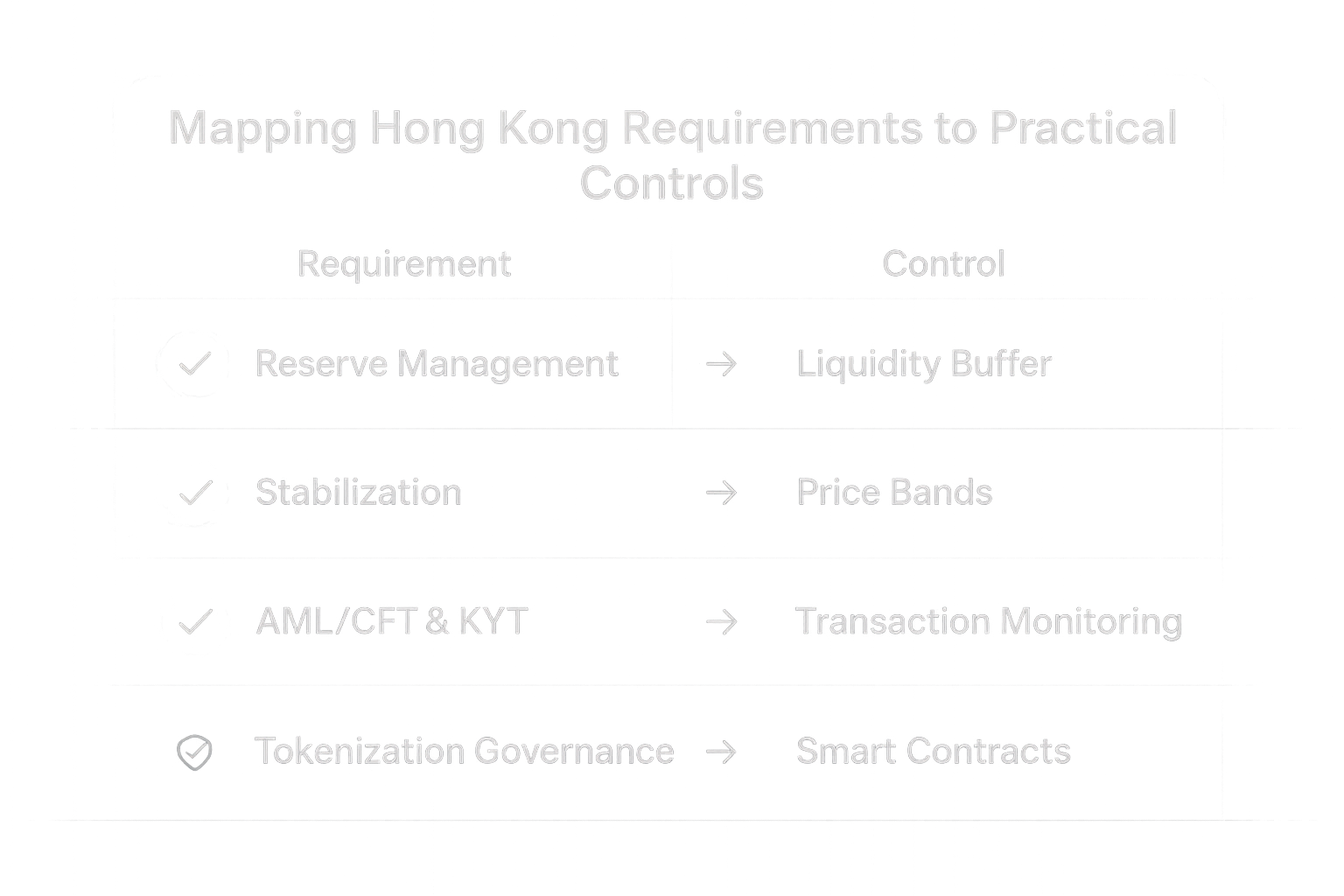
- Reserve management (HKMA): Segregated fiat/safe assets; daily reconciliation; monthly attestations from a recognised audit firm.
- Stabilisation and redemption: T+0–T+1 redemption windows; disclosed fees; stress-tested liquidity waterfalls.
- AML/CFT and KYT: Sanctions/PEP screens, travel rule integration, typology libraries tuned for HK corridors (HK–SG, CN–HK).
- Tokenisation governance (Policy 2.0): On‑chain disclosures; oracle whitelisting; versioned legal terms hashed to contract.
- Custody (exemption note): If only custoding your own stablecoins as HKMA licensee, document the exemption rationale and operational controls; otherwise, pursue VA custodian licensing.
What to do now (90‑day plan)
- Gap assess against HKMA’s reserve, redemption, and AML/CFT expectations; write a 12–15 page internal policy pack.
- Choose a KYT vendor with strong APAC coverage and travel rule connectivity; run a 30‑day sandbox to baseline false positives.
- Finalise token legal terms and disclosures aligned to Policy 2.0; hash signed PDFs into the contract.
- Decide custody path: leverage the HKMA issuer exemption (if eligible) or engage a licensed VA custodian; document key management, MPC, and incident response.
- Prepare your supervisory engagement memo: product, controls, wind‑down plan, and board oversight.
One last point.
In Hong Kong, “compliant by design” isn’t a slogan—it’s your route to speed. If you need help stitching ESG token mechanics, KYT, and the HKMA’s stablecoin regime into one deployable stack, StanCOMP is already doing this in production. Let’s make your launch date stick.


