
StanCOMP Compliance: Hot Wallet EDD & Risk-Based Controls

StanCOMP Compliance: Hot Wallet EDD & Risk-Based Controls
Why this matters now If you run a VASP or FI in Hong Kong and you touch stablecoins, your hot wallet controls are now squarely in scope. The HKMA’s consultation conclusions on the stablecoin regime make two points crystal clear: conduct due diligence on any institution providing a customer’s custodial wallet, and apply additional controls where unhosted wallets are involved. When you can’t complete wallet due diligence to a satisfactory level, you must screen wallet addresses using appropriate technology and mitigate higher ML/TF risk. That’s the bar.
See HKMA’s AML/CFT resources and relevant guidance: https://www.hkma.gov.hk/eng/key-functions/banking-stability/anti-money-laundering-and-counter-terrorist-financing/
The practical challenge Classifying wallets isn’t straightforward. Several respondents told the HKMA that reliably distinguishing unhosted vs custodial wallets on-chain is hard with current analytics. The HKMA acknowledged this. Which means you need a risk-based playbook that works under uncertainty, not a binary switch.
What good looks like: Hot wallet EDD, grounded in HKMA expectations
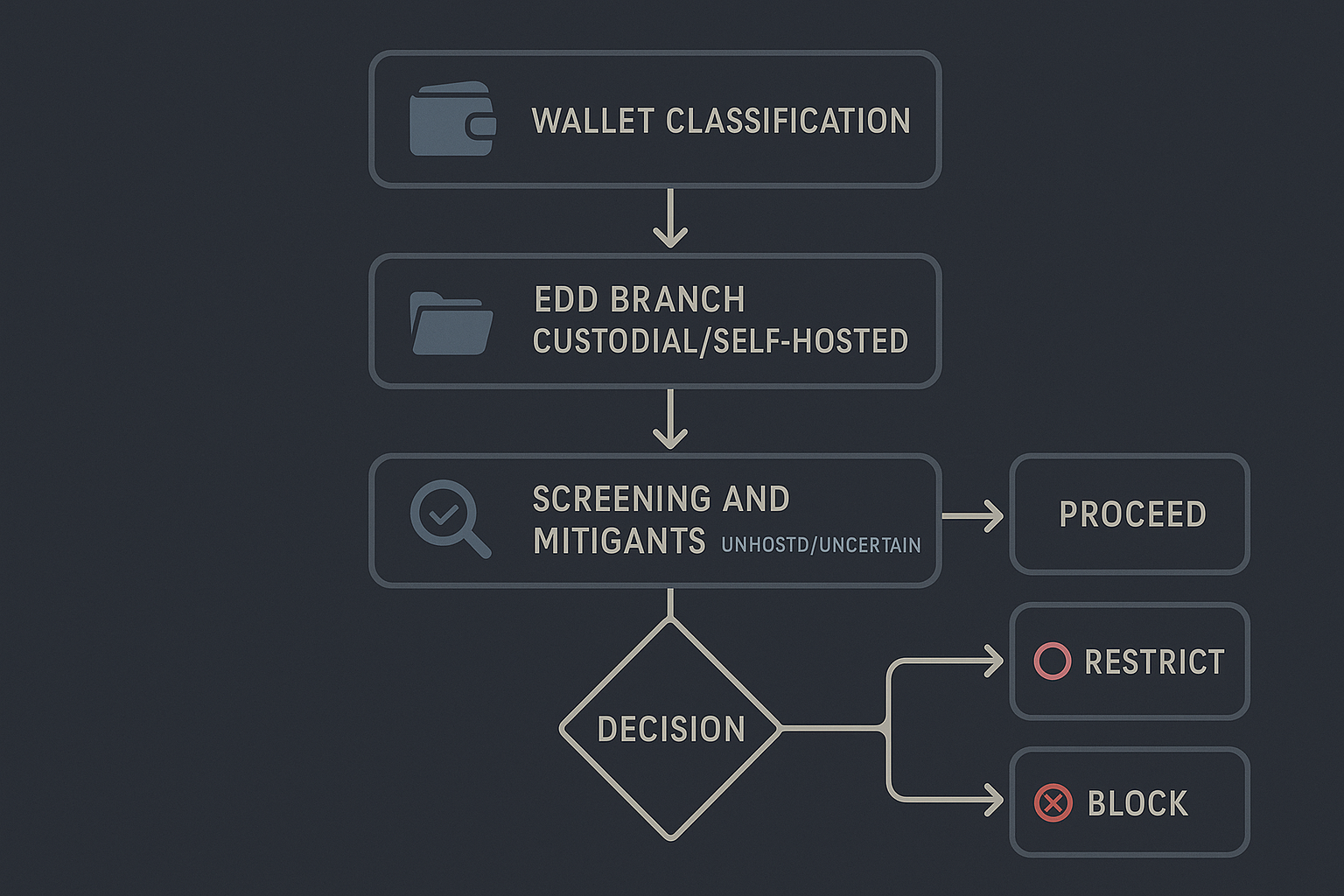
- Classify the counterparty wallet, then set the control path
- Custodial wallet provided by a regulated FI/VASP: Perform EDD on the institution. Validate license status, AML/CFT supervision, and controls. If satisfactory, allow activity with standard monitoring.
- Self-hosted wallet used by an FI/VASP: Obtain evidence of control (signed message or micro-tx loopback). Confirm the entity’s regulatory status and sanction exposure.
- Other/unhosted/uncertain wallets: Treat as higher risk. Screen with reputable blockchain analytics, assess sanctions/mixer exposure, and tighten limits.
- Institution-level EDD for custodial wallet providers
- Governance and supervision: Licensing/registration, regulator, scope of AML/CFT oversight, last inspection date (where available).
- Controls: KYC standards, sanctions screening stack, Travel Rule capability, hot–cold segregation, incident history (breaches, hacks).
- Operations: Jurisdiction(s), omnibus vs segregated accounts, redemption practices for stablecoins, freeze/recall capabilities.
- Evidence to collect: Copies of licenses, AML policy excerpts, SOC2/ISO attestations (if any), attestations on source-of-funds checks.
- Screening and mitigants for unhosted or unverified wallets
- Pre-transaction screening: Sanctions hits, exposure to mixers, darknet markets, scam clusters, and high-risk services. Push alerts into case management.
- Proof-of-control options: Signed message, small loopback transaction, or exchange deposit tag verification. If not feasible, escalate risk tier.
- Transaction mitigants: Lower per-tx limits (e.g., HKD 50k illustrative), velocity caps, geofencing, stablecoin-only allowlists (e.g., HKD-referenced or top-tier USD-referenced stablecoins with transparent reserves), and manual approval for redemptions.
- Post-transaction monitoring: Behavior analytics (new counterparties, peels/funnels), trigger reviews on negative news or sanctions updates.
- Stablecoin-specific controls around redemption flows
- Map redemption counterparties: Issuer, authorized redemption agent, or third-party desk.
- If the customer’s wallet routes through a custodial provider that is not yet AML-regulated or supervised, treat as higher risk; require additional documentation and enhanced screening before redemption.
- Maintain the ability to pause withdrawals/redemptions when EDD cannot be completed satisfactorily.
- Documentation, governance, and testing
- Document your wallet classification logic, data sources, and residual risk acceptance. Board-approved risk appetite should state when you’ll transact with unhosted wallets and at what limits.
- Backtest screening efficacy quarterly: sample 30–50 historical transfers, re-score with updated datasets, and record uplift/false negatives.
- Keep an exceptions register: who approved, why, mitigating steps, and outcome.
A note on realism You won’t perfectly classify every wallet. The HKMA understands the limitations. Your defensible position is a transparent, consistently applied, risk-based methodology with clear triggers to escalate, restrict, or block.
What to do this week
- Refresh your hot wallet SOPs to align with the HKMA’s “custodial vs unhosted vs uncertain” framing.
- Stand up a lightweight proof-of-control workflow.
- Tune your analytics thresholds for stablecoin flows, especially for redemption-related movements.
- Close documentation gaps: EDD checklists, exception logs, and board-approved risk appetite.
Need a second set of eyes? StanCOMP can review your hot wallet EDD pack and run a gap analysis against HKMA AML/CFT expectations for stablecoin wallets.


