StanCOMP Compliance: HKMA Retail Stablecoin & RWA Guide

StanCOMP Compliance: HKMA Retail Stablecoin & RWA Guide
Introduction Retail stablecoins and tokenized real‑world assets (RWA) are converging in Hong Kong. The HKMA’s forthcoming regime for stablecoin issuers, paired with proposals on virtual asset (VA) custody, gives founders a workable path to launch retail products and embed stablecoin settlement into trade, funds, and payment rails. Below is the practical read: what the rules mean, how distribution and custody actually work, and what to build now.
What the HKMA regime really requires The direction from the HKMA and Government is clear: enable licensed stablecoin issuance with investor protection and AML/CFT baked in, and support cross‑border use cases.
- Issuer licensing and supervision: Stablecoin issuers licensed by the HKMA will be under ongoing HKMA supervision, including prudential, conduct, and compliance oversight. See HKMA resources and policy updates on virtual assets and stablecoins at hkma.gov.hk.
- Custody perimeter and exemptions: Under the virtual asset custodian proposal, issuers licensed by the HKMA that custody only the stablecoins they themselves issue are proposed to be exempted from the separate VA custodian licence—even if they safekeep private keys—because they are already under HKMA oversight (source: public consultation on VA custodian services).
- Investor protection baseline: Segregation of client assets, adequate audit, robust record‑keeping, and other safeguards are expressly highlighted (same consultation).
- AML/CFT scope: “Full range” AML/CFT obligations will apply to issuers (consultation conclusions on AML for stablecoins).
- Distribution chains are allowed: The HKMA acknowledges issuers may use third‑party distributors; these distributors are customers of the issuer. Those distributors may in turn appoint their own custodian service providers to hold stablecoins (consultation conclusions).
Why this matters for RWA and retail Policy Statement 2.0 notes strong corporate demand to use stablecoins for cross‑border settlement to cut cost and time. This translates to three immediate RWA plays:
- Trade and supply chain: Tokenized invoices or receivables settled instantly in a Hong Kong‑issued stablecoin vs T+2 bank transfers.
- Funds and securities: Subscriptions/redemptions in tokenized fund units or structured notes with stablecoin legs, plus on‑chain NAV cut‑offs.
- Commodities and logistics: Title tokens for goods with delivery‑versus‑payment (DvP) in stablecoin, in minutes, not days.
The custody and distribution decision tree You have three viable patterns. Licensing triggers and operational risk differ.
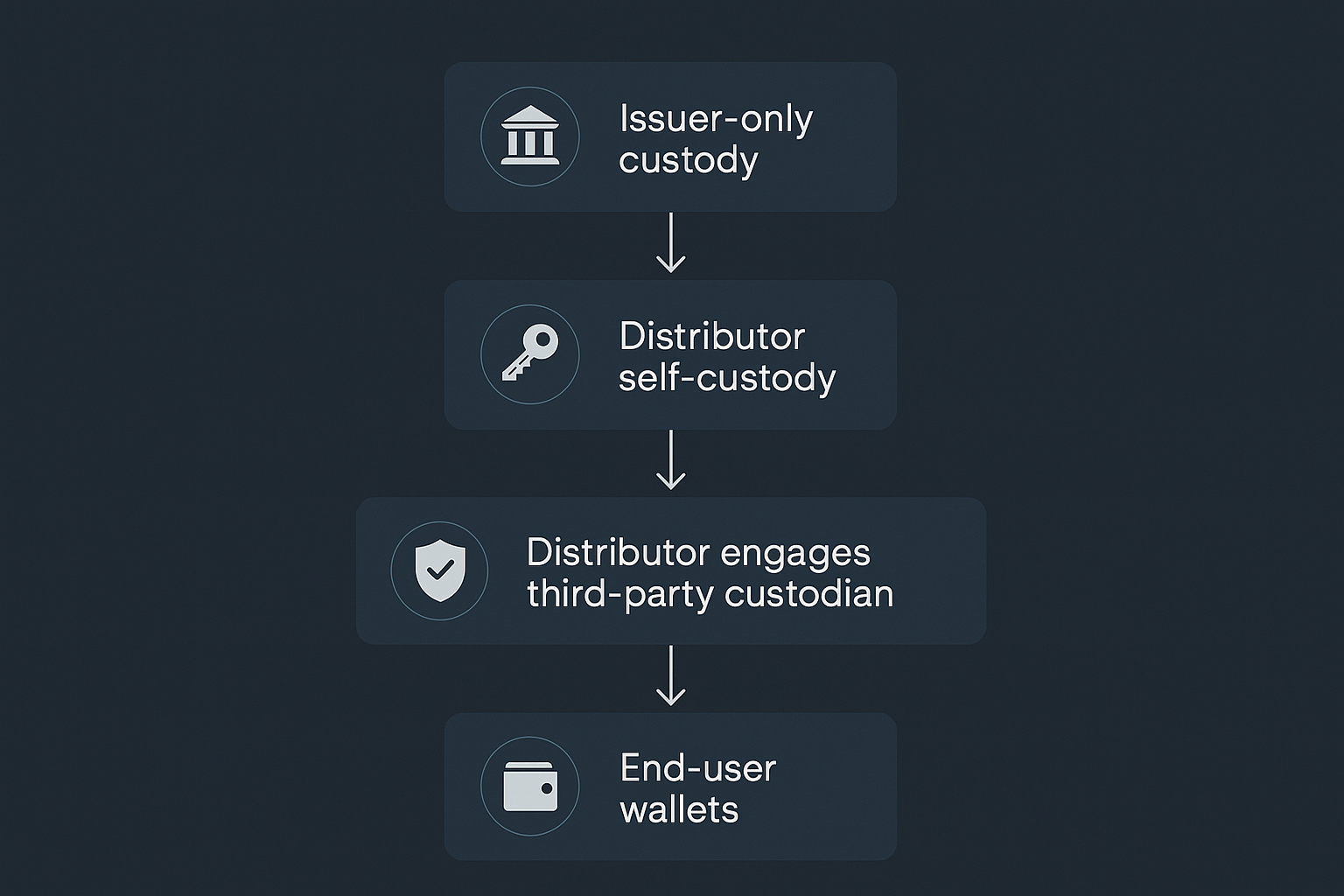
- Pattern A — Issuer‑custodied: Issuer holds client stablecoins. Proposed exemption from separate VA custodian licence applies if issuer only custodies its own coin. Strongest end‑to‑end control; heavier operational burden.
- Pattern B — Distributor self‑custody: Distributor (e.g., wallet, exchange, bank) holds client stablecoins itself. Distributor may fall into the separate VA custodian regime if in Hong Kong and not exempt.
- Pattern C — Distributor with third‑party custodian: Distributor appoints an external custodian. That custodian likely needs the VA custodian licence if operating in Hong Kong.
Who does what (at a glance)
| Role | Likely licence | Core obligations called out |
|---|---|---|
| Stablecoin issuer | HKMA issuer licence | Reserves governance; segregation; audit and records; full AML/CFT; ongoing HKMA supervision |
| Distributor (customer of issuer) | Depends (payment, VA, or unlicensed if outside scope) | Onboarded under issuer’s AML/CFT; distribution conduct; disclosures; tech and wallet safeguards |
| Third‑party custodian | VA custodian licence (proposed), unless exempt | Key management; asset segregation; reporting; incident handling |
AML/CFT you can’t gloss over
- Treat distributors as customers: Do full KYC and ongoing due diligence at the entity level; assess their downstream controls and jurisdictions.
- Chain‑of‑custody visibility: If a distributor uses an external custodian, obtain comfort (contracts + audits) that segregation, key management, and reconciliation meet Hong Kong expectations.
- Transaction monitoring: Screen wallets and flows; document risk scoring and escalation. Maintain detailed records to satisfy audit and regulatory queries.
- Travel rule and counterpart screening: Implement where applicable to stablecoin transfers between VASPs; document exemptions and thresholds.
Design tips for retail and RWA integration
- Wallet design: Decide early between omnibus vs segregated on‑chain addresses; it affects auditability and client asset segregation proofs.
- Reserve transparency: Publish attestations on a tight cadence (e.g., daily holdings, monthly assurance). “Near‑real‑time” dashboards are now standard.
- DvP settlement rails: For RWA, build atomic settlement (smart contract escrow) or tightly orchestrated settlement windows with clear fail‑safes.
- Cross‑border playbooks: Map FX, sanctions, and licensing exposure for key corridors (e.g., Hong Kong–Southeast Asia). Use geofencing and counterpart restrictions where needed.
What to do in the next 90 days
- Licence scoping: Confirm whether you’ll be an issuer, distributor, or custodian—and whether any exemptions apply.
- Custody blueprint: Pick Pattern A/B/C; finalize key management, incident response, and reconciliations against the segregation/audit standard.
- Distribution framework: Paper the issuer–distributor–custodian tri‑party obligations, reporting, and right‑to‑audit.
- RWA legal wrapper: Define the token’s legal nature (claim vs title), settlement finality, and investor disclosures aligned to Hong Kong law.
Conclusion Hong Kong’s retail stablecoin path is usable—if you respect the custody perimeter, distributor oversight, and AML/CFT depth the HKMA expects. Get the architecture right, and stablecoin settlement can unlock real RWA utility across trade and funds.
If you want a fast read on your licensing and custody options, StanCOMP can map your structure to the HKMA regime and the proposed VA custodian rules, and flag gaps before you code.