
StanCOMP Compliance: HK VA Licence & Source of Funds

If you’re applying for a Hong Kong virtual asset licence in 2025, one issue will make or break your timeline: source of funds.
The regime has matured. The SFC’s trading platform rules are bedded in, retail access is now mainstream via authorised funds, and a separate custodian regime is on the way. But onboarding still collapses when firms can’t prove where the money—and the coins—really came from.
What changed in 2025 (and why it matters)
- The SFC’s ASPIRe roadmap (Feb 2025) signalled a path for staking, borrowing/lending and VA derivatives under a controlled framework, widening the product set beyond spot trading. See the SFC’s Guidelines for Virtual Asset Trading Platform Operators (Part X on custody and safekeeping).
- Retail access increased via the SFC’s 7 April 2025 circular on SFC-authorised funds with virtual asset exposure, tightening distribution and custody expectations.
- Government policy now prefers the term “Digital Assets” (Policy Statement 2.0) and doubles down on “same activity, same risks, same regulation.”
- A new legislative proposal to regulate virtual asset custodian services is out for consultation, aiming at purpose-built requirements for custody providers (segregation, governance, audits), complementing Part X of the VASP Guidelines.
The bottom line: more products, more retail touchpoints, and much higher expectations on AML/CFT and safekeeping.
Source of funds: what “good” looks like in Hong Kong The SFC/HKMA joint line since 22 December 2023 is clear: intermediaries and platforms dealing in VAs must perform robust KYC and ongoing monitoring proportionate to risks. That includes credible evidence of source of funds (SoF) and source of wealth (SoW) for both fiat and on-chain assets. See the SFC circular (ref. 23EC67) and the HKMA AML/CFT framework.
A practical approach we implement for applicants:
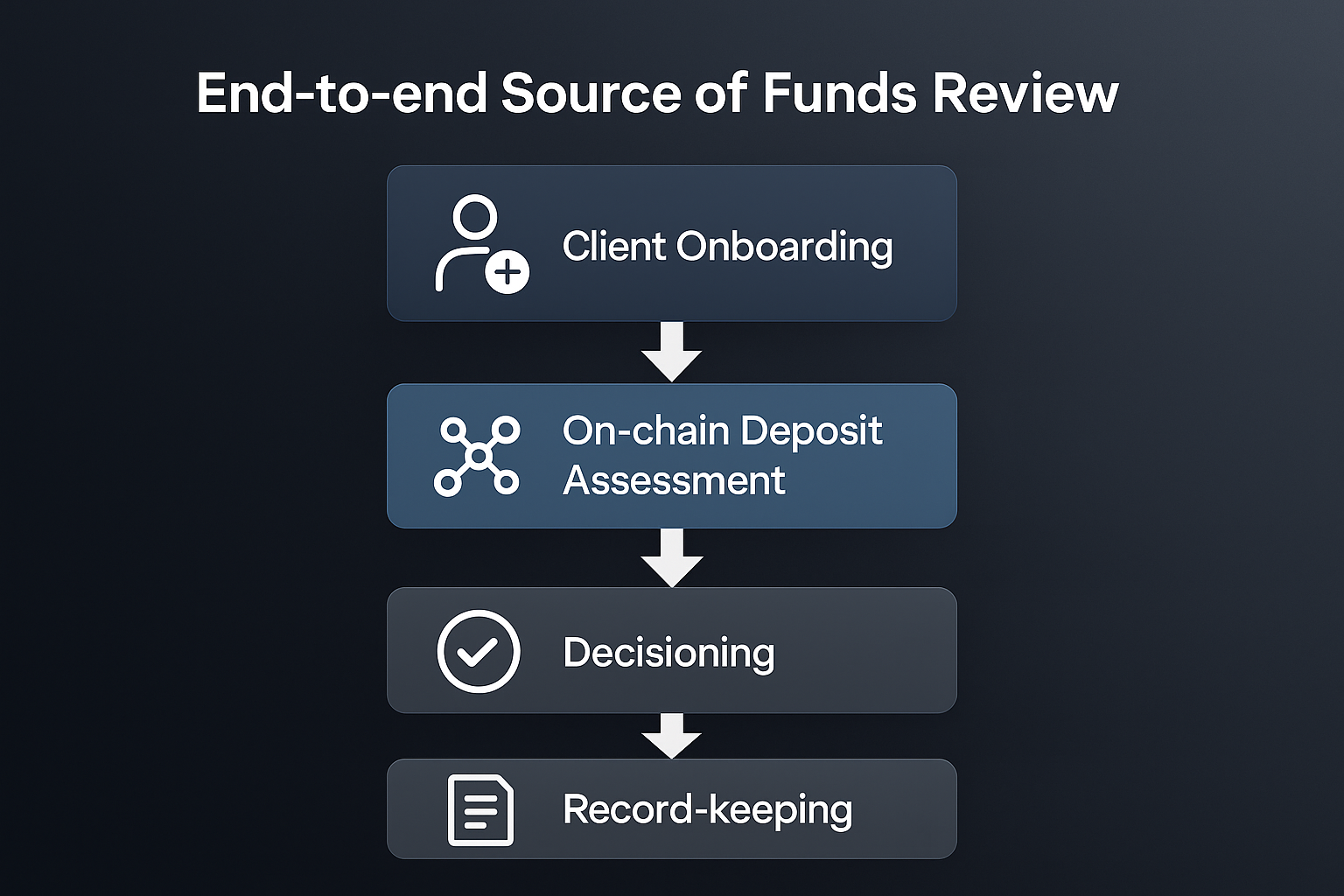
- Map the money trail end-to-end
- Fiat leg: Bank statements from the customer’s own account; payroll slips/tax returns; sale contracts (e.g., property, equity); dividend/bonus statements. Cross-check payer/payee consistency and dates.
- On-chain leg: Transaction graph from origin wallet to deposit address, using analytics to detect mixers, peel chains, sanctions, darknet services, or sanctioned jurisdictions.
- Apply risk-based thresholds
- Mixer or high-risk service exposure >20% of inbound flow over 12 months triggers enhanced due diligence (illustrative).
- Cross-chain bridges: require proof of control of pre-bridge and post-bridge wallets (signed message or dust test) and additional screening on bridge contracts.
- OTC/P2P: validate the counterparty—licensed exchange withdrawal receipts or OTC invoices; avoid “screenshot only” evidence.
- Evidence, don’t assert
- Keep raw proofs: full PDF statements, blockchain explorer links, analytics reports. Screenshots alone don’t pass.
- For legacy holdings: dated exchange statements, tax filings showing early crypto purchases, or mining logs and hardware invoices (where applicable).
- Bake in the Travel Rule
- Ensure Travel Rule data capture for transfers above threshold, aligned with your Travel Rule provider’s coverage. Reconcile originator/beneficiary info with KYC files.
Custody expectations you can’t ignore
- For licensed VATPs, Part X of the SFC Guidelines requires robust segregation, wallet governance, key management, and insurance/compensation arrangements.
- The 2025 consultation on a dedicated custodian regime points to heightened standards for stand-alone custodians. Plan for Hong Kong governance, auditability, and client asset segregation that mirrors securities custody discipline.
Quick reference: controls to build now
- Control: On-chain provenance with analytics • Reference: SFC/HKMA 22 Dec 2023 joint circular (ref. 23EC67)
- Control: Enhanced due diligence for high-risk flows • Reference: HKMA AML/CFT expectations for AIs/SVFs
- Control: Wallet governance and private key controls • Reference: SFC VASP Guidelines, Part X
- Control: Distribution and custody for VA-exposed funds • Reference: SFC circular 7 Apr 2025 (ref. 25EC21)
- Control: Client asset segregation and audits (custodians) • Reference: Public consultation on virtual asset custodian services
What to do now (so your licence doesn’t stall)
- If you’re a VATP applicant: Write SoF/SoW playbooks with clear escalation thresholds, Travel Rule reconciliation, and documentary checklists. Test them with 10–20 back-tested client files before filing (illustrative).
- If you’re an intermediary distributing VA products: Align investor profiling, product due diligence, and custody arrangements with the SFC’s 2025 fund circular; update staff training and surveillance.
- If you’re a custodian or building one: Design segregation, key ceremonies, and audit trails to the expected custodian regime; avoid retrofitting later.
Regulators are not asking you to catch everything. They are asking you to show your work.
Key links:
- SFC Guidelines for Virtual Asset Trading Platform Operators (Part X): https://www.sfc.hk/-/media/EN/assets/components/codes/files-current/web/guidelines/Guidelines-for-Virtual-Asset-Trading-Platform-Operators/Guidelines-for-Virtual-Asset-Trading-Platform-Operators.pdf
- SFC/HKMA joint circular (22 Dec 2023), ref. 23EC67: https://apps.sfc.hk/edistributionWeb/gateway/EN/circular/doc?refNo=23EC67
- SFC circular on SFC-authorised funds with VA exposure (7 Apr 2025), ref. 25EC21: https://apps.sfc.hk/edistributionWeb/gateway/EN/circular/doc?refNo=25EC21
If you need a second set of eyes on your SoF files or custody design, we’re happy to pressure-test it before the SFC does.


