
StanCOMP Compliance: HK Fund Tokenisation & Crypto Payments

Introduction
Hong Kong’s next phase in digital assets is no longer theoretical. Policy Statement 2.0 backs real-world tokenisation and stablecoin payment pilots, while the AMLO-based VATP regime is live and expanding. If you’re exploring fund tokenisation or cross-border crypto payments, you need to map your build to three pillars: securities law, payment oversight under Cap. 584, and AML/CFT under Cap. 615.
Tokenising a Hong Kong Fund: What Actually Changes
The core rule doesn’t change: a tokenised fund is still a fund. Units are “securities” under the Securities and Futures Ordinance (SFO), so the usual SFC fund authorisation/distribution rules apply; tokenisation is a tech wrapper, not a regulatory bypass.
What SFC expects in practice:
- Technology governance: clear smart contract controls, key management, auditability, and a rollback/contingency plan for on-chain errors. See SFC’s guidance on tokenised securities-related activities.
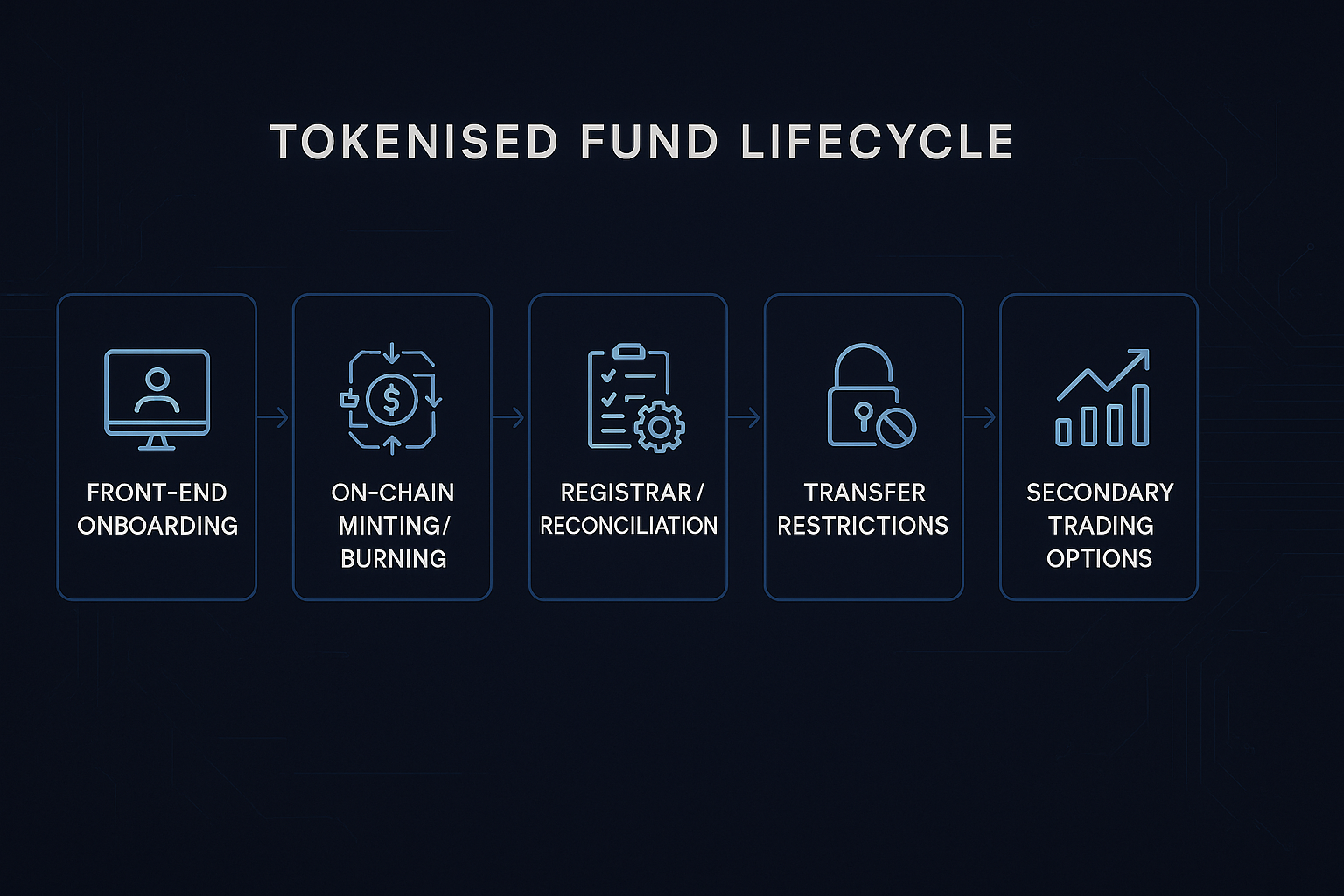
- Transfer controls: whitelist logic to enforce eligible investors, lock-ups, and Hong Kong offering restrictions.
- Record integrity: DLT as a register is fine if you can reconcile to a golden source and meet books-and-records obligations.
- Custody: if the fund holds virtual assets (beyond tokenised representations of traditional assets), SFC’s VA fund manager requirements apply. If you outsource token custody, track Hong Kong’s proposed VA custodian regime under AMLO.
- Secondary liquidity: on-exchange retail trading of tokenised fund units may require VATP admission; Hong Kong VATPs are licensed under AMLO since Dec 2022. Off-platform peer-to-peer trading raises suitability and transfer control risks.
Context that helps: Hong Kong is already issuing tokenised government bonds on a recurring basis, signalling regulators are comfortable with institutional-grade tokenisation when controls are solid. See HKMA’s multi-currency digital bond issuance (Feb 2024).
Cross‑Border Crypto Payments: Where the Lines Are
Policy Statement 2.0 explicitly supports stablecoin payment use cases, with a dedicated regime being stood up by the Government/HKMA. Until that regime commences, structure your cross-border flow around today’s rules:
- Cap. 584 (often called the Payment Systems Ordinance): if you issue stored value or operate a retail payment system touching Hong Kong users, you may trigger stored value facility (SVF) or designated retail payment system oversight. Design your product so corporate-only, closed-loop settlement doesn’t accidentally resemble an SVF.
- AMLO (Cap. 615): if you provide VA exchange, transfer, or dealing services in Hong Kong, you risk falling within VATP/VA service scope; Travel Rule applies to VA transfers between obliged entities.
- Stablecoin issuance/redemption in or from Hong Kong will be brought under a dedicated licensing framework. Plan for capital, reserve, and governance requirements (issuer, wallet, and reserve management roles will matter).
What Triggers What: Fast Mapping
-
Tokenised fund offered to HK investors; on-chain register
- Regime: SFO/SFC fund authorisation; SFC tokenised securities guidance
- Actions: DLT controls, transfer whitelists, registrar reconciliation, distribution via SFC-licensed intermediaries
-
Secondary trading of fund tokens to the public
- Regime: AMLO VATP licensing by SFC
- Actions: List only on SFC-licensed VATPs; ensure market maker arrangements align with VATP rules
-
Corporate cross-border pay with fiat‑redeemable stablecoin
- Regime: Cap. 584 (payment), upcoming stablecoin regime (HKMA), AMLO Travel Rule
- Actions: Determine SVF/RPS perimeter; Travel Rule compliance; sanctions/FX controls; disclose settlement finality and redemption risks
-
VA custody for funds/treasuries
- Regime: Forthcoming AMLO VA custodian licensing; SFC/HKMA expectations today
- Actions: Segregation, on-chain proofing, key ceremony, insurance; monitor custodian bill progress
Operational Must‑Dos (actionable, not theoretical)
- Product scoping memo: one page that states “we are/are not” an SVF, VATP, or (future) stablecoin issuer, with reasons tied to Cap. 584 and AMLO.
- Travel Rule build: integrate an IVMS 101-compatible provider; test transfers ≥ HKD 8,000 equivalent with originator/beneficiary data.
- Token contract audit: external audit plus emergency pause/upgrade playbook approved by your board.
- Registrar model: define golden source (DLT vs. off-chain), reconciliation frequency, and error rectification process.
- Distribution controls: KYC gating on-chain, jurisdictional blocks, and investor categorisation logic.
Useful links
- AMLO (Cap. 615) – VATP licensing and AML/CFT framework: https://www.elegislation.gov.hk/hk/cap615
- SFC page on VA trading platform licensing: https://www.sfc.hk/en/Virtual-Assets-and-Related-Activities/VA-trading-platforms-licensing
- Payment Systems and Stored Value Facilities Ordinance (Cap. 584): https://www.elegislation.gov.hk/hk/cap584
- Policy Statement 2.0 highlights on tokenisation and stablecoin: HKSAR Government overview
- HKMA tokenised bond issuance (Feb 2024): https://www.hkma.gov.hk/eng/news-and-media/press-releases/2024/02/20240207-4/
Bottom line
Tokenise the fund if it improves distribution, but treat it like any SFC‑authorised product with extra tech controls. Use stablecoins for cross‑border settlement only after you’ve mapped Cap. 584 and the incoming stablecoin regime, and wired in Travel Rule compliance. If you want a second set of eyes, StanCOMP helps teams pressure‑test structures before you write a single line of code.


