
StanCOMP Compliance Guide: SFC VATP Fit and Proper

StanCOMP Compliance Guide: SFC VATP Fit and Proper
The “fit and proper” test is where SFC VATP applications live or die. It’s not just a checkbox; it’s the backbone of whether you can be trusted with client money, token listings, and market integrity in Hong Kong.
Don’t leave “fit and proper” to the end.
What “fit and proper” means under the VATP regime
- Since June 2023, anyone operating a virtual asset trading platform in Hong Kong must be licensed by the SFC and satisfy a fit-and-proper test that explicitly includes AML/CTF and investor protection requirements. The SFC has supervisory, investigative, and intervention powers.
- See Part X of the SFC’s Guidelines for Virtual Asset Trading Platform Operators for the core standards (link: SFC VATP Guidelines PDF).
- The joint circular on intermediaries’ virtual asset-related activities remains the benchmark for distribution, suitability, and safeguarding when you interact with licensed intermediaries (link: SFC Intermediaries Policies & Circulars).
- Expect alignment with adjacent proposals: the government’s consultation on OTC regulation and the consultation to regulate VA custodians both emphasize fit and proper. For custodians, authorities signaled the test will apply to substantial shareholders and individuals performing core custody functions.
- On 7 April 2025, the SFC issued a circular on SFC-authorised funds with VA exposure, reinforcing investor protection themes across the ecosystem.
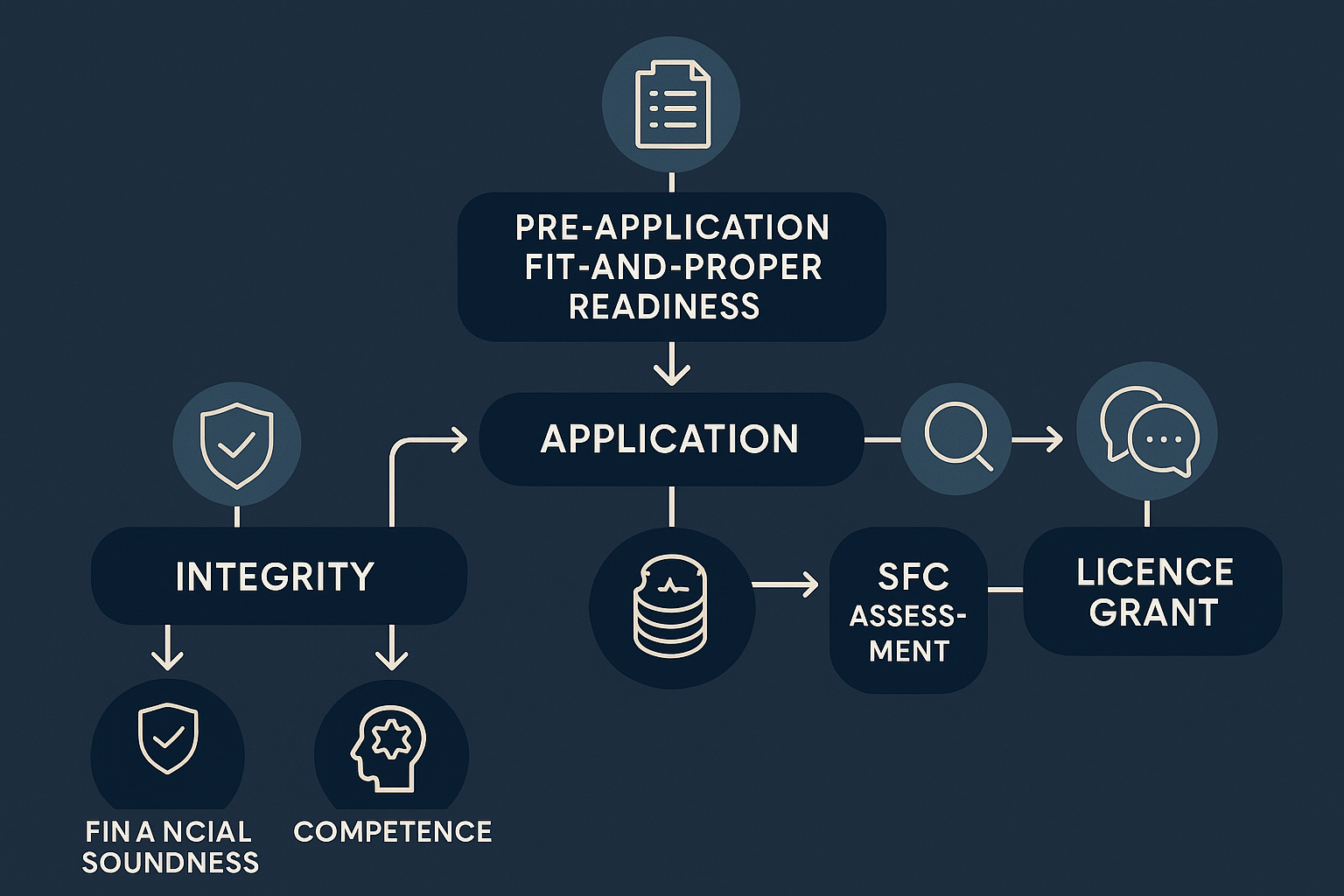
What the SFC actually looks for
| Pillar | What the SFC assesses | What to put on the table |
|---|---|---|
| Integrity & financial soundness | Clean disciplinary history, transparent ownership, no undisclosed controllers | Full UBO map to natural persons; declarations by controllers; litigation/disqualification checks |
| Competence & governance | Board/Risk/Listing committees; experience in exchange ops, custody, tech, and compliance | CVs of key personnel, MIC/RO matrix, role charters, minutes of governance meetings |
| AML/CTF | End-to-end program tailored to VAs and travel rule; sanctions rigor | End-user onboarding flows, adverse media demos, rule-based + behavioral monitoring scenarios, STR workflow metrics |
| Investor protection | Product due diligence, token admission/delisting, cold/hot wallet mix, insurance/compensation arrangements | Token due diligence files, market surveillance rules, wallet policies, incident response runbooks |
| Financial resources | Capital buffer and liquidity adequate for stress | Capital plan, treasury policy, wind-down analysis, third-party audit readiness |
Five red flags that stall applications
- Opaque ownership: layered SPVs with unclear control. Fix with a full controller tree and signed disclosures.
- Weak token listing governance: marketing drives listings. Set a formal Listing Committee with veto power independent of business.
- Custody shortcuts: single-admin keys or unclear wallet segregation. Move to multi-sig/hardware-backed segregation with dual control and access logs.
- AML/CTF “pdfware”: policies exist but no system evidence. Bring case files, alert stats, and sample STRs (redacted).
- Cross-border mismatch: key staff and systems entirely offshore without substance in Hong Kong. Anchor MIC/ROs, core servers, and key controls onshore.
What to do now (practical, time-bound)
- Week 1–2: Map controllers and officers. Produce an org chart showing UBOs to 10% and all MIC/RO roles. Run background checks and attestations.
- Week 2–4: Evidence AML/CTF effectiveness. Configure travel rule connectivity, tune alert scenarios, document sanctions screening thresholds, and show three closed investigation files.
- Week 3–5: Lock investor protection controls. Finalize token admission criteria, market surveillance rules, wallet architecture, and incident/compensation playbooks. Obtain non-binding insurance quotes where feasible.
- Week 4–6: Dry-run an SFC meeting. Prepare a 20–30 slide deck that answers “who controls you,” “how you stop market abuse,” and “how you protect retail.” Bring your CTO, CCO, and Head of Risk.
Context you shouldn’t ignore
- OTC and custodians are next. The government’s OTC consultation and the custodian-services proposal both point to fit-and-proper standards applying to substantial shareholders and function holders. Expect cross-read across regimes.
- Intermediary distribution will scrutinize you. If you plan to onboard users via licensed brokers, align with the joint circular’s suitability and risk disclosure expectations early.
- The SFC is intervention-ready. Be prepared for on-site inspections, thematic reviews, and directions to suspend listings if controls falter.
If you want a second set of eyes before you face the SFC, StanCOMP can run a fit-and-proper readiness review focused on governance, AML/CTF, and investor protection — the three areas most questioned in recent filings.
Key references
- SFC Guidelines for Virtual Asset Trading Platform Operators (Part X): https://www.sfc.hk/-/media/EN/assets/components/codes/files-current/web/guidelines/Guidelines-for-Virtual-Asset-Trading-Platform-Operators/Guidelines-for-Virtual-Asset-Trading-Platform-Operators.pdf
- SFC Intermediaries Policies & Circulars (joint circular on VA-related activities): https://www.sfc.hk/en/rules-and-standards/policies-and-circulars/intermediaries
- FSTB materials on VA regulatory initiatives (OTC and custody consultations): https://www.fstb.gov.hk/en/financial_services/financial-services-policy/virtual-assets.html
Build the record now. The licence follows.


