
StanCOMP Compliance Guide: HK RWA & Wholesale Stablecoins

StanCOMP Compliance Guide: HK RWA & Wholesale Stablecoins
Hong Kong’s Policy Statement 2.0 is no longer a vision piece. It’s a delivery agenda: incentivise RWA tokenisation, keep issuing tokenised government bonds on a regular cadence, expand to sectors like precious metals, and support stablecoin payment use cases — all underpinned by tighter AML/CFT, OECD CARF reporting, and cross‑border cooperation.
Translation for founders and product owners: the window to pilot is open, but the compliance floor is rising.
What Policy Statement 2.0 means in practice
- Tokenisation is moving beyond pilots: the Government has already issued tokenised green bonds more than once and intends “regular issuance” going forward. See HKMA releases in 2023 and 2024 for context.
- RWAs will expand across asset classes (including precious metals), with sustainability and related data embedded to integrate with global inventory systems.
- Stablecoin use cases, especially payment and settlement, are explicitly encouraged — but with a licensing perimeter and robust AML/CFT guardrails aligned with FATF and OECD CARF.
Key rules-of-the-road you can’t ignore
- Tokenised securities are still securities: The SFC’s 2 Nov 2023 statement makes it clear that tokenised securities fall under the Securities and Futures Ordinance. If your RWA token represents a share, bond, fund interest, or a CIS, expect Type 1/4/9 licensing implications and prospectus/CIS code issues. Source: SFC policy statement on tokenised securities.
- Stablecoin issuer regime is coming into force: The HKMA/FSTB consultation proposes licensing fiat‑referenced stablecoin issuers, full reserve backing, redemption at par, and a ban on algorithmic models. Wallets and key ecosystem participants may face registration/standards. Source: HKMA stablecoin consultation (Dec 27, 2023).
- AML/CFT is non‑negotiable: BIS and FATF flagged ML/TF and sanctions risks, especially with unhosted wallets. Expect Travel Rule enforcement, counterparty due diligence, sanctions screening, and blockchain analytics as table stakes.
- Tax transparency is rising: Prepare for OECD CARF data capture (wallet addresses, transaction types, fair market values, tax residencies). Start building the fields now to avoid painful retrofits.
How to structure your build: two tracks
-
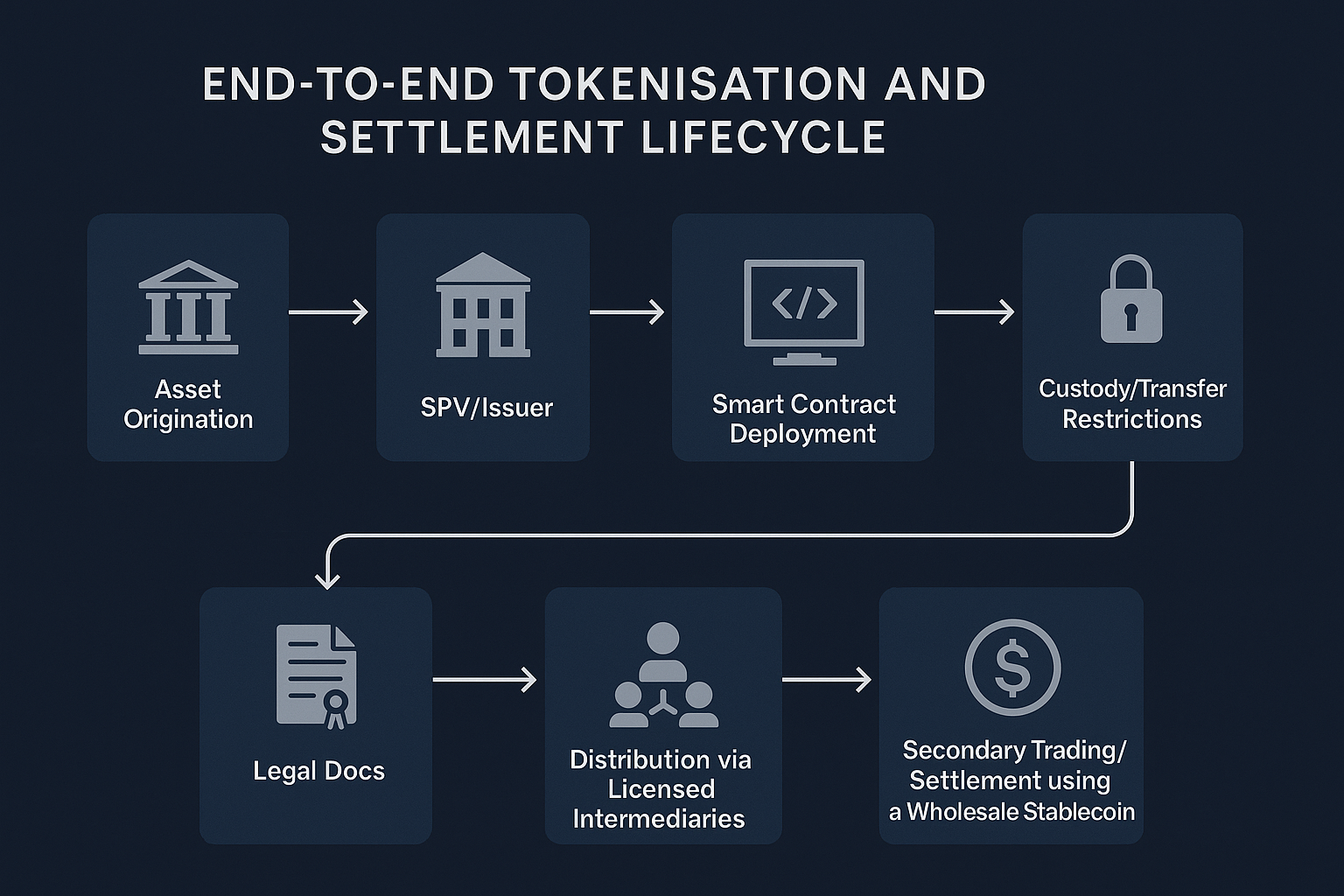
RWA tokenisation
- Perimeter check: classify the token (security vs non‑security commodity/receipt). If it’s a CIS, trustee/custodian and offering restrictions apply.
- Issuance design: consider SPV vs on‑balance‑sheet issuance, disclosure pack, and smart contract audits. Embed sustainability metrics where relevant to align with government priority.
- Distribution: if dealing in tokenised securities, use SFC‑licensed intermediaries; secondary trading belongs on a permitted venue (not a retail VATP unless the asset qualifies).
- Custody: use licensed custody or a qualified trustee with segregation, key‑management, and insurance.
-
Wholesale stablecoins (closed‑loop settlement)
- Scope: limit to institutional users initially (banks, brokers, large corporates) in a defined scheme with KYC’d participants.
- Backing: hold high‑quality, short‑dated assets with daily reconciliation and independent attestations. Real‑time reserve dashboards are becoming expected.
- Redemption: same‑day (T+0/T+1) redemption at par in the reference currency.
- Wallet controls: whitelist counterparties; treat unhosted wallet interactions as an exception with enhanced due diligence.
- Governance: pre‑application meetings with HKMA; align disclosures, risk factors, and wind‑down playbooks.
90‑day execution plan
- Week 1–2: Map regulatory perimeter and licensing triggers (SFO/AMLO/HKMA regime). Decide if your token is a security or not; document the rationale.
- Week 3–6: Stand up AML stack: Travel Rule provider, blockchain analytics, sanctions screening, and unhosted wallet policy. Draft responsible disclosure for smart contracts.
- Week 7–10: Choose partners: SFC‑licensed distributors/custodians, trustees, and reserve asset managers. Book a supervisory touchpoint with SFC/HKMA.
- Week 11–12: Pilot in a closed loop. For RWAs, mirror terms of traditional instruments and test settlement using a wholesale stablecoin or tokenised deposits.
Quick readiness checklist
| Area | RWA Tokenisation | Wholesale Stablecoin |
|---|---|---|
| Legal classification | Security/CIS analysis; offering rules | Issuer licensing perimeter; fiat-referenced only |
| Reserves/Backing | Asset registry, escrow/custody proof | High-quality liquid assets; daily reconciliation |
| Disclosures | Prospectus/CIS docs; sustainability data | Redemption, reserves, audits, wind-down |
| AML/CFT | Travel Rule, analytics, source of funds | Closed-loop KYC, wallet whitelist, sanctions |
| Tech risk | Smart contract audit; key mgmt | Real-time monitoring; incident response |
| Reporting | Investor registry, ESG metrics | CARF fields; transaction logs |
Why this matters now Regular tokenised government bond issuance signals the playbook is ready. Policy Statement 2.0 invites real usage — not just pilots — across assets and settlement rails.
Compliance is how you get there without rework.
Links for deeper reading
- HKMA/FSTB stablecoin consultation (Dec 27, 2023): https://www.hkma.gov.hk/eng/news-and-media/press-releases/2023/12/20231227-7/
- SFC statement on tokenised securities (Nov 2, 2023): https://www.sfc.hk/en/News-and-announcements/Policy-statements-and-announcements/Statement-on-tokenised-securities-and-authorised-offerings-of-tokenised-investment-products
- HKSAR Government tokenised green bond issuances: 2023 and 2024
- OECD Crypto-Asset Reporting Framework (CARF): https://www.oecd.org/tax/exchange-of-tax-information/crypto-asset-reporting-framework-and-amendments-to-the-common-reporting-standard.htm
If you want a fast perimeter assessment or a regulator-ready memo, StanCOMP can help structure both tracks — RWA tokenisation and wholesale stablecoins — with the fewest moving parts needed to launch.


