
StanCOMP Compliance Guide: e-HKD & CRS in Hong Kong

Introduction: why e-HKD and CRS now Everyone in Hong Kong is piloting tokenized money in some form. The HKMA’s e-HKD work is progressing, and banks/SVFs are experimenting with programmability and offline payments. At the same time, tax transparency hasn’t paused for innovation. If your product touches e-HKD-like rails or virtual assets, you still have Common Reporting Standard (CRS) obligations today.
The risk is simple: building great tech, then discovering your wallet or ledger model is reportable under CRS with data gaps you can’t fix retroactively.
Where e-HKD stands in 2025
- Status: No retail launch yet. The HKMA continues its e-HKD Pilot Programme (Phase 2), exploring use cases such as tokenized deposits, settlement, and programmable payments. See HKMA’s e-HKD page and pilot updates: https://www.hkma.gov.hk/eng/key-functions/international-financial-centre/fintech/central-bank-digital-currency-research/e-hkd/
- Likely model: Intermediated. Banks and stored value facilities (SVFs) would hold customer relationships and onboard wallets.
- Regulatory perimeter: Hong Kong is converging on a unified approach. The SFC sets standards for digital/virtual asset custody, while the HKMA is the frontline supervisor for banks and SVFs and their VA/DA custodian activities. Subsidiaries of locally incorporated banks acting as VA custodians are regulated by the SFC. This “unified and holistic approach” aims to provide clarity and safeguard market integrity, with OTC and custodian activities “already placed under the robust regulation of the SFC and the HKMA, as applicable.” See SFC/HKMA/FSTB materials and policy statements: https://www.sfc.hk and https://www.hkma.gov.hk
CRS lens: how e-HKD-like products map today Under Hong Kong’s CRS regime (IRD guidance: https://www.ird.gov.hk/eng/tax/dta_aeoi.htm), Reporting Financial Institutions (FIs) must identify and report reportable accounts. If e-HKD is intermediated by banks/SVFs, many wallet balances will look like Depository Accounts for CRS purposes.
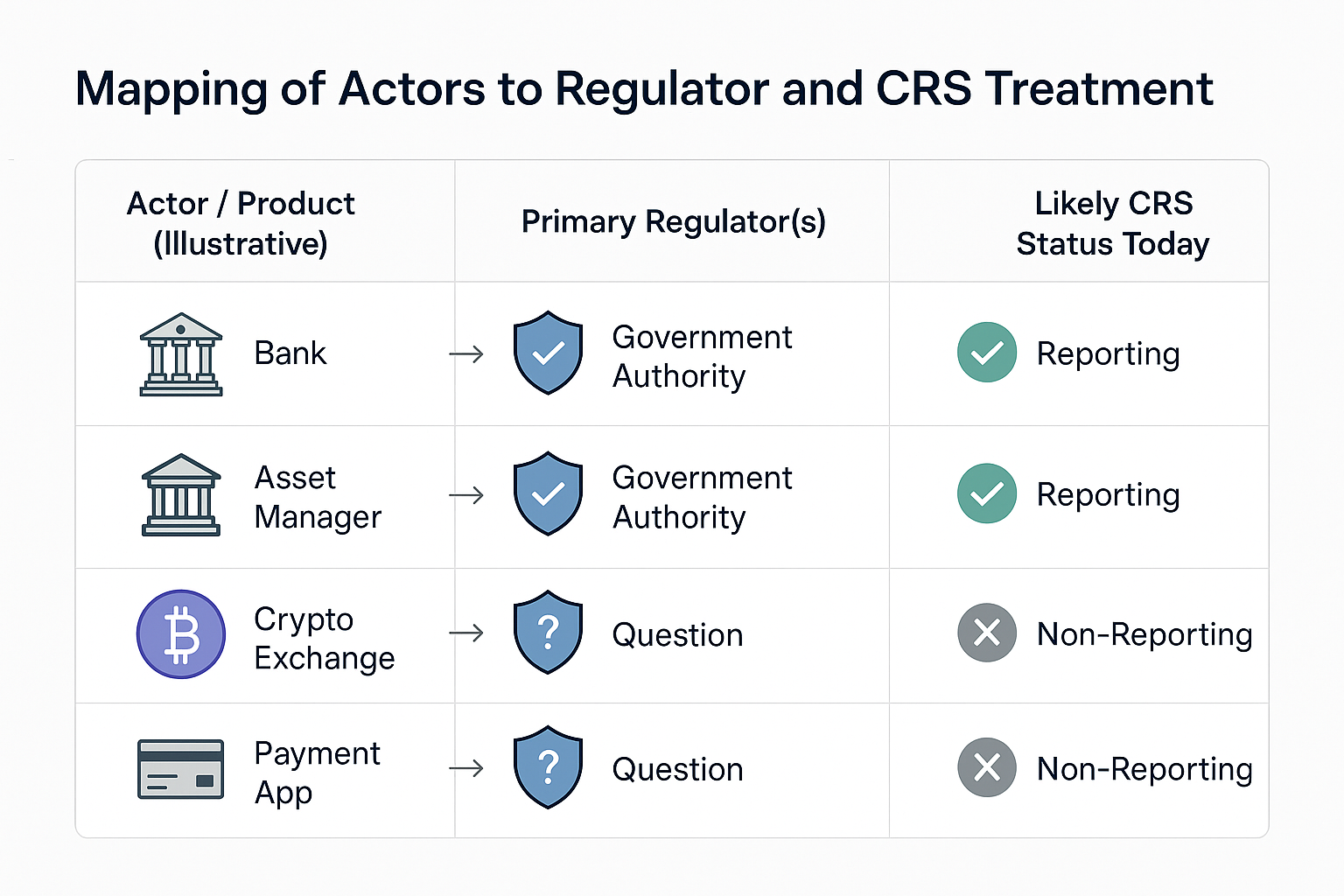
| Actor / product (illustrative) | Primary regulator(s) | Likely CRS status today | Immediate focus |
|---|---|---|---|
| Bank-issued e-HKD pilot wallet | HKMA (frontline), SFC standards | Depository Account held with a Reporting FI | Collect tax residency, TINs; align account holder definitions |
| SVF-issued tokenized money wallet | HKMA (SVF), SFC standards | Depository Account if SVF qualifies as Reporting FI | Indicia review, self-certification at onboarding |
| Non-bank VA custodian subsidiary of a local bank | SFC (entity), HKMA (group supervision) | Custodial Account if holding customer financial assets | Distinguish on-chain custody from balance sheet liabilities |
| OTC VA broker with client wallets | SFC/HKMA per proposals | Depends: custodial/transactional roles may be in-scope | Document roles; avoid “accidental” FI status via features |
What to fix now (90-day playbook)
- Data model and onboarding
- Embed CRS self-certification into wallet onboarding. Capture tax residency and TINs for 98%+ of accounts (illustrative target). Build remediation paths for missing indicia.
- Classify accounts early: individual vs entity; look-through for passive NFE controllers where applicable.
- Product and ledger design
- Tag account types in the core ledger (Depository vs Custodial) from day one. Don’t rely on downstream mapping.
- For programmability, log payer/payee roles and controlling persons to support reportable jurisdiction mapping.
- Reporting mechanics
- Map data to CRS schemas used by IRD. Dry-run a production file with a 500-account pilot set (illustrative) to check schema integrity, TIN formats, and address standards.
- Calendarize report timelines (due dates, pre-notification to customers, error correction windows).
- Governance and outsourcing
- If custody/OTC functions are outsourced, document regulatory handles: SFC/HKMA scopes, service levels, and right-to-audit. Obtain SOC 1/ISAE 3402 where reporting relies on third-party controls.
- Align AML/KYC with CRS indicia discovery to avoid double work; one questionnaire, two obligations.
Regulatory horizon to watch
- OTC VA trading and standalone VA custodians: the Government’s proposals aim to bring them into formal licensing so that “the SFC and the HKMA have sufficient regulatory handle” and protections apply consistently. Expect the SFC to set standards, with HKMA frontline for banks/SVFs.
- e-HKD: even pre-launch, expect supervisors to assess CRS readiness during pilots. If you can’t produce CRS-quality data, you’re not production-ready.
One line to remember If it looks like an account at a financial institution, assume CRS applies until proven otherwise.
How StanCOMP can help We translate HKMA/SFC expectations into buildable checklists. Typical outcomes: reduce missing TINs below 2% (illustrative), produce IRD-acceptable CRS files in one cycle, and harden custodian/OTC workflows to match the coming unified regime.
Close e-HKD isn’t live yet, but CRS is. Build with the supervisors’ “unified and holistic” direction in mind, and you’ll avoid costly rebuilds when e-HKD switches on. If you want a quick gap review against HKMA/SFC expectations and CRS data sufficiency, we’ll make it precise and fast.


