
StanCOMP Compliance: EDD for Stablecoin Wallet Risks

StanCOMP Compliance: EDD for Stablecoin Wallet Risks
Why this matters now Stablecoin flows are moving from exchanges into wallets—both custodial and unhosted. Hong Kong regulators have been clear: if you touch stablecoin customers or their wallets, you’re expected to perform due diligence on the wallet provider and apply extra controls for unhosted wallets. The latest consultation conclusions on AML/CFT for stablecoins confirm this direction and add clarity on third‑party distributors and ongoing monitoring of issuers’ customers.
The goal: enable redemption and transfers without opening the floodgates to sanctions, mixer-tainted funds, or mule networks.
What Hong Kong is asking for
- Due diligence on custodial wallet providers: Treat them like financial institutions—assess licensing status, AML programme, Travel Rule capability, and controls. The AML/CFT Guideline will include a new paragraph aligning third‑party due diligence with expectations for custodial wallet providers. See HKMA materials on stablecoins and AML/CFT guidance.
- Additional controls for unhosted wallets: Apply enhanced checks before allowing inflows/outflows. Expect to justify your thresholds and evidence your verification steps.
- Ongoing monitoring of issuer’s customers: Not just at onboarding—transaction profiling, anomaly detection, and event-driven reviews are required, per the consultation conclusions.
- Third‑party distributors: The HKMA has clarified that due diligence applies to any entity assisting in distribution—depth should be risk-based but consistent with custodial wallet standards.
For policy context, see Hong Kong’s Policy Statement 2.0 on Digital Assets, which emphasizes risk management and adaptive oversight.
Practical EDD playbook (what to implement)
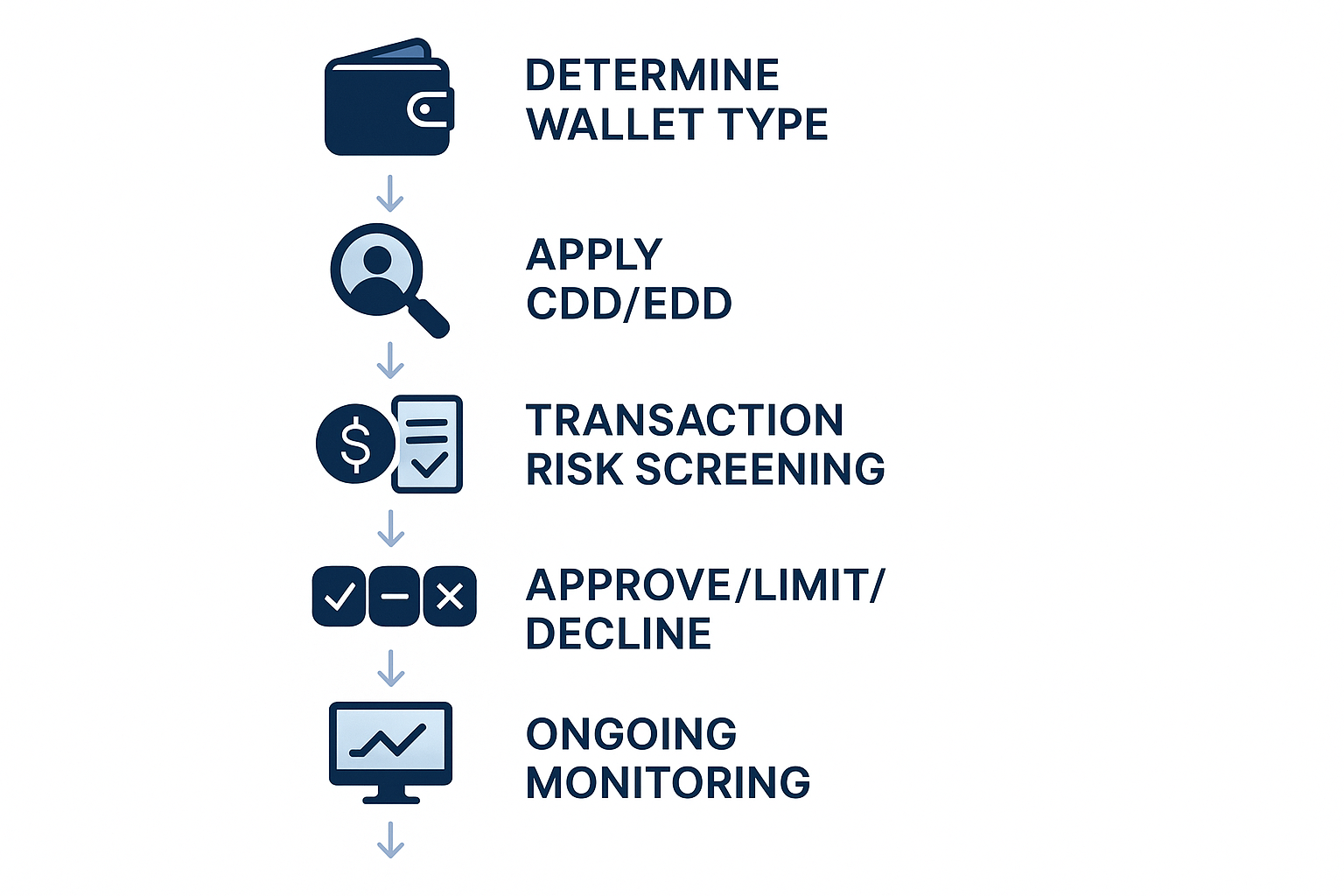
- Wallet risk assessment matrix
| Factor | Higher Risk Indicators | EDD Actions |
|---|---|---|
| Wallet type | Unhosted; newly created; no on-chain history | Signed message to prove control; micro-transfer verification; device/IP profiling; allowlisting; lower limits until history established |
| Counterparty exposure | Links to mixers, darknet, sanctioned addresses | Blockchain analytics with case notes; escalate to Level 2 review; consider SAR to JFIU and block |
| Jurisdiction | High‑risk or sanctioned geography | Enhanced KYC; SOF/SOW; senior management approval |
| Stablecoin issuer path | Unclear redemption channels; third‑party “arrangers” | Verify redemption mechanics; review distributor contracts; attestations on reserves/settlement SLAs |
| Velocity/volume | Rapid cycling through multiple wallets | Source/use of funds narrative; investigate layering patterns; set cooling‑off periods |
- Unhosted wallet controls that stand up to audit
- Proof of control: Require signed message from the private key and a “penny drop” micro‑transfer roundtrip.
- Travel Rule gap closure: When the counterparty is unhosted, collect originator/beneficiary data directly and screen before releasing funds. Align with AMLO and VA Transfer requirements.
- Limits and sequencing: Start at HKD 50,000 daily (illustrative), scale limits based on clean on-chain history ≥90 days and stable KYC signals.
- Behavioral analytics: Flag “fresh wallet → large redemption → immediate off‑ramp” sequences.
- Sanctions evasion safeguards: Auto‑block risky routing patterns (e.g., Tornado Cash adjacency within 3 hops with high risk score).
- Due diligence on custodial providers and distributors
- Legal/regulatory: Licensing/registration, jurisdictions served, cross‑border restrictions.
- AML/CFT: Policy review, screening stack, SAR process, training records.
- Travel Rule readiness: Messaging standard, interoperability, unhosted handling procedures.
- Resilience and SLAs: Downtime stats, incident logs, redemption SLAs, dispute handling.
- Contractual guardrails: Right to audit, data sharing, termination for AML breaches, reporting cadence.
- Ongoing monitoring
- Baselines and alerts: Create wallet behavior baselines at T+30 days; investigate deviations >2x normal value/velocity (illustrative).
- Event‑driven reviews: Trigger on sanctions updates, adverse media, law enforcement inquiries, ownership changes.
- QA cadence: Quarterly sampling of EDD files; yearly model validation of blockchain risk scoring.
- MI to Board: Monthly dashboard—unhosted inflow %, alerts cleared in 24h, SAR count, distributor risk ratings.
What to do this quarter
- Map all wallet touchpoints (custodial, unhosted, third‑party distributors). Close Travel Rule and unhosted data gaps.
- Implement signed-message verification and micro‑transfer checks for unhosted wallets.
- Refresh third‑party DD files to align with the “custodial-equivalent” standard referenced by the HKMA.
- Document your risk thresholds and rationales. If it isn’t written down, it doesn’t exist.
One last point. EDD isn’t a box-tick—your audit trail must tell a coherent story from risk to decision.
Need a quick gap assessment or playbook templates? StanCOMP can benchmark you against Hong Kong’s evolving stablecoin expectations and prepare you for supervisory review. Links: HKMA stablecoin resources and AML/CFT guidelines; Policy Statement 2.0 on Digital Assets.


