
StanCOMP Compliance Brief: SFC DeFi & VA OTC Licensing 2025

StanCOMP Compliance Brief: SFC DeFi & VA OTC Licensing 2025
Hong Kong is tightening two fronts in 2025: DeFi touchpoints are being pulled under existing SFO/AMLO triggers, and VA OTC trading will be brought into a dedicated licensing regime under AMLO (Cap. 615). The direction is clear: same risks, same rules—no exemptions just because code is involved.
What’s new (and why it matters)
- FSTB’s VA OTC regime under AMLO: Following the February–April 2024 consultation, the Government confirmed plans to introduce a licensing regime for VA OTC providers under AMLO, targeting both physical shops and online channels. See the Financial Services and the Treasury Bureau’s consultation materials: Public Consultation on Legislative Proposals to Regulate Over-the-Counter Trading of Virtual Assets and VA OTC consultation paper (FSTB). The aim is to fold OTC desks into the same anti-money laundering and counter-terrorist financing standards already applied elsewhere.
- SFC to lead on dealing and custody: Under the Government’s Policy Statement 2.0 on digital assets, the SFC is being positioned as the lead authority for licensing and registration of digital asset dealing and custodian services. Expect the OTC licence to sit under AMLO with the SFC as the gatekeeper, aligned with the virtual asset trading platform framework.
- Funds and DeFi exposure: On 7 April 2025, the SFC issued a circular on SFC-authorised funds with exposure to virtual assets, reinforcing disclosure, custody, and risk-management expectations. If your public fund touches DeFi (lending, AMMs, staking), expect the SFC to scrutinise your wallet governance, counterparty due diligence, and valuation controls. Refer to the SFC website for circulars and product guidance.
DeFi: where SFC requirements bite
DeFi is not “unregulated” in Hong Kong. It’s assessed by function:
- Front-ends and aggregators: If you operate a UI that matches orders, routes flow, or takes fees from protocol interactions, you may trigger “dealing” or “automated trading service” (ATS) under the SFO for tokenised securities, or VA service provider obligations under AMLO for non-security tokens.
- Arranging and advisory: Introducing clients to protocols, constructing DeFi strategies, or taking discretion over wallets can trigger Type 1/4/9 licensing (depending on the token’s status) and AMLO AML/CTF duties. Disclaimers won’t save you if you’re effectively arranging transactions.
- Custody: “Self-custody” claims are closely examined. If staff can move client assets (e.g., via multi-sig or admin keys), you’re in custody territory and should align to proposed custodian standards flagged in the Government’s policy roadmap.
VA OTC licensing: shape and expectations
The upcoming AMLO licence for OTC providers is designed for storefronts, chat/phone brokers, and online quoting portals.
- Scope: In-person and remote OTC dealing, fiat–VA and VA–VA ramps, brokerage/arranging.
- Likely obligations (AMLO-aligned):
- Full CDD/KYC (including source of funds/wealth for higher-risk cases), sanctions screening, ongoing monitoring, record-keeping (≥7 years), travel rule compliance for VA transfers, and suspicious transaction reporting.
- Fit-and-proper management, independent AML audit, and clear responsible officers (ROs)/MLRO.
- Transparent pricing and client disclosures; restrictions on misleading promotions.
- Timeline: Based on prior AMLO regimes, expect transitional arrangements with a short application window and 3–6 months to operationalise controls before inspections ramp up. (Illustrative)
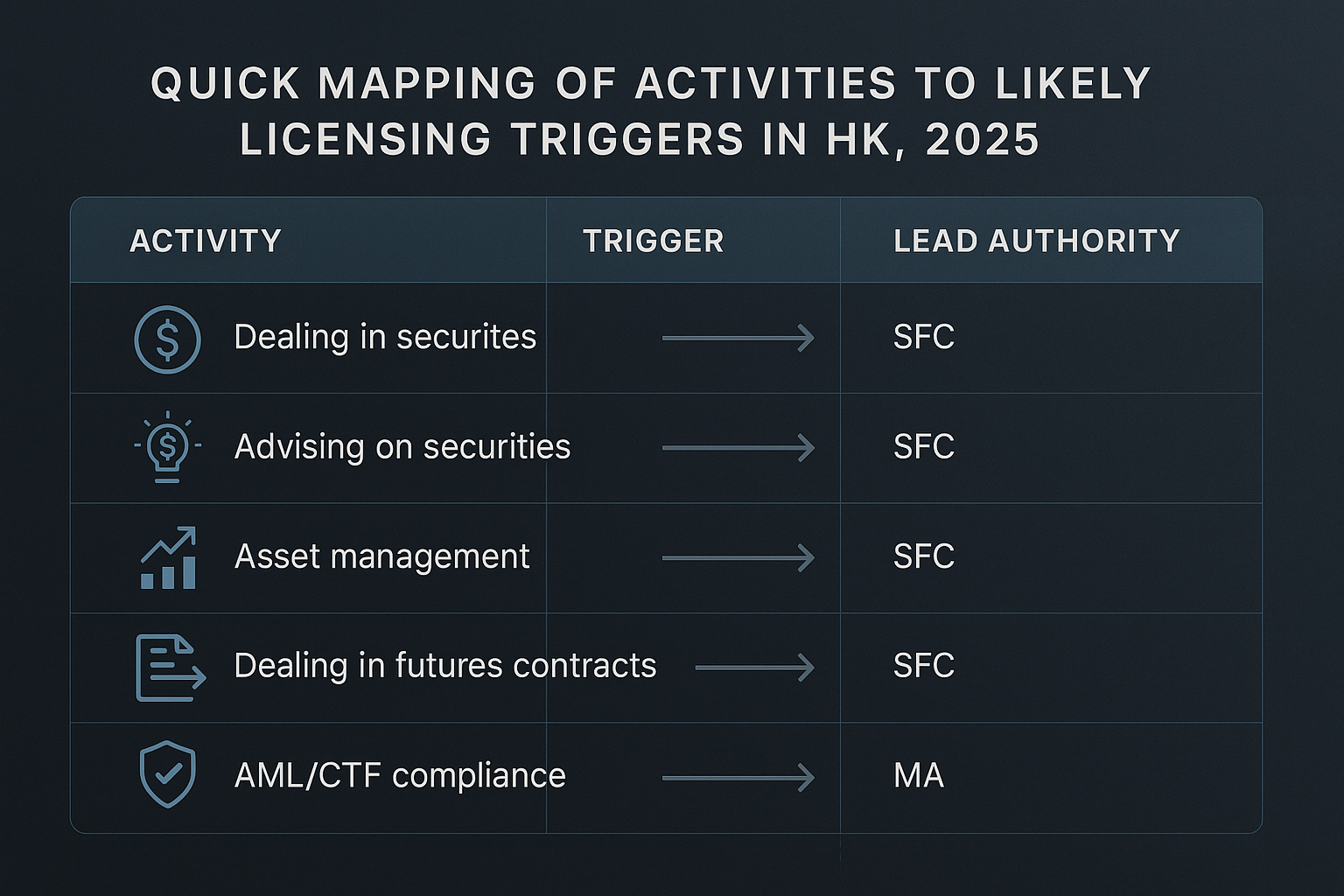
- Activity: DeFi front-end that routes orders and collects fees | Trigger: SFO ATS or AMLO VA service provider | Lead authority: SFC
- Activity: OTC shop quoting fiat–VA | Trigger: AMLO OTC licence | Lead authority: SFC (proposed)
- Activity: Discretionary DeFi yield for clients | Trigger: Type 9 (if securities), AMLO AML/CTF | Lead authority: SFC
- Activity: VA custody for clients | Trigger: DA custodian regime (policy track) | Lead authority: SFC (proposed)
What to do now (practical 60–90 day plan)
- Map your flows: For each product, decide if tokens are securities or non-securities; identify whether you “operate,” “arrange,” “advise,” or “custody.” Write this down—regulators will ask.
- Build AML for OTC today: Even pre-licensing, implement full KYC, sanctions checks, ongoing monitoring, and travel rule tooling. Choose a travel rule provider and test transfers end-to-end.
- Governance: Appoint an MLRO and deputy; define ROs with relevant VA experience. Commission an independent AML review within 90 days. (Illustrative budget: HKD 200k–400k, vendor-dependent)
- DeFi controls:
- Wallet policy (M-of-N, HSM/MPC, key ceremonies, incident runbooks)
- Protocol due diligence (governance risk, oracle design, admin-key risk, TVL/volume decay)
- Valuation and slippage controls for funds interacting with AMMs
- Marketing clean-up: Remove “no licence required” language. Align storefront and website disclosures to AMLO expectations.
- Early engagement: Arrange a pre-application meeting with the SFC once the OTC bill is tabled; bring your control framework and transaction monitoring rules.
One final note
Compliance is now a product feature in Hong Kong. If you architect it early, licensing becomes a project plan—not an emergency.
Key references
- FSTB: Public Consultation on Legislative Proposals to Regulate Over-the-Counter Trading of Virtual Assets – https://www.fstb.gov.hk/en/public/consultation/index.html
- AMLO (Cap. 615) – https://www.elegislation.gov.hk/hk/cap615
- SFC virtual asset regime and circulars – https://www.sfc.hk/en and SFC’s VA platform/AML resources – https://www.sfc.hk/en/Rules-and-standards/Anti-Money-Laundering-and-Counter-Financing-of-Terrorism/Regulation-of-virtual-asset-trading-platforms


