StanCOMP Compliance Brief: HK SFC VATP, KYT & Travel Rule

StanCOMP Compliance Brief: HK SFC VATP, KYT & Travel Rule
Hong Kong’s crypto rules are no longer “coming soon.” They’re here, maturing fast, and expanding to cover the gaps. If you run a VATP, broker, OTC desk, or stablecoin-related service, the three pillars to get right in 2025 are SFC VATP guidelines, KYT monitoring, and the Travel Rule.
What changed recently — and why it matters
- SFC VATP regime is live: Since June 2023, virtual asset trading platforms must be licensed by the SFC, subject to fit-and-proper, AML/CTF, and investor protection requirements. See the SFC’s Guidelines for Virtual Asset Trading Platform Operators (including Part X) and the joint circular on intermediaries’ VA activities for cross-entity expectations.
- Guidelines for VATPs: https://www.sfc.hk/-/media/EN/assets/components/codes/files-current/web/guidelines/Guidelines-for-Virtual-Asset-Trading-Platform-Operators/Guidelines-for-Virtual-Asset-Trading-Platform-Operators.pdf
- Intermediaries’ VA activities (SFC/HKMA joint guidance): https://www.sfc.hk/en/Rules-and-standards/Guidelines-and-circulars/Intermediaries/Guidance-on-virtual-asset-related-activities
- Funds signal the bar: On 7 April 2025, the SFC issued a circular on SFC-authorised funds with VA exposure, underscoring governance, custody and risk disclosures for products touching virtual assets. Check the SFC’s Circulars page (filter by date): https://www.sfc.hk/en/News-and-announcements/Policy-statements-and-announcements
- OTC licensing is coming: The FSTB ran a consultation (Feb–Apr 2024) to license VA OTC service providers under the AMLO. Expect Travel Rule, KYT and onboarding standards to apply. Background: https://www.info.gov.hk/gia/general/202402/08/P2024020800419.htm
- Custody will be separately regulated: The Government consulted on a standalone regime for virtual asset custodians to harmonise safekeeping standards across the market, with references to the VATP Guidelines and related SFC/HKMA circulars.
KYT: what “good” looks like in 2025 KYT isn’t a checkbox. It’s live surveillance.
- Coverage: All inbound/outbound transfers, deposits, withdrawals, internal ledger moves, cross-chain bridges, and smart contract interactions.
- Sources: At least two analytics vendors to reduce false negatives; weekly model calibration; 24/7 sanctions update feeds.
- Controls:
- Pre-transfer risk scoring (counterparty, asset, chain, hop count, exposure to mixers/ransomware/scams).
- Auto-hold for high-risk indicators (e.g., exposure to sanctioned addresses above a set threshold).
- Human review within SLA (suggested: 2 hours for high, 24 hours for medium).
- Metrics (illustrative):
- False positive rate below 15% after 90 days.
- 100% logging of rule overrides with rationale.
- Evidence packs (graph views, trace IDs, timestamped decisions) retained for 7 years.
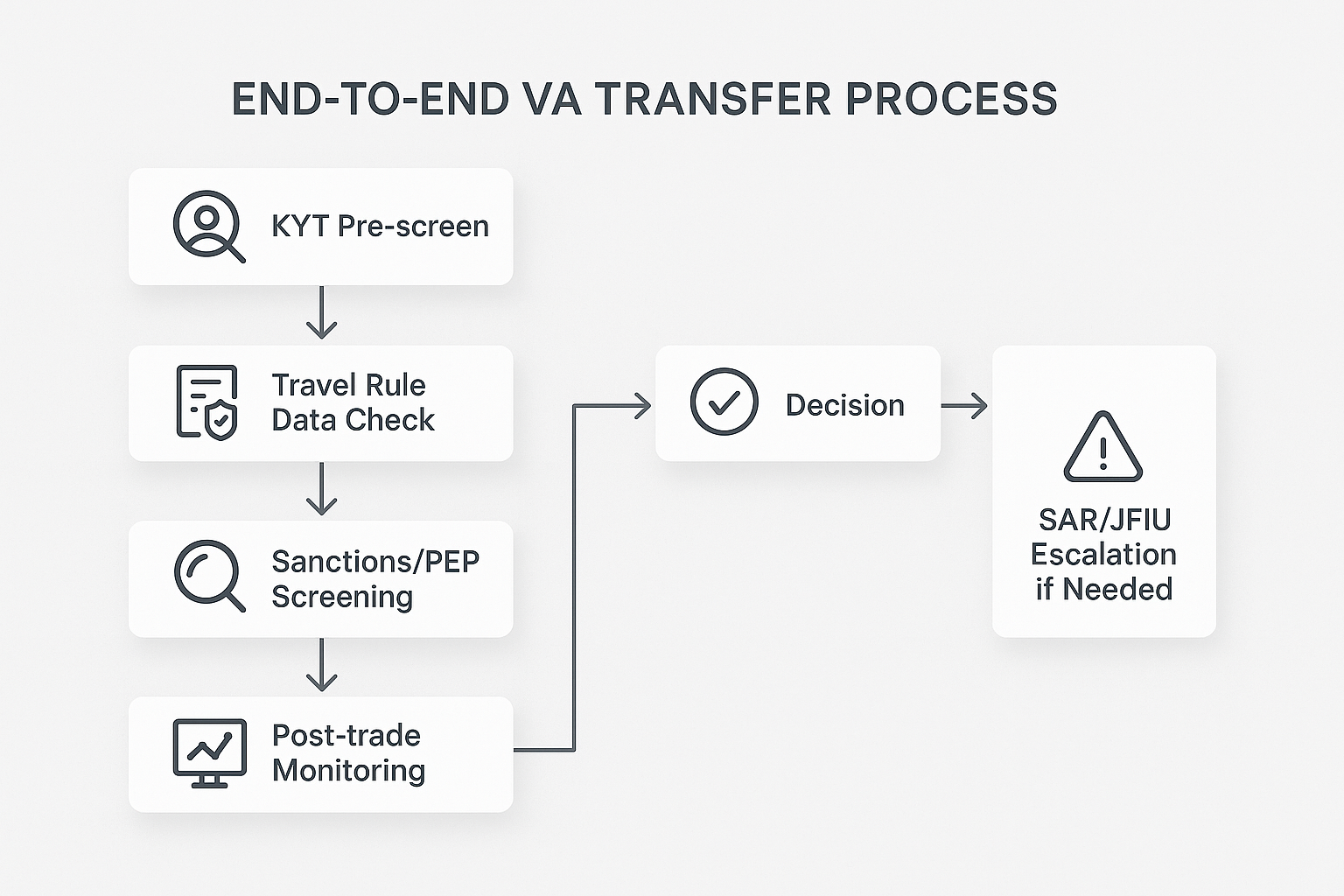
Travel Rule: practical implementation for HK VASPs HK aligns with FATF’s Travel Rule. The HKMA has reiterated that the Travel Rule is a key AML/CFT requirement; even if you’re not the ordering or beneficiary institution in a stablecoin transfer, you should manage the associated AML/CTF risks consistent with the Rule’s intent.
Core expectations:
- Collect and transmit originator and beneficiary information for qualifying VA transfers between VASPs.
- Use secure Travel Rule messaging (e.g., IVMS 101 schema via interoperable TRSPs).
- For unhosted wallets:
- Perform enhanced due diligence where risk dictates (proof-of-control, micro-transfers).
- Document risk decisions when full Travel Rule data cannot be transmitted.
- Handle “sunrise” gaps:
- If the counterparty VASP cannot receive Travel Rule data, record attempts, apply risk-based limits or manual holds, and consider rejecting where residual risk is high.
SFC VATP, brokers, OTC — who must do what
What to do now
- Map your flows: Identify every transfer path (on/off-ramp, intra-platform, cross-chain). Document which are VASP-to-VASP versus to unhosted wallets.
- Close Travel Rule gaps: Select interoperable TRSPs, implement IVMS 101, create fallback procedures for non-compliant counterparties.
- Harden KYT: Add second analytics provider, define escalation SLAs, and tune thresholds quarterly.
- Prepare for OTC licensing: If you operate OTC, align onboarding, KYT and Travel Rule now to AMLO-grade standards.
- Custody readiness: Track the upcoming custodian regime; ensure segregation, reconciliations, and insolvency-remote structures match SFC expectations.
The window for “best effort” has closed. Build controls you can defend — with data, evidence, and clear decisioning — before the auditors and supervisors ask.