KYT & Source of Funds for VASPs: HK Compliance Guide

Introduction KYT and Source of Funds are no longer “good-to-have” extras for Hong Kong VASPs. They sit at the center of your licence viability and banking access. With FATF Recommendation 15 requiring regulation of VASPs, Hong Kong’s AMLO framework now expects transaction-level monitoring and robust evidence for where customer funds come from—especially around stablecoin flows and unhosted wallets.
Why this matters now in Hong Kong
- Policy direction: FATF’s Recommendation 15 sets the baseline, and Hong Kong implements it through the AMLO (Cap. 615) and SFC’s VATP regime. See FATF’s Recommendation 15 and AMLO’s Schedule 2 for CDD obligations.
- SFC/VATP custody expectations: For SFC‑authorised funds investing in VAs, trustees/custodians may delegate VA safekeeping only to an SFC‑licensed VATP, a bank, or a subsidiary of a locally incorporated bank. That bar is a signal for custody standards across the market.
- Stablecoin controls: Hong Kong’s stablecoin policy work emphasises that FIs and VASPs offering custodial wallets to stablecoin holders must implement stronger AML/CFT, and apply additional controls for unhosted wallets. Some jurisdictions require identification/verification of any stablecoin holder at launch—expect Hong Kong to stay conservative on this axis.
- Custodian perimeter: The Government has consulted on bringing virtual asset custodian services into a direct regulatory net. If you custody client assets—even without operating an exchange—plan for fit-and-proper, segregation, SOC‑level controls, and ongoing AML testing.
Links:
- FATF Recommendation 15: https://www.fatf-gafi.org/en/recommendations/rec15.html
- AMLO (Cap. 615): https://www.elegislation.gov.hk/hk/cap615
- SFC VATP regime overview: https://www.sfc.hk/en/Rules-and-standards/Virtual-asset-trading-platforms
- FSTB consultation page (for policy updates): https://www.fstb.gov.hk/en/public/consultation/index.html
Know Your Transaction (KYT): what “good” looks like Your KYT should do three things well: see the full VA transfer context, rate risk in near real-time, and trigger the right control quickly.
- Data capture: Originating/beneficiary VASP details (Travel Rule), wallet ownership assertions, chain analytics risk tags, protocol type (DEX, mixer, bridge), and cross‑chain paths.
- Detection: Flags for exposure to sanctioned services, ransomware, darknet, mixers/tumblers, peel chains, newly created/self‑funded wallets, high‑velocity hop patterns, and cross‑jurisdiction routing.
- Decisioning: Auto‑clear low‑risk, pause and escalate medium/high, and hard‑block where policy requires (e.g., sanctioned addresses).
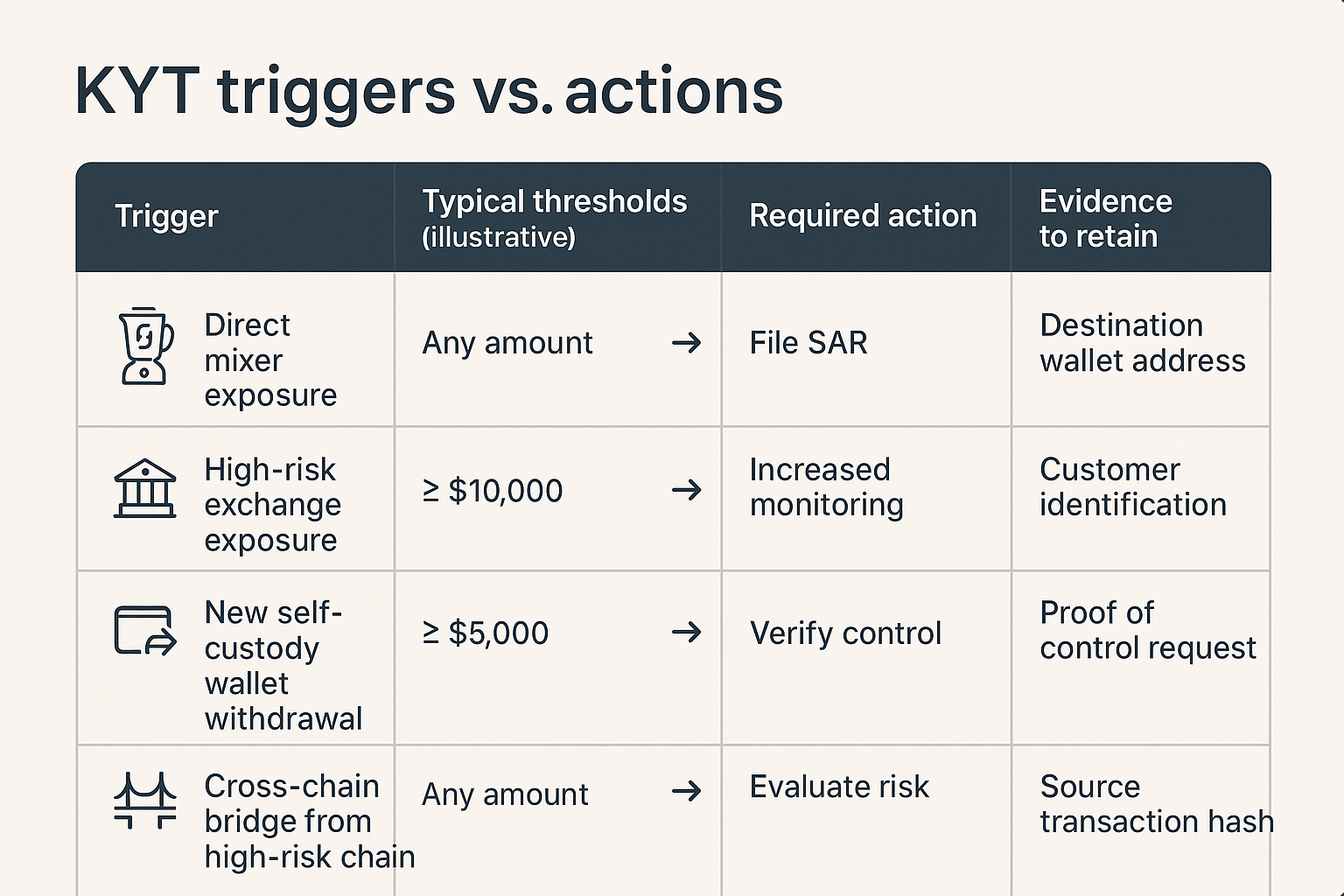
Source of Funds (SoF) vs Source of Wealth (SoW): get the basics right
- SoF: Where this specific deposit or trading float came from. Evidence must be current and transaction‑linked.
- SoW: How the customer accumulated their overall wealth. Evidence is broader and more static.
For retail and SME clients, most issues come from weak SoF. Collect documents that match the crypto reality.
Stablecoin custody and unhosted-wallet risk mitigation If you provide custodial wallets for stablecoin holders, assume higher expectations:
- Holder identification: Apply KYC to all holders. Avoid “KYC‑lite” even for low balances.
- Segregation and reconciliation: Daily stablecoin supply reconciliation at wallet level; variances explained within T+1.
- Unhosted wallet controls:
- Withdrawal allowlisting with address ownership proof (message signing or Satoshi test transfers).
- Per‑address and per‑day limits until provenance is established.
- KYT screening on inbound/outbound, including bridge paths and issuer blacklists.
- Refuse deposits from privacy‑enhancing tools until EDD completed.
What to do this quarter
- Implement a Travel Rule‑aware KYT pipeline that ingests both VASP‑to‑VASP metadata and on‑chain analytics.
- Add an SoF checklist to onboarding and triggering events (e.g., cumulative deposits over HKD [illustrative] 100,000, or any unhosted‑wallet interaction).
- Formalise an “unhosted wallet playbook”: verification steps, thresholds, cooling‑off periods, and approval levels.
- Run a custodial wallet gap‑assessment against SFC custody expectations—even if you’re not an SFC‑authorised fund service provider.
- Prove it: keep audit‑ready artefacts (risk scores, memos, approvals, Travel Rule payloads) for at least 6 years.
One last point KYT without solid SoF is noisy. SoF without KYT is blind. You need both.