Hong Kong VASP Registration: FATF AML/CFT Compliance

Hong Kong VASP Registration: FATF AML/CFT Compliance, without the guesswork
If you’re applying (or planning) for a Hong Kong virtual asset licence, the real exam isn’t the application form. It’s whether your AML/CFT program actually matches FATF’s standard — because that’s the yardstick the SFC and future VA regulators will use.
What FATF really expects
- Since 2019, FATF Recommendation 15 requires jurisdictions to regulate VASPs for AML/CFT, with supervision and enforcement, not just guidance. See Recommendation 15 and its Interpretive Note from FATF.
- VASPs must meet the same AML/CFT obligations as financial institutions and DNFBPs: risk assessment, CDD, ongoing monitoring, record keeping, suspicious transaction reporting, sanctions screening, and the Travel Rule.
- Hong Kong has implemented this through the Anti-Money Laundering and Counter-Terrorist Financing Ordinance (Cap. 615) and SFC rules for Virtual Asset Trading Platforms (VATPs). The SFC regime began in June 2023 and requires a licence, a fit-and-proper test, and robust AML/CFT and investor protection systems. The SFC can supervise, investigate and intervene.
Where Hong Kong is today (2025 snapshot)
- VATPs: In force. Licence required with the SFC. See SFC’s Guidelines for Virtual Asset Trading Platform Operators and Cap. 615 on Hong Kong e-Legislation.
- OTC VA providers: Government has consulted on regulating OTC providers to address ML/TF risks in line with FATF, including CDD and record-keeping obligations. Expect a licensing/registration architecture with active supervision.
- VA custodians: Government has also consulted on a regime to license or register custodians, imposing the full AML/CFT suite equivalent to financial institutions.
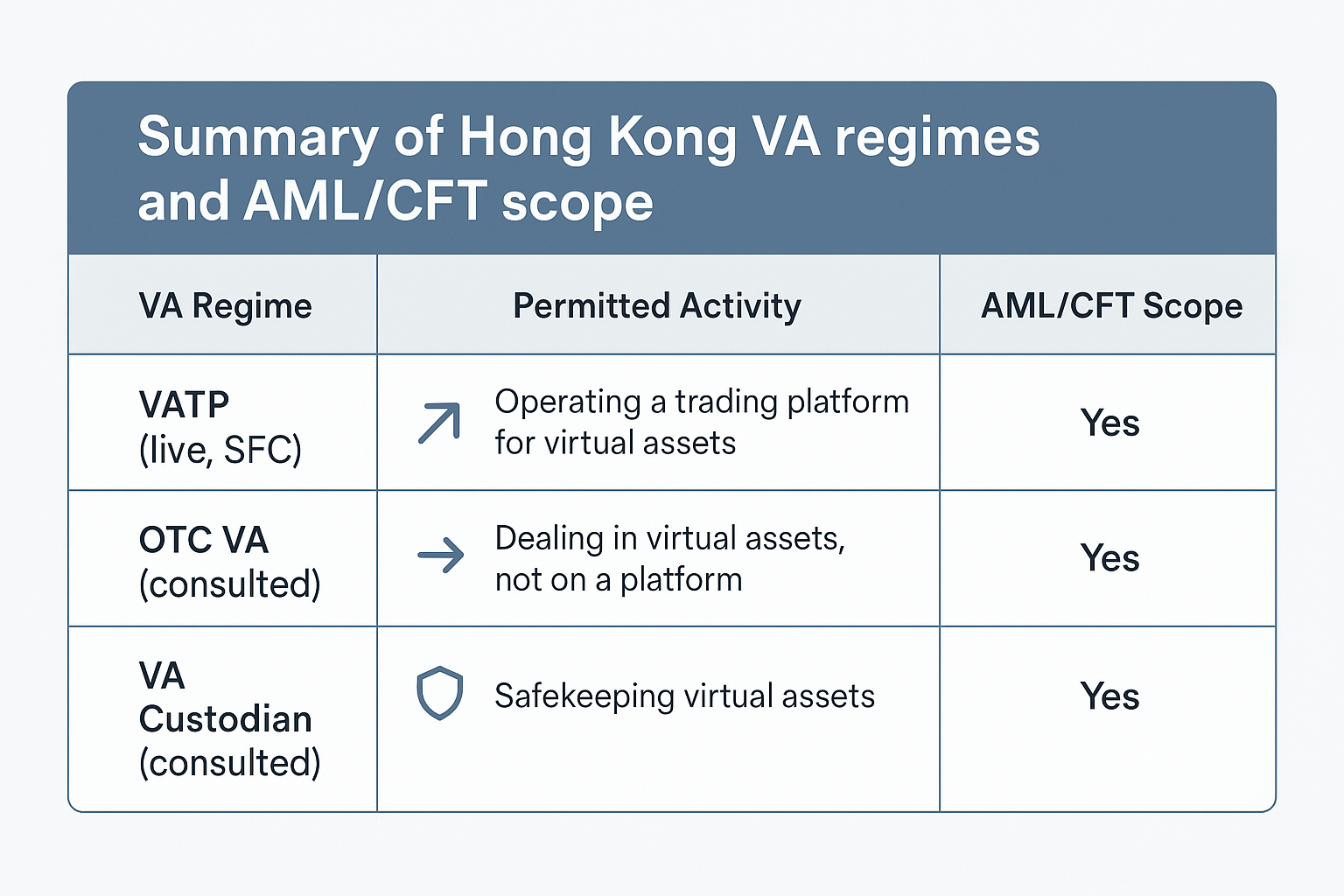
- VATP (live, SFC): Licence; full AML/CFT obligations; fit-and-proper; Travel Rule; investor protection; SFC supervision/enforcement.
- OTC VA (consulted): Proposal to bring providers into AML/CFT perimeter; CDD, record keeping, ongoing monitoring; supervisory powers anticipated.
- VA Custodian (consulted): Proposal to license/register custodians; full AML/CFT equivalent to FIs/DNFBPs; ongoing supervision.
What founders should lock down before (or alongside) registration
- Enterprise-wide ML/TF risk assessment: Document VA product risks (spot, P2P, OTC channels), geographies, and customer segments. Tie controls to risks. Update at least annually or upon material change.
- CDD with risk-based tiers:
- Simplified: low-risk retail with low velocity/limits.
- Standard: full KYC, PEP/sanctions screening, source-of-funds.
- Enhanced: SOW/SOF verification for high-risk (e.g., offshore corporates, mixers exposure, high-value OTC). Keep records for at least 6 years.
- Travel Rule compliance: Implement interoperable Travel Rule messaging for VA transfers and document counterparty VASP due diligence (onboarding questionnaires, public registry checks, sanctions/ownership checks). Maintain fail-closed logic for missing beneficiary/sender data except for documented, risk-managed exceptions.
- On-chain risk controls: Use blockchain analytics to flag exposure to sanctioned addresses, mixers, darknet markets, and hacked funds. Calibrate thresholds (e.g., auto-hold at “High” risk; manual review at “Medium”) and show evidence of outcomes.
- Ongoing monitoring: Scenario testing with illustrative thresholds (e.g., rapid in-and-out within 24 hours over HKD 100,000; address reuse across multiple customers; unusual cross-chain hops). Evidence of alert tuning and model governance matters more than glossy dashboards.
- Governance and independence:
- MLRO with authority and escalation rights.
- Independent AML audit (internal or external) at least annually.
- Training tailored by function — KYC, trading, custody, customer support — not a one-size slide deck.
- Reporting and record keeping: STR filings to the JFIU; keep CDD/transaction records for 6+ years; preserve Travel Rule payloads with a tamper-evident approach.
- Third-party management: Written oversight over KYC vendors, Travel Rule providers, and custodians. Contractual SLAs, KPIs, breach/exit clauses, and data localization/transfer assessments.
A note on fit-and-proper The SFC will test culture as much as controls. Expect questions on how the Board reviews AML metrics, what happens when revenue conflicts with compliance (show minutes), and how you would offboard a profitable but risky client.
Bottom line Hong Kong is aligning VA rules with FATF — VATPs already live under SFC; OTC and custodians are next. Build to the full FATF standard now and you’ll pass both the licence test and the day-2 supervision test.
Helpful links:
- FATF Recommendation 15 (Virtual Assets and VASPs): https://www.fatf-gafi.org/en/publications/Fatf-recommendations/Recommendation15.html
- Anti-Money Laundering and Counter-Terrorist Financing Ordinance (Cap. 615): https://www.elegislation.gov.hk/hk/cap615
- SFC Guidelines for Virtual Asset Trading Platform Operators: https://www.sfc.hk/en/Rules-and-standards/Policies-and-codes/Guidelines/Guidelines-for-Virtual-Asset-Trading-Platform-Operators
- Joint Financial Intelligence Unit (JFIU) STR guidance: https://www.jfiu.gov.hk/eng/str.html
If you’re unsure whether your current framework would stand up in an SFC inspection, start with an independent gap assessment against FATF and Cap. 615, then remediate with evidence, not promises.