
Hong Kong RWA & VASP Compliance 2025 | StanCOMP

Introduction: What changed for RWA and VASPs in 2025 Hong Kong just tightened the nuts and bolts around virtual assets while opening more product pathways. The SFC’s ASPIRe roadmap (February 2025) signals support for staking, borrowing/lending and derivatives. At the same time, government consultations move to license dedicated virtual asset custodians and bring VA OTC under a fit‑for‑purpose regime. If you touch real‑world assets (RWA), stablecoins, or custody, your operating map in 2025 is clearer—and stricter.
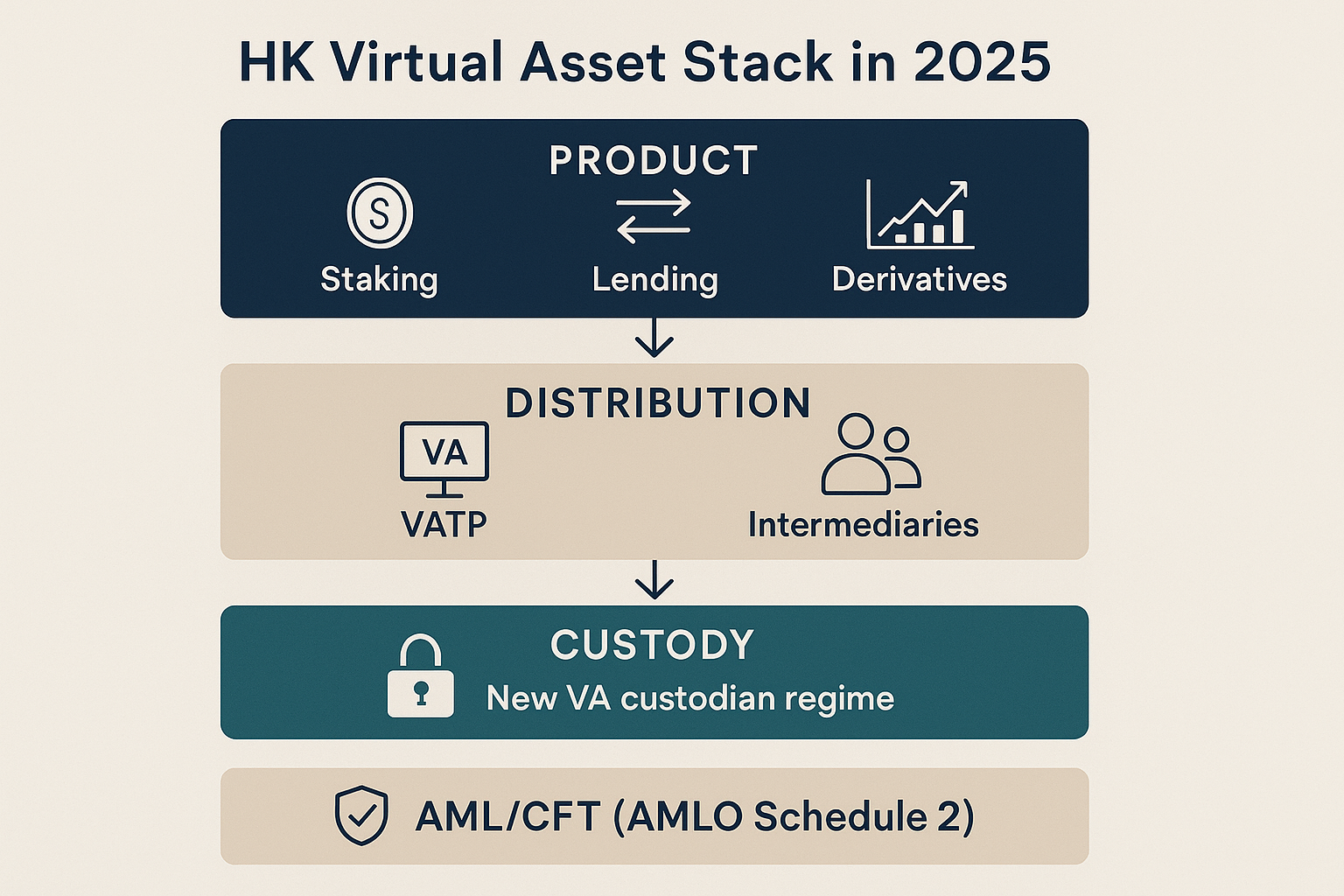
The headline rules to anchor on
- ASPIRe (SFC, Feb 2025): Opens the door for more VA products (staking, lending/borrowing, derivatives) under tighter investor protection and risk controls. See SFC policy updates: https://www.sfc.hk/en/News-and-announcements/Policy-development
- VA custodian regulation: Proposed licensing/registration for dedicated virtual asset custodians, with explicit obligations to comply with AMLO Schedule 2 (CDD and record‑keeping) and other prudential/custody controls. Consultation docs: https://www.fstb.gov.hk/en/financial-services/policy-documents/consultations.html and AMLO: https://www.elegislation.gov.hk/hk/cap615
- Stablecoin custodial wallets: If a financial institution (FI) or VASP provides custodial wallets to stablecoin holders, expect additional safeguards and controls for interactions with unhosted wallets, per the latest stablecoin consultation conclusions.
- VA OTC: Proposed regime borrows from VATP and MSO playbooks—require a competent Compliance Officer and MLRO, system and security incident controls, and full AML/CFT. See FATF VASP expectations: https://www.fatf-gafi.org/en/publications/Virtual-Assets.html
Where RWA fits—and the traps Most tokenised RWAs marketed in Hong Kong will be “securities” under the SFO. This means:
- Distribution: Type 1 (dealing) and possibly Type 4/9 (advising/asset management) licensing for intermediaries; VATP licence if you operate an order‑book platform for VA “securities.”
- Custody: Either use your own SFC‑licensed/VASP‑authorised custody stack (once the VA custodian regime commences) or appoint an appropriately licensed third party. Expect segregation, reconciliations, key management governance, and incident reporting standards aligned with the custodian consultation.
- Investors: Professional Investor gating for complex VA/RWA products remains the safe default unless and until the SFC explicitly widens retail access under ASPIRe.
Designing custody and wallet controls that pass scrutiny
- Segregation: Legal and on‑chain segregation of client assets; daily reconciliations; cold/warm/hot thresholds (illustrative: ≤2% hot, ≤10% warm).
- Key management: MPC/HSM, dual controls, emergency key rotation; board‑approved key ceremonies.
- Unhosted wallets: Source‑of‑funds/wealth triggers, allowlist/denylist logic, enhanced monitoring for stablecoin inflows/outflows, and Travel Rule implementation (data capture and secure transmission) between VASPs.
- Incident readiness: 24/7 monitoring, breach playbooks, and mandatory notifications within tight SLAs (set and rehearse them; illustrative target: T+24h internal, T+48h regulator/client).
If you run a VA OTC desk
- Prepare for licensing with CO and MLRO designations, VATP‑style conduct rules for product risk disclosures, and MSO‑style fiat on/off‑ramp controls.
- Implement robust screening (wallet, counterparty, sanctions), fair pricing disclosures, and surveillance for wash trading and layering.
- Build capacity for resilience and breach reporting; regulators will expect forensics‑grade logs.
A 90‑day execution plan (practical, founder‑friendly)
- Map licences: RWA issuance/distribution (SFO Types 1/4/9), VATP, future VA custodian, and MSO if you move fiat.
- Policies uplift: Align CDD/EDD and record‑keeping with AMLO Schedule 2; codify Travel Rule workflows.
- Custody architecture: Select MPC/HSM provider, define hot/warm/cold policy, test key ceremonies, and document segregation.
- Product governance: Define eligibility (PI vs retail), disclosures for staking/lending/derivatives per ASPIRe.
- Outsourcing: Paper vendor risk assessments, exit plans, and right‑to‑audit clauses for custodians/tech vendors.
One final point ASPIRe gives you a bigger canvas. But the paint—AML/CFT, custody hygiene, and investor protection—must be immaculate.
If you want a fast, defensible build, StanCOMP can pressure‑test your licensing map and custody design, and help you stand up AMLO Schedule 2 controls without over‑engineering.


