
Hong Kong Compliance: KYT, Tokenised Securities & Custody

Introduction: why this matters now Hong Kong has moved from pilots to plumbing. If you’re running a VASP, a tokenisation project, or a custody stack in 2025, three themes now decide whether you get licensed and banked: Know Your Transaction (KYT), compliant tokenised securities, and custody with real segregation. The policy direction is clear: align with IOSCO/FSB/Basel standards and wire Hong Kong into OECD CARF for tax transparency under the Government’s Policy Statement 2.0 on digital assets.
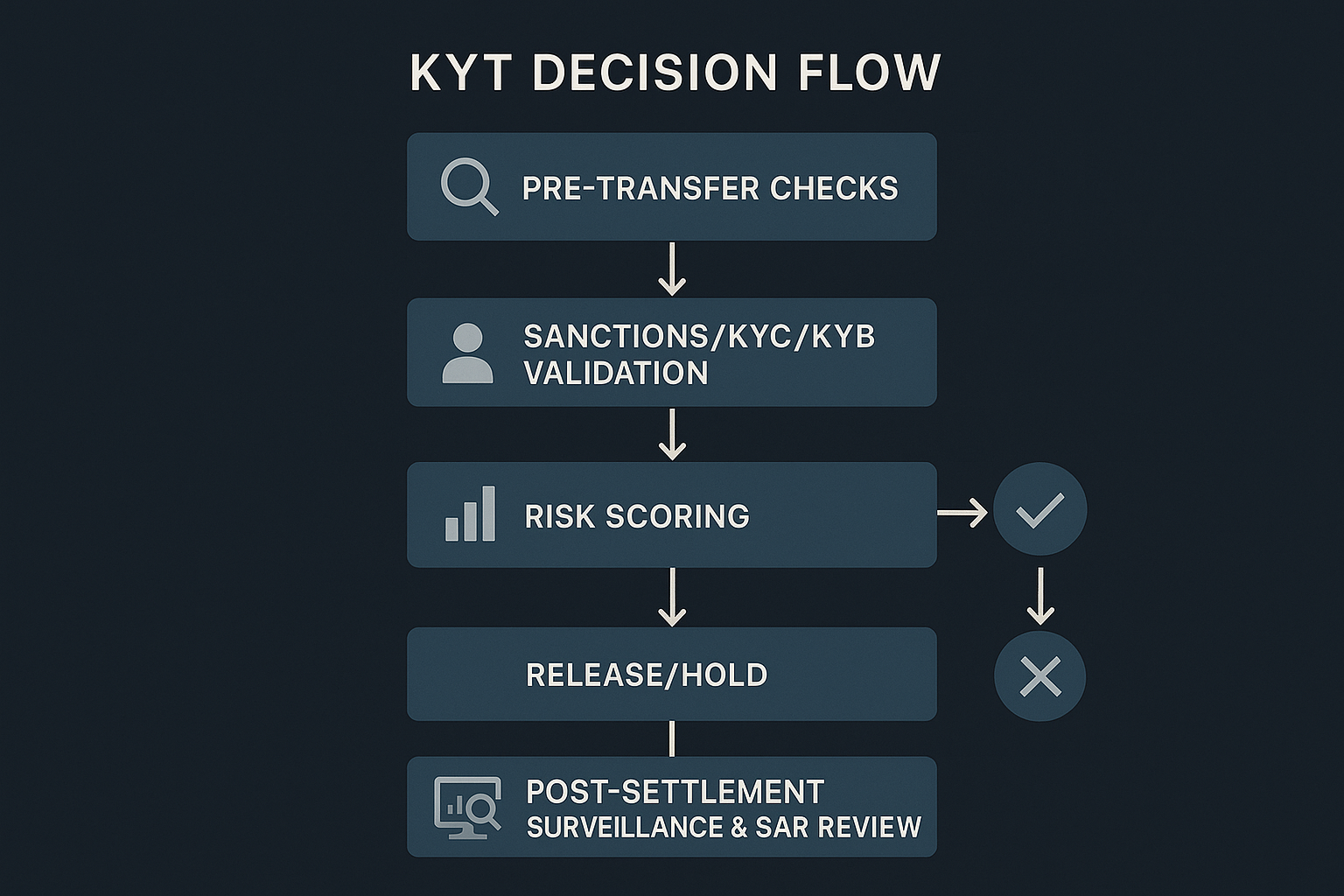
KYT in practice: from Travel Rule to stablecoin-specific data KYT is no longer just “on-chain analytics.” It’s the connective tissue across AML/CFT, sanctions, and fraud defences.
- Stablecoin transfers: The latest Hong Kong stablecoin AML/CFT consultation conclusions make it explicit that transfer messages should carry essential originator/beneficiary information to support monitoring, sanctions screening, and risk mitigation. That means building message standards and data validation comparable to wire transfers, even when settlement is on-chain.
- Custodial vs unhosted wallets: Expect extra controls when customers interact with unhosted wallets (e.g., proof-of-ownership checks, test transactions, restricted assets lists), and full Travel Rule compliance when transfers are between regulated entities.
- OECD CARF readiness: CARF will push you to reconcile on-chain flows with reportable user data. Map addresses to legal accounts, maintain audit trails, and preserve evidentiary quality logs.
Tokenised securities: structure beats sizzle Policy Statement 2.0 highlights a legal and regulatory review on tokenisation of RWAs and financial instruments. For issuers and intermediaries, this means:
- Treat the token as a security first: Apply SFO licensing where relevant (Type 1/4/6/9), and follow SFC tokenised securities guidance for issuance, distribution, and dealing. Avoid “utility” labels when the economics look like debt/equity.
- Books-and-records parity: Your token ledger must reconcile with registrars/CSDs and corporate actions. Settlement finality and investor rights cannot rely on “best efforts” code.
- Distribution controls: Primary and secondary flows must respect selling restrictions, suitability, and disclosure standards. If you’re running a platform, align to the SFC VATP framework.
- International baselines: Design controls consistent with IOSCO’s crypto-asset market recommendations, FSB’s global framework for crypto activities, and Basel’s prudential treatment where banks are involved in exposure or custody.
Crypto custody standards: segregation that actually protects The public consultation on virtual asset custodians zeroes in on investor protection via safekeeping with segregation, robust audit, records, and comprehensive AML/CFT. Also, stablecoin issuers licensed by the HKMA who custody their own coins will be supervised on an ongoing basis.
What this means operationally:
- Legal segregation: Client assets off balance sheet, trust or client asset account structure, and insolvency-remote arrangements spelled out in T&Cs.
- Technical segregation: Distinct key sets per client or omnibus-with-sub-ledger, daily on-chain reconciliation, and MPC/HSM with dual control.
- Governance: Independent custody function, SOC 2 Type II or equivalent, penetration testing, and incident playbooks that regulators can audit.
- Access and change control: Four-eyes for key ceremonies and withdrawals; tamper-evident logs retained for 7+ years (illustrative).
Quick mapping: requirement to control
| Regulatory pointer | What to implement now |
|---|---|
| Stablecoin AML/CFT transfer data | Enforce Travel Rule-compliant messages; reject transfers lacking originator/beneficiary fields; automated sanctions screening pre- and post-settlement. |
| Unhosted wallet risk | Ownership attestation, micro-deposit tests, higher KYT thresholds, restricted jurisdictions, manual review above set limits (e.g., HKD 50,000, illustrative). |
| Investor protection—segregation | Legal trust framework + wallet-level segregation; daily reconciliations; independent audits; client-level statements with on-chain proofs. |
| OECD CARF | Data model linking addresses to account holders; event logs for acquisitions/disposals; annual reporting workflows with QA checks. |
| IOSCO/FSB/Basel alignment | Risk taxonomy for market/operational/liquidity risks; stress tests for redemptions; capital and insurance cover policies. |
What to do this quarter
- KYT uplift: Integrate Travel Rule gateways and stablecoin message fields; tune risk models for layering via bridges and mixers.
- Tokenisation controls: Lock a registrar-reconciliation process and settlement finality policy; pre-clear offering docs with SFC counsel.
- Custody hardening: Move to MPC with geo-distributed shards; implement withdrawal cool-downs and address whitelists; commission an external audit.
- CARF prep: Build a single source of truth for wallet-to-customer mapping and start dry-run reporting.
Regulators will forgive speed. They won’t forgive sloppiness.
References and further reading
- Hong Kong Policy Statement 2.0 on Digital Assets – emphasis on tokenisation review and international alignment.
- OECD Crypto-Asset Reporting Framework (CARF): https://www.oecd.org/tax/automatic-exchange-of-financial-account-information/crypto-asset-reporting-framework/
- SFC Virtual Asset Trading Platforms regime: https://www.sfc.hk/en/Rules-and-standards/Virtual-asset-trading-platforms
- IOSCO recommendations for crypto and digital asset markets: https://www.iosco.org/library/pubdocs/pdf/IOSCOPD740.pdf
- FSB global regulatory framework for crypto-asset activities: https://www.fsb.org/2023/07/fsb-publishes-global-regulatory-framework-for-crypto-asset-activities/
- Basel Committee’s prudential treatment of cryptoasset exposures: https://www.bis.org/bcbs/publ/d545.htm
If you want a 2-hour gap analysis against these pillars (KYT, tokenised securities, custody), we can deliver a punch-list you can execute within 30 days.


