
Hong Kong Compliance: Fiat & Wholesale Stablecoins 2025

Hong Kong Compliance: Fiat & Wholesale Stablecoins 2025
If you’re building stablecoin rails in Hong Kong this year, two themes matter most: (1) AML/CFT controls around custody and redemptions, and (2) how “wholesale” stablecoins fit into institutional settlement alongside CBDCs and tokenised deposits. The regulators are signalling openness—but only if controls are watertight.
What’s changed in 2025: clearer AML/CFT expectations
- The Government’s Policy Statement 2.0 welcomes market proposals to test licensed stablecoins in real payment flows, even for government disbursements, to address real‑world pain points. See the public stance on supporting stablecoin and tokenisation projects and payment use cases.
- Consultation conclusions on AML for stablecoins emphasise two pillars: due diligence on institutions (FIs or VASPs) providing custodial wallets for customers, and additional controls for unhosted wallets. This aligns with the BIS’s warnings on stablecoin vulnerabilities to ML/TF and sanctions evasion, and the FATF’s guidance on risks from unhosted wallets due to anonymity and mobility.
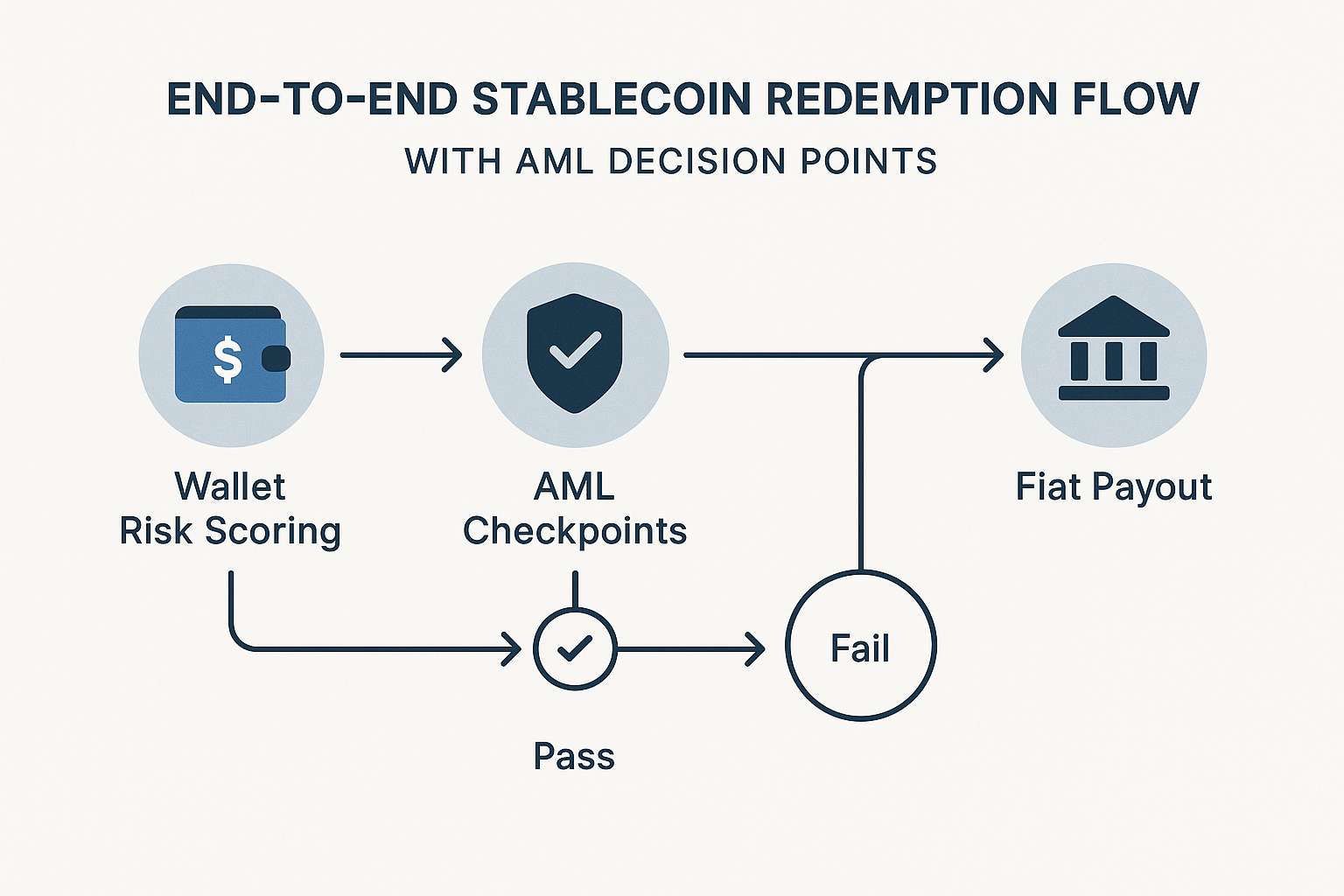
- Practically, this means VASPs and FIs must harden onboarding, wallet-risk management, and redemption workflows—especially where redemptions can be abused as cash-out channels.
Fiat-backed stablecoins: licensing, custody, redemption
- Licensing landscape: Expect coordination between the SFC (VASPs) and HKMA (payment/settlement and prudential aspects). The SFC’s VASP regime already covers platform operators; HKMA’s earlier discussions on crypto-assets and stablecoins foreshadow prudential requirements (reserves, governance, redemption). Don’t launch assuming “payments only” equals “no licence.”
- Redemption is the control choke point: The consultation conclusions point to due diligence on the custodial wallet provider and specific measures for unhosted wallets during redemption. Build tiered redemption limits, source‑of‑funds/source‑of‑stablecoin checks, sanctions screening, and on-chain analytics before fiat is released.
- Reserves and disclosure: Daily backing tests, monthly reserve attestations, and clear redemption SLAs are becoming table stakes. If you quote “T+1” redemption, measure it and publish actuals (e.g., “Last quarter: 98.7% T+1 redemptions” – illustrative).
Wholesale stablecoins: where they fit Wholesale stablecoins—tokenised claims used by regulated institutions for settlement—sit alongside two adjacent rails:
- mBridge-style wholesale CBDC for cross-border settlements (with HKMA/BIS).
- Tokenised deposits for on-chain settlement inside banks’ balance sheets.
If you issue or use a wholesale stablecoin in Hong Kong:
- Structure: Ring-fence issuance to licensed institutions with bilateral or tri-party legal agreements; define insolvency treatment and segregation of client assets.
- Interoperability: Design with programmability hooks for delivery-versus-payment (DvP) with tokenised securities and PvP with FX legs.
- Compliance-by-design: Embed Travel Rule messaging, counterparty whitelisting, and chain analytics into the mint/burn and transfer functions. No clean data, no transfer.
Custodial vs unhosted wallets: what regulators expect
| Wallet type | Who holds keys | Hong Kong expectation (AML/CFT) | Controls you should implement |
|---|---|---|---|
| Custodial | FI/VASP | Full CDD on the customer; ongoing monitoring of wallet activity | KYC refresh, transaction monitoring tuned to stablecoin typologies, sanctions screening on addresses and issuers, redemption gating tied to risk scores |
| Unhosted | End-user | Additional controls due to anonymity/mobility risks (per BIS/FATF signals) | Counterparty address risk scoring, allowlist/denylist, lower limits, enhanced SOW/SOF at redemption, Travel Rule data collection via address ownership proofs |
What to do now (practical checklist)
- Licensing analysis: Map activities to SFC VASP scope and HKMA oversight (issuance, custody, payments). Document your position and pre‑consult with regulators before pilot launch.
- Wallet risk policy: Define when unhosted wallets are allowed, under what limits, and what extra data is required. Bake this into terms and product design.
- On-chain controls: Integrate blockchain analytics; auto-block sanctioned or high‑risk addresses; maintain audit trails for Travel Rule compliance.
- Redemption controls: Tie fiat release to successful KYC/KYB, proof of stablecoin provenance, and screening outcomes. Implement cooling-off/circuit breakers for anomalous flows.
- Disclosure: Publish reserve composition, attestation cadence, and redemption performance. Surprises kill trust.
One final point. Regulatory openness in Hong Kong is real—but it’s conditional on rigorous controls at the custody and redemption layers. Build those in from day one and you’ll be invited into the pilots that matter.
References and further reading
- FATF Guidance for a Risk-Based Approach to Virtual Assets and VASPs: https://www.fatf-gafi.org/en/publications/VirtualAssets/Guidance-RBA-VA-VASP.html
- SFC VASP licensing overview: https://www.sfc.hk/en/permits/licensing/virtual-asset-trading-platforms
- HKMA discussion on crypto-assets and stablecoins (background): https://www.hkma.gov.hk/eng/news-and-media/press-releases/2023/01/20230131-5/
- BIS mBridge overview: https://www.bis.org/about/bisih/topics/cbdc/mbridge.htm
- Hong Kong AMLO (Cap. 615): https://www.elegislation.gov.hk/hk/cap615


