
Hong Kong Compliance: ESG Tokens, CBDC & Stablecoins

Hong Kong Compliance: ESG Tokens, CBDC & Stablecoins
Hong Kong’s “Policy Statement 2.0” on digital assets puts three themes in the same lane: legal clarity (“L”), more tokenised products (“E”), and practical rails for stablecoins and CBDC. If you’re building ESG tokens, experimenting with e-HKD, or using stablecoins for settlement, the direction is clear: structure tokens to be regulator-ready, prove the data, and bake AML in from day one.
The policy anchor: “L” and “E” in 2025
- “L” – Legal and regulatory streamlining: unified oversight and a legal review on tokenisation to close gaps between securities, payments, and trust law. Expect more explicit expectations on disclosures, custody, and transfer restrictions for tokenised assets.
- “E” – Expanding tokenised products: regularising tokenised Government bond issuance and expanding real-world asset (RWA) tokenisation. Hong Kong has already executed two landmark tokenised Government green bond issuances to demonstrate the model, with more to follow as “regular issuance” becomes the norm.
- The Government also flags facilitation of stablecoin use cases and stronger cross-border collaboration—this is about real payment and settlement, not just pilots.
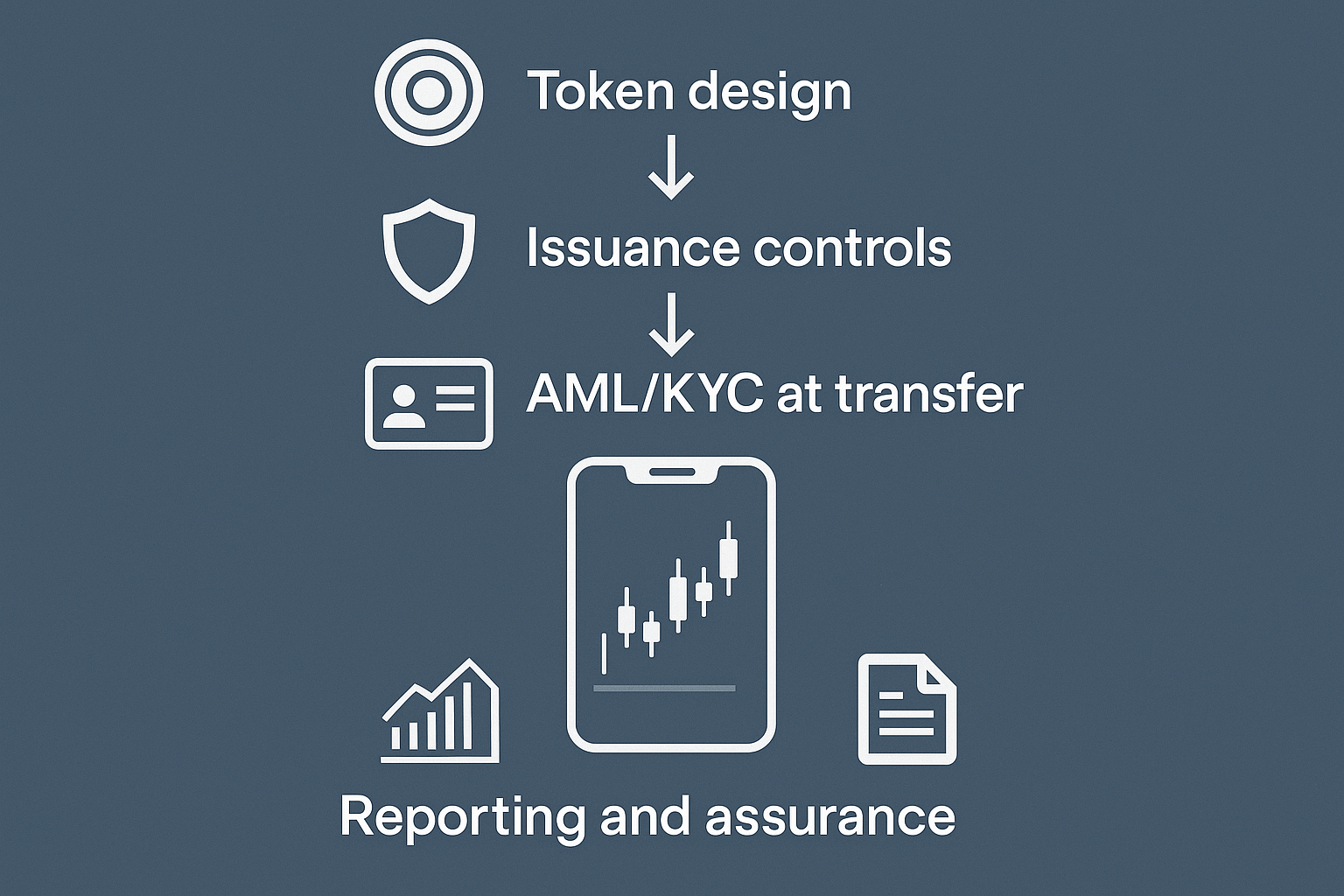
ESG-compliant token structures: what “good” looks like No regulator wants a pretty front-end masking unverifiable claims. The priority is traceability and auditability.
-
Evidence-first design
- Tie each token (or lot) to a verifiable asset: project ID, methodology, verifier, issuance date, serial number, and lifecycle status (issued/retired/cancelled).
- Align with accepted frameworks (for example: ICMA Green Bond Principles for use-of-proceeds, GHG Protocol/ISO 14064 for carbon data, and ISSB for disclosure alignment). Don’t over-claim equivalence—document it.
-
Transfer governance
- Embed transfer restrictions to KYC’d addresses; use allowlists and purpose-bound transfers where feasible.
- For secondary trading, ensure clear rules on fungibility, rescission/cancellation logic, and avoidance of double-counting (especially for environmental attributes like RECs or carbon).
-
MRV and attestation
- Store critical attestations on-chain (hashes) with signed off-chain reports; avoid mutable links without version controls.
- If you tokenise government or corporate green bonds, mirror the use-of-proceeds and impact reporting cadence already accepted in traditional markets.
CBDC (e-HKD) and tokenised bonds: practical intersections Hong Kong’s e-HKD workstream is exploring programmable payments, tokenised deposits, and settlement of tokenised assets—see HKMA’s e-HKD programme overview. Programmable settlement for tokenised government bonds is the near-term “killer” use case: delivery-versus-payment with atomicity and intraday finality. If you issue ESG-linked tokens or green bonds, design now for:
- Pay-to-conditions (escrowed disbursements when impact milestones are met).
- Interoperability with bank tokenised deposits and e-HKD test rails.
- Custody models that segregate keys, governance, and audit trails suitable for SFC/HKMA inspections.
Stablecoins: AML plumbing and treasury treatment
- AML obligations: Consultation conclusions on stablecoin AML emphasise that institutions participating in a transfer must receive essential data for transaction monitoring, sanctions screening, and risk mitigation (think Travel Rule-grade originator/beneficiary information with wallet identifiers and risk flags). Build APIs to exchange:
- Originator/beneficiary name, account/wallet ID, institution identifier.
- Jurisdiction, screening results, and purpose of transfer.
- Sanctions and adverse media hits (yes/no + reference).
- Accounting signal from the US: The SEC’s updated staff guidance (as reported by Bloomberg via The Block) indicates certain USD-pegged stablecoins could qualify as cash equivalents if there’s a guaranteed redemption mechanism. Helpful context—but under HKFRS/IFRS your auditor will still judge based on contractual rights and redemption certainty. Don’t reclassify without a memo and auditor sign-off.
What to do in the next 90 days
- Token design review: Map your ESG token metadata to the table above; add missing attestations and transfer controls.
- Legal wrapper: Confirm whether your token is a security, an environmental attribute, or a payment instrument under Hong Kong law; align offering docs and on-chain terms.
- AML integration: Implement Travel Rule-grade data exchange for stablecoin flows; test sanctions screening before mainnet.
- e-HKD readiness: Prototype programmable settlement with a bank partner or sandbox aligned to HKMA’s e-HKD track.
- Reporting pack: Prepare an assurance-ready bundle (methodology, verifier attestations, impact KPIs) on a quarterly cadence.
One final point: regularised tokenised government bonds are not a novelty—they are a compliance benchmark. Build to that bar, and most other doors open.
Useful links
- Hong Kong Monetary Authority – e-HKD overview: https://www.hkma.gov.hk/eng/key-functions/digital-currency/e-hkd/
- Securities and Futures Commission (tokenisation guidance hub): https://www.sfc.hk
- Financial Services and the Treasury Bureau (policy materials): https://www.fstb.gov.hk
- Coverage of SEC stablecoin guidance: https://www.theblock.co/


