
Hong Kong CBDC & KYT: Compliance Playbook 2025

Introduction: CBDC meets KYT, reality check for 2025 Hong Kong’s digital asset policy has moved from slides to shipping. With the e-HKD pilots expanding under the HKMA, Project mBridge edging toward production-grade cross-border settlement, and a stablecoin regime being readied for licensed issuers, compliance leaders now have to make Know Your Transaction (KYT) work across fiat, CBDC, and stablecoin rails—consistently.
The punchline: the controls don’t radically change, but the data does.
What regulators are signaling (and why it matters)
- CBDC and pilots: The HKMA’s e-HKD Pilot Programme is testing programmability and settlement of tokenised assets. Programmable payments mean programmable compliance. See HKMA’s e-HKD pilots: https://www.hkma.gov.hk/eng/key-functions/international-financial-centre/fintech/e-hkd-pilot-programme/
- Cross-border CBDC: BIS and the HKMA are core participants in Project mBridge, which focuses on wholesale CBDC for cross-border settlement with embedded compliance features. Reference: https://www.bis.org/about/bisih/topics/cbdc/mbridge.htm
- Stablecoin regime: Consultation conclusions on fiat-referenced stablecoins in Hong Kong emphasise that institutions participating in a stablecoin transfer must exchange essential information to enable transaction monitoring, sanctions screening, and risk mitigation. Expect Travel Rule-style payloads to be standardised for stablecoin.
- Market infrastructure: HKEX launched a Digital Asset index series to give Bitcoin/Ether benchmarks in Asian hours—useful for risk models and price-based surveillance.
- Enablement: Policy Statement 2.0 says “Digital Assets,” not “Virtual Assets,” and commits resources—e.g., Cyberport funding for Blockchain & Digital Assets pilots—to help serious teams commercialise tokenisation use cases.
The core playbook: KYT across CBDC and stablecoins
- Map the flows, not the logos
- Identify which rails you actually use: bank FPS, on-chain stablecoins, e-HKD sandbox wallets, or mBridge pilots.
- Draw a swimlane of message standards (ISO 20022, Travel Rule messages, stablecoin metadata) and where identity and sanctions checks occur.
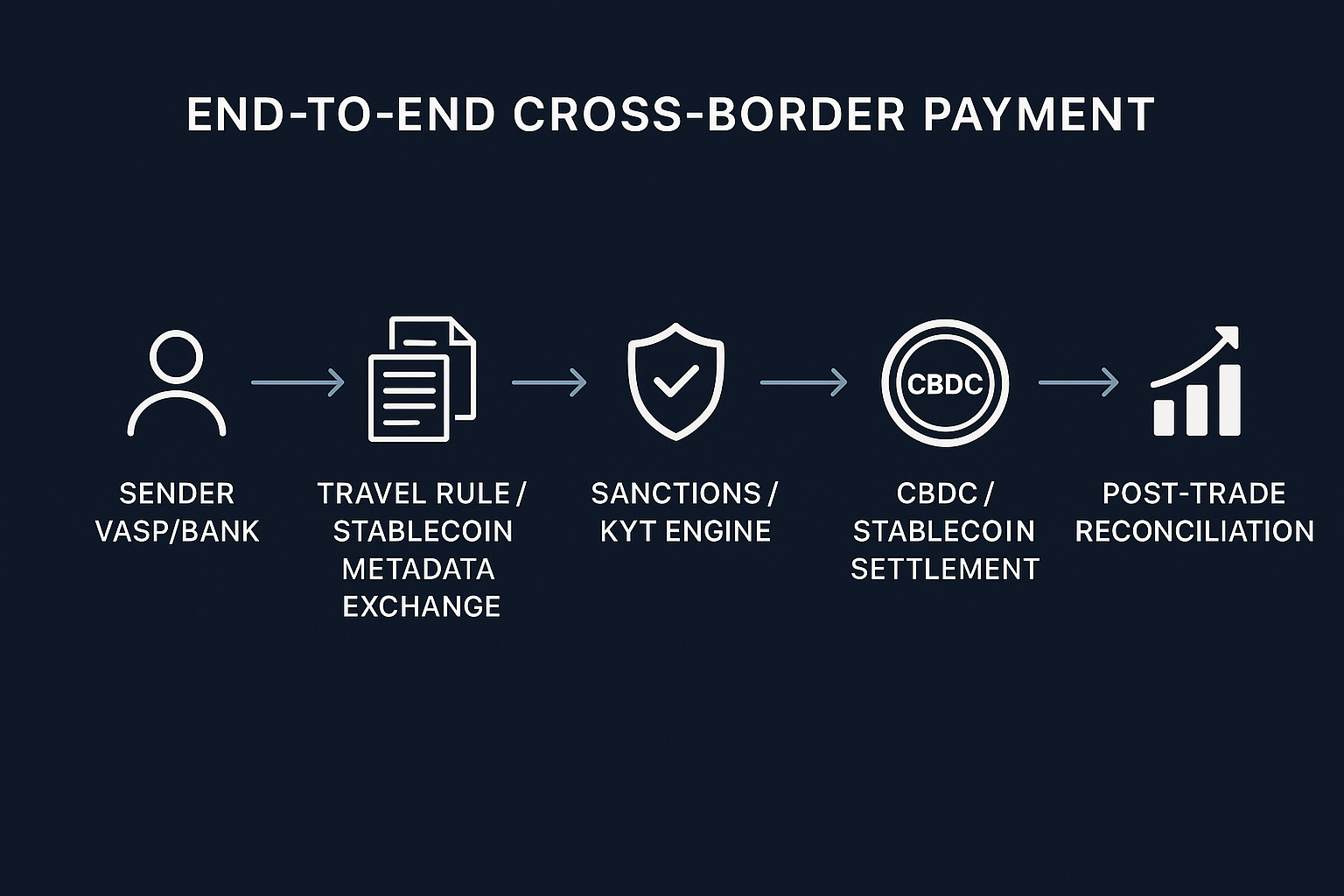
Generated diagram
- Standardise the data model Consultation conclusions point to a minimum info set accompanying stablecoin transfers. Mirror it for CBDC pilots so your analytics don’t fork.
- Column 1: Data element
- Column 2: Stablecoin transfer
- Column 3: CBDC (pilot e-HKD/mBridge) Rows:
- Originator/beneficiary legal name; Required via Travel Rule-style payload; Required via wallet/KYC registry reference
- Wallet/account identifier; Public address + VASP ID; CBDC wallet ID + institution ID
- Jurisdiction/country; Yes; Yes
- Sanctions screening results; Yes (UN, plus OFAC/EU as policy); Yes (UN, plus OFAC/EU as policy)
- Purpose code/payment reference; Strongly recommended; Native to programmable CBDC
- Licensing/registration status of counterpart; VASP/issuer status; Participating FI/CBDC node status
- Risk score + heuristics; On-chain + off-chain; Ledger-native + off-chain
- Build the real-time controls
- Sanctions and watchlist: Screen against UN Sanctions (Cap. 537) at minimum; layer OFAC/EU if your policy requires.
- On-chain analytics: Address clustering, indirect exposure tracing, and typology flags (e.g., mixer adjacency, smart-contract risk) within a sub-300ms decision budget for retail flows and sub-2s for B2B (illustrative targets).
- Programmable compliance: Use CBDC/stablecoin memo fields to pass purpose codes, invoice refs, or whitelist proofs. If allowed, embed rule checks pre-settlement.
- Evidence, or it didn’t happen
- Keep full KYT decision trails, Travel Rule payloads, and sanctions evidence for at least five years (AMLO record-keeping baseline).
- Reconcile ledger events with bank statements and node logs daily; variance threshold >0.05% by value (illustrative) should trigger review.
- Incident and counterpart governance
- Auto-interdict transfers with sanctioned exposure >0% (unless policy permits risk-based de minimis for false positives).
- Pre-clear counterparties: verify licensing/registration and Travel Rule readiness. For OTCs and custodians, test their message formats and fallback channels quarterly.
Near-term checkpoints in Hong Kong (2025)
- e-HKD pilots: Build pilots that test both programmability and KYT traceability end-to-end, not just wallet UX.
- Stablecoin licensing: Prepare for issuer/operator requirements—reserve attestations, segregated trust arrangements, and mandatory transaction data sharing.
- Market linkage: Use HKEX DA indices for time-zone-consistent pricing in surveillance models.
- Funding and partnerships: Tap Cyberport’s Blockchain & Digital Assets scheme to co-fund compliance-grade pilots with banks and payment firms.
Common pitfalls we’re seeing
- Travel Rule ≠ KYT. Travel Rule moves identity; KYT decides risk in context.
- “We screen the address” is not enough. You need path analysis, behavioral scoring, and smart-contract risk.
- No policy for CBDC metadata. Decide what you must log, what you may cache, and how to protect privacy before pilots scale.
Closing thought CBDC and stablecoins won’t replace AML—they’ll expose whether your AML works in real time. If you align your data model now and make programmability serve compliance, you’ll pass audits and ship faster when Hong Kong’s Digital Assets stack goes mainstream.
Useful references
- HKMA e-HKD Pilot Programme: https://www.hkma.gov.hk/eng/key-functions/international-financial-centre/fintech/e-hkd-pilot-programme/
- BIS Project mBridge: https://www.bis.org/about/bisih/topics/cbdc/mbridge.htm
- SFC rules for virtual asset trading platforms (context for Travel Rule/VASP obligations): https://www.sfc.hk/en/Rules-and-standards/Policy-and-circular-issues/Virtual-asset-trading-platforms/ Overview
- United Nations Sanctions Ordinance (Cap. 537): https://www.elegislation.gov.hk/hk/cap537/ Ordinance text


