
Hong Kong AML Workflows with AI: FATF 2030 Readiness

Hong Kong AML Workflows with AI: FATF 2030 Readiness
The FATF’s June 2025 signal was unambiguous: start gap analyses now and draft AML/KYC system updates with 2030 in mind. Hong Kong has already moved—stablecoin consultations emphasised transparency, traceability and risk mitigation, and the proposed OTC virtual asset regime brings licensing, AML/CTF obligations (including CDD and record-keeping) and enforcement for non-compliance. The direction is set. The question is execution.
AI can harden AML without ballooning headcount. But only with the right workflow, controls and evidence.
What’s changed, concretely
- FATF (June 2025): urges regulators and firms to complete gap analyses and draft upgrades now for a 2030 compliance horizon.
- Stablecoins: consultation conclusions noted broad support for AML/CFT measures for licensed issuers and alignment with international standards, especially on transparency/traceability.
- OTC VA services: the public consultation proposes licensing, CDD and record-keeping obligations, and clear investigative/enforcement powers for non-compliance, with a licence and transitional period.
These aren’t theoretical. They redefine what your AML stack must prove.
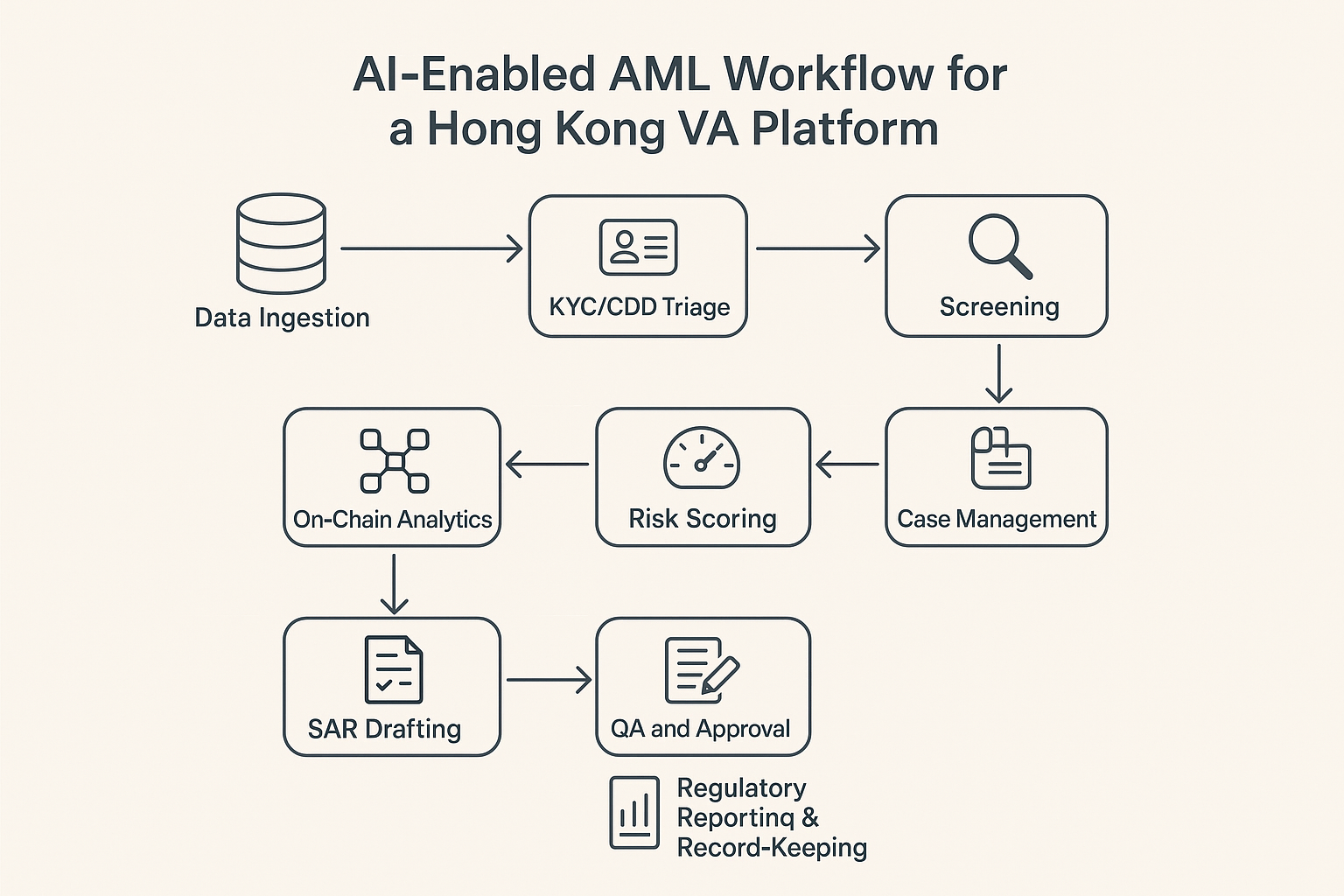
A practical AI AML workflow for Hong Kong VA firms, OTCs and stablecoin issuers
- Data foundation and Travel Rule
- Integrate KYC, transactional (fiat + on-chain), screening, and open-source intel into a unified store.
- Implement Travel Rule messaging and counterparty due diligence; keep evidence of originator/beneficiary information exchange.
- KYC/CDD triage with AI
- Use document/liveness models to pre-validate IDs; route edge cases to human review.
- Apply LLMs to summarise multilingual adverse media and customer declarations. Maintain model outputs, prompts, and sources in the file.
- Screening and watchlists
- Continuous sanctions/PEP/adverse media screening with AI-assisted fuzzy matching to reduce name-matching noise.
- Document thresholds, override rationales, and timing (e.g., intraday refresh for sanctions deltas).
- On-chain analytics and typologies
- Combine blockchain analytics with AI classifiers for typologies (mixers, peel chains, sanctioned exposure, ransomware tags).
- Calibrate with Hong Kong-relevant risk indicators; evidence the logic in model “cards.”
- Risk scoring and monitoring
- Unified risk score blending KYC, screening and on-chain signals; escalate above defined thresholds.
- Monitor model drift and false positive/negative rates; retrain on a scheduled cadence.
- Case management and SAR drafting
- Use LLMs to generate case summaries and draft SAR narratives; human analysts approve and file.
- Enforce a “four-eyes” rule and keep versioned drafts for audit.
- Record-keeping and audit trails
- Retain CDD, screening hits, Travel Rule messages, analytics outputs, and SARs per AMLO timeframes; ensure easy retrieval.
Governance guardrails (don’t skip these)
- Model risk management: inventory, validation, performance metrics, drift alerts, backtesting.
- Explainability: store decision rationales; avoid “black box” approvals.
- Data protection: comply with Hong Kong’s PDPO; document cross-border data transfers with vendor DPAs and security reviews.
- Vendor oversight: conduct due diligence and ongoing monitoring; map subcontractors and data residency.
A 2030 readiness path you can defend
- 2025–H1 2026: Gap assessment vs FATF and Hong Kong consultations; select vendors; pilot KYC/screening AI. KPI: illustrative 25–35% reduction in KYC turnaround time with <1% IDV error creep.
- H2 2026–2027: Roll out Travel Rule, on-chain analytics, unified risk scoring. KPI: illustrative 30–50% false-positive reduction while keeping true-positive capture steady.
- 2028: SAR drafting assistant and QA automation; model validation and attestation. KPI: SAR drafting time cut from 140 to 70 minutes (illustrative).
- 2029: Independent assurance; dry-run against evolving rules for stablecoin issuers and OTCs.
- 2030: Full compliance evidence pack, including model cards, controls testing, and board attestations.
Quick wins in 90 days
- Centralise CDD evidence and screening logs; fix retrieval.
- Pilot adverse media LLM summaries for high-risk onboarding.
- Implement basic on-chain exposure checks for inbound/outbound VA flows.
- Draft an AI governance policy and model inventory.
The bar is rising. AI helps you clear it—if you can explain it, measure it, and audit it.
References: FATF, Hong Kong stablecoin AML/CFT consultation conclusions, and the public consultation on regulating OTC VA services all point to tighter transparency, traceability and enforceable AML/CTF obligations. Start the upgrades now, not in 2029.
Links:
- FATF: https://www.fatf-gafi.org/
- Hong Kong stablecoin/AML materials: https://www.hkma.gov.hk/ and https://www.sfc.hk/
- OTC VA consultation (FSTB): https://www.fstb.gov.hk/
- PDPO (privacy): https://www.pcpd.org.hk/


