
Hong Kong AML: SOW Checks & Real-Time VA Monitoring

Introduction Source of wealth (SOW) and real-time virtual asset (VA) monitoring are now the two pressure points in Hong Kong AML. Between the stablecoin framework moving forward, the upcoming regulation of VA OTC shops, and a dedicated licensing regime for custodians, regulators want stronger provenance checks and live oversight — not just periodic reviews.
What changed — and why it matters
- Stablecoins: Recent consultation conclusions emphasise that participants in stablecoin transfers should share essential information for transaction monitoring, sanctions screening and risk mitigation. Licensees may also keep a list of customers’ wallet addresses that have been subject to AML/CFT control measures to speed up identification and screening during transfers.
- Ongoing monitoring: Anyone seeking issuance or redemption of stablecoins (and distributors/agents) must be subject to ongoing monitoring under section 5 of Schedule 2 to the AMLO — the same standard that applies to other financial institutions.
- VA OTC and custodians: The Government has said OTCs play a “channeling” role for public funds and must come under regulation to ensure AML/CTF and investor protection. A separate consultation proposes that licensed/registered VA custodians observe Schedule 2 CDD and record-keeping, with added sector-specific requirements.
For busy founders, this means two concrete shifts: prove the customer’s wealth story with on-chain and off-chain evidence, and watch flows in real time across exchange, OTC, custodian and stablecoin rails.
SOW that stands up in Hong Kong SOW ≠ source of funds (SOF). SOW explains how the customer accumulated their wealth over time; SOF shows where this specific transaction comes from.
What to collect (mix of documentary and on-chain evidence):
- Employment/Business: tax returns, audited financials, dividend vouchers, sale proceeds (SPAs), board minutes (where relevant).
- Crypto-native wealth: wallet provenance showing early accumulation, mining income, validated staking yields, vesting schedules, SAFT/ITO allocations, exchange PnL exports signed by the platform.
- OTC history: deal tickets, settlement confirmations, bank slips, and counterparties screened under sanctions/PEP lists.
- Cross-checks: adverse media, litigation, bankruptcy registers.
Risk triggers that require enhanced SOW:
- Rapid net worth jumps (e.g., +HKD 20m in <6 months, illustrative).
- Frequent stablecoin redemptions from newly created wallets.
- Exposure to high-risk services (mixers, sanctioned protocols), even indirectly.
Tip: Build a wallet map per customer. Maintain an internal list of “customer-controlled addresses” that have undergone your AML/CFT control measures to enable prompt identification during transfers, as allowed by the latest stablecoin guidance.
Real-time VA monitoring: what “good” looks like in 2025
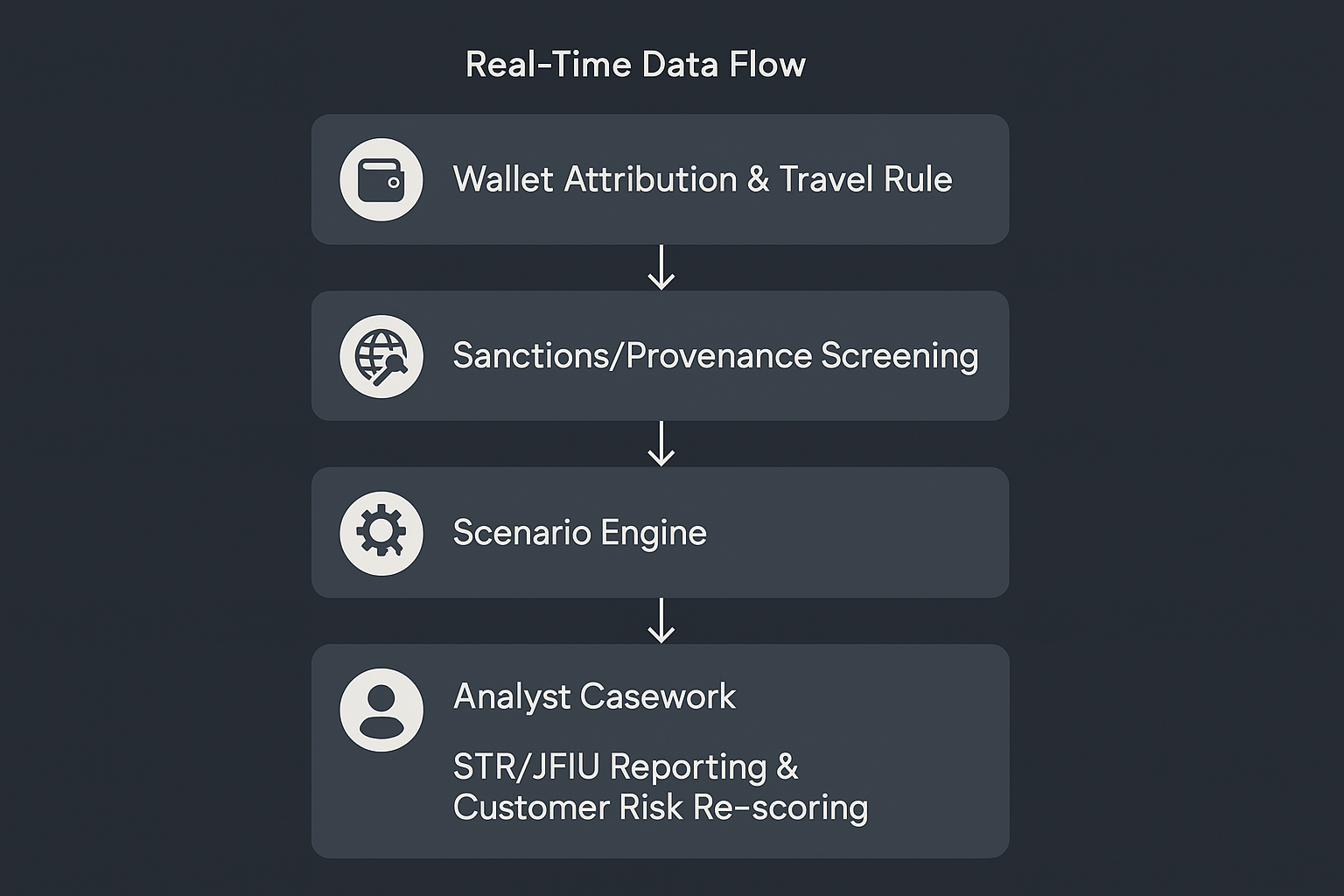
- Data points to capture live: wallet ownership assertions, Travel Rule payloads, sanctions/PEP screening hits, clustering signals (e.g., links to mixers), jurisdiction risk, speed/amount anomalies, stablecoin issuer/distributor references.
- Coverage: exchange accounts, OTC counterparties, custodian wallets, and stablecoin issuance/redemption. If one leg is blind, the control fails.
- Alerting and casework: set SLAs (e.g., triage within 15 minutes; suspicious escalation within 1 business day — illustrative). Document all decisions; file STRs to the JFIU as soon as reasonably practicable and without tipping off.
- Governance: link your scenarios to AMLO Schedule 2 ongoing monitoring and the SFC/HKMA AML guidelines. Review thresholds quarterly; evidence backtests.
Who must do what (at a glance)
-
Stablecoin issuer/distributor
- Duties: CDD, ongoing monitoring per AMLO Schedule 2; maintain list of customer wallets under control measures
- Focus: issuance/redemption screening, sanctions, wallet provenance, counterparty info exchange
- Reference: HKMA stablecoin consultation conclusions
-
VA OTC (proposed to be regulated)
- Duties: AML/CTF framework, CDD, record-keeping; investor protection
- Focus: cash/fiat-to-VA monitoring, face-to-face onboarding risks, Travel Rule where applicable
- Reference: FSTB VA OTC consultation
-
VA custodian (proposed licensing)
- Duties: Schedule 2 CDD and record-keeping plus sector-specific controls
- Focus: inbound/outbound wallet surveillance, segregation and address whitelisting, incident reporting
- Reference: Public consultation on VA custodian services
-
VASP/exchange
- Duties: SFC/HKMA AML guidelines, Travel Rule, ongoing monitoring
- Focus: cross-venue flow analytics, stablecoin corridor risks, market abuse adjacency
What to do this quarter
- SOW playbook refresh: add crypto-native evidence templates; mandate wallet mapping and provenance checks for high-risk clients.
- Real-time stack: integrate an on-chain analytics provider, Travel Rule gateway, and case management. Aim for <5 minutes to screen a new inbound address (illustrative).
- Wallet lists: implement a controlled registry of customer-owned addresses aligned with your AML/CFT guideline procedures.
- Metrics to track: alert-to-close time, % of transfers screened pre-settlement, SOW completeness rate, false-positive ratio, and STR conversion.
Key references
- AMLO (Cap. 615) Schedule 2 – CDD and ongoing monitoring: https://www.elegislation.gov.hk/hk/cap615?sch=2
- SFC AML/CFT Guideline (including for SFC-licensed VASPs): https://www.sfc.hk/en/Rules-and-standards/Anti-money-laundering-and-counter-financing-of-terrorism
- HKMA stablecoin policy resources: https://www.hkma.gov.hk/eng/key-functions/international-financial-centre/fintech/
- FSTB virtual assets policy and consultations: https://www.fstb.gov.hk/en/financial-services/policy/capital-markets/virtual-assets.html
Bottom line SOW is your narrative. Real-time monitoring is your safety net. In Hong Kong 2025, you need both — documented, automated, and defensible. If your team can’t explain the customer’s wealth and can’t see their transfers as they happen, you’re one exam away from a remediation plan.


