
HKMA Stablecoin Sandbox: AML/CFT for Fiat-Backed Issuers

HKMA Stablecoin Sandbox: AML/CFT for Fiat-Backed Issuers
The HKMA’s stablecoin sandbox is open, and AML/CFT is the make-or-break item for admission and scale-up. The Bank for International Settlements has warned that stablecoins are attractive rails for money laundering, terrorist financing and sanctions evasion, and the FATF continues to flag risks from unhosted wallets due to anonymity and mobility. If you’re building a fiat-backed HKD/USD stablecoin in Hong Kong, treat AML/CFT as product design, not paperwork.
What the HKMA is signaling
- Consultation direction is clear: industry broadly supports the draft AML/CFT Guideline for Licensed Stablecoin Issuers (LSIs), and HKMA is moving to codify expectations. See HKMA materials and updates on the sandbox and AML/CFT framework on the HKMA site.
- Scope goes beyond your customers. The HKMA expects ongoing monitoring of stablecoins in secondary markets, including holdings by non-customers, to discharge AML/CFT obligations.
- If you custody your own token for clients, expect ongoing HKMA supervision aligned to the virtual asset custodian regime (segregation of client assets, adequate audit, record-keeping, and full AML/CFT controls).
- Transfers matter. Controls on mint, redeem, and on-chain transfers (including screening and Travel Rule interoperability with VASPs) are part of the package.
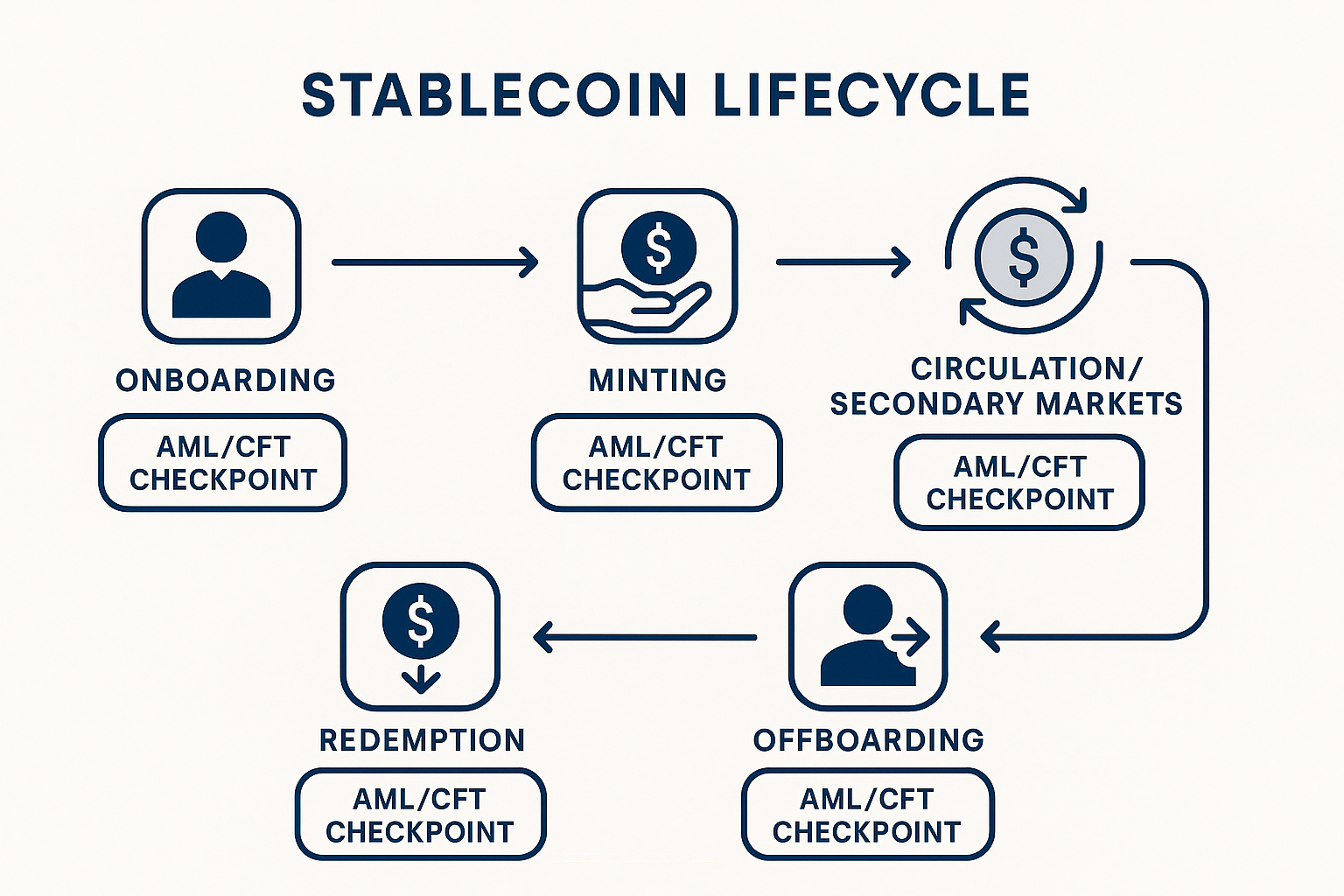
Practical playbook for sandbox applicants
- Governance and accountability
- Appoint a fit-and-proper MLRO and designate board-level oversight. Document three lines of defense and outsourcing oversight for KYC, Travel Rule and analytics providers.
- KYC/KYB and sanctions
- For retail: verify identity with liveness/biometric checks and validate source of funds on first mint above risk thresholds.
- For institutions: full KYB on exchanges, OTCs, payment firms and corporates; beneficial ownership, purpose-of-use, and anticipated activity profile.
- Screen against UN/HKSAR sanctions lists and adverse media at onboarding and on a daily refresh cycle.
- Unhosted wallets: risk-based access
- Permit interactions with unhosted wallets, but apply additional checks: test transfers, wallet provenance scoring, ownership attestation, velocity/amount caps, and enhanced due diligence for high-risk geographies or mixers.
- Travel Rule readiness
- Interoperate with VASP Travel Rule protocols (e.g., IVMS101-compliant messaging). Apply Hong Kong’s AMLO-aligned Travel Rule where transfers involve regulated VASPs; collect and transmit originator/beneficiary data; implement exception handling when counterparty VASP data is missing or fails verification.
- On-chain and off-chain monitoring
- Blend on-chain analytics (sanctions clustering, mixer exposure, darknet attribution) with fiat rails monitoring (card/bank inflows).
- Define typologies: rapid mint→transfer→redeem loops, chain-hopping through bridges, peels to high-risk exchanges, sanctions nexus.
- Automate case management with escalation to the MLRO and file STRs to Hong Kong’s Joint Financial Intelligence Unit (JFIU) when warranted.
- Secondary market oversight
- Track concentration by non-customer addresses, large holder flows, and sudden spikes in velocity. Maintain the technical ability to freeze or decline transfers when legally required (e.g., sanctions).
- Record-keeping and auditability
- Keep complete KYC, transaction, screening and analytics records for the statutory retention period under AMLO. Commission independent audits of AML systems and smart-contract controls.
- Privacy and data protection
- Align with Hong Kong’s Personal Data (Privacy) Ordinance (PDPO) on cross-border transfers and purpose limitation. Minimise sensitive data on-chain.
Controls to build into the token and stack
| Control area | What “good” looks like | Evidence for HKMA |
|---|---|---|
| Sanctions enforcement | Contract-level freeze/blacklist with governance safeguards | Code review report; freeze playbooks; incident logs |
| Transfer screening | Real-time address risk scoring pre-transfer | Vendor SLAs; latency and hit-rate metrics |
| Travel Rule | IVMS101 messaging, routing by VASP directory, fallback handling | End-to-end test results; exception registers |
| Secondary market analytics | Holder concentration, mixer exposure, anomaly alerts | Dashboard screenshots; rule tuning records |
| Mint/redeem governance | T+1 redemption at par; HQLA reserve backing; reconciliation | Daily reconciliations; independent attestations |
Two quick realities
- You will need to monitor tokens you didn’t issue to your own customers once they circulate. That’s the point.
- Freezing authority is sensitive. Calibrate controls with legal advice and document triggers tightly.
How to use the sandbox well
- Start narrow: HKD or USD fiat-backed only, limited counterparties, low velocity caps. Prove the control loop works before expanding.
- Pre-clear your typology library and alert thresholds with HKMA supervisors; iterate monthly with data.
- Run a red-team exercise on your AML stack before go-live. Catch the gaps yourself.
Resources
- HKMA stablecoin sandbox and AML/CFT updates: hkma.gov.hk
- FATF virtual asset guidance: fatf-gafi.org
- BIS research on stablecoin risks: bis.org
- JFIU e-reporting: jfiu.gov.hk
If you design AML/CFT into the token, wallet flows and operations from day one, the sandbox becomes your fast lane to an LSI licence — not an obstacle course.


