
HKMA Stablecoin Licensing: Fit-and-Proper & CRS Guide

Hong Kong’s stablecoin regime is finally real. From 1 August 2025, the HKMA will license stablecoin issuers under a framework that hardwires reserve quality, stabilisation mechanisms, daily redemption, and prudential risk management into law. If you plan to issue (or custody) a fiat-referenced stablecoin in or from Hong Kong, two questions now decide your launch velocity: are your leaders fit-and-proper, and will your structure trigger Common Reporting Standard (CRS) reporting?
Why this matters now The HKMA has been clear (see Policy Statement 2.0 and prior consultation conclusions): issuers that also custody their own coins will be supervised on custody, investor protection (segregation, audit, record-keeping), and full AML/CFT coverage, including monitoring coins circulating in secondary markets and even those held by non-customers. This goes beyond retail onboarding—your risk program must see “off-platform” flows too.
On the accounting side, recent U.S. SEC staff guidance (as reported by Bloomberg/The Block) suggests USD-pegged stablecoins with guaranteed redemption could be treated as cash equivalents. That doesn’t change HKMA rules, but it raises the bar on your redemption terms, reserve transparency, and attestation cadence. Investors will ask for them on day one.
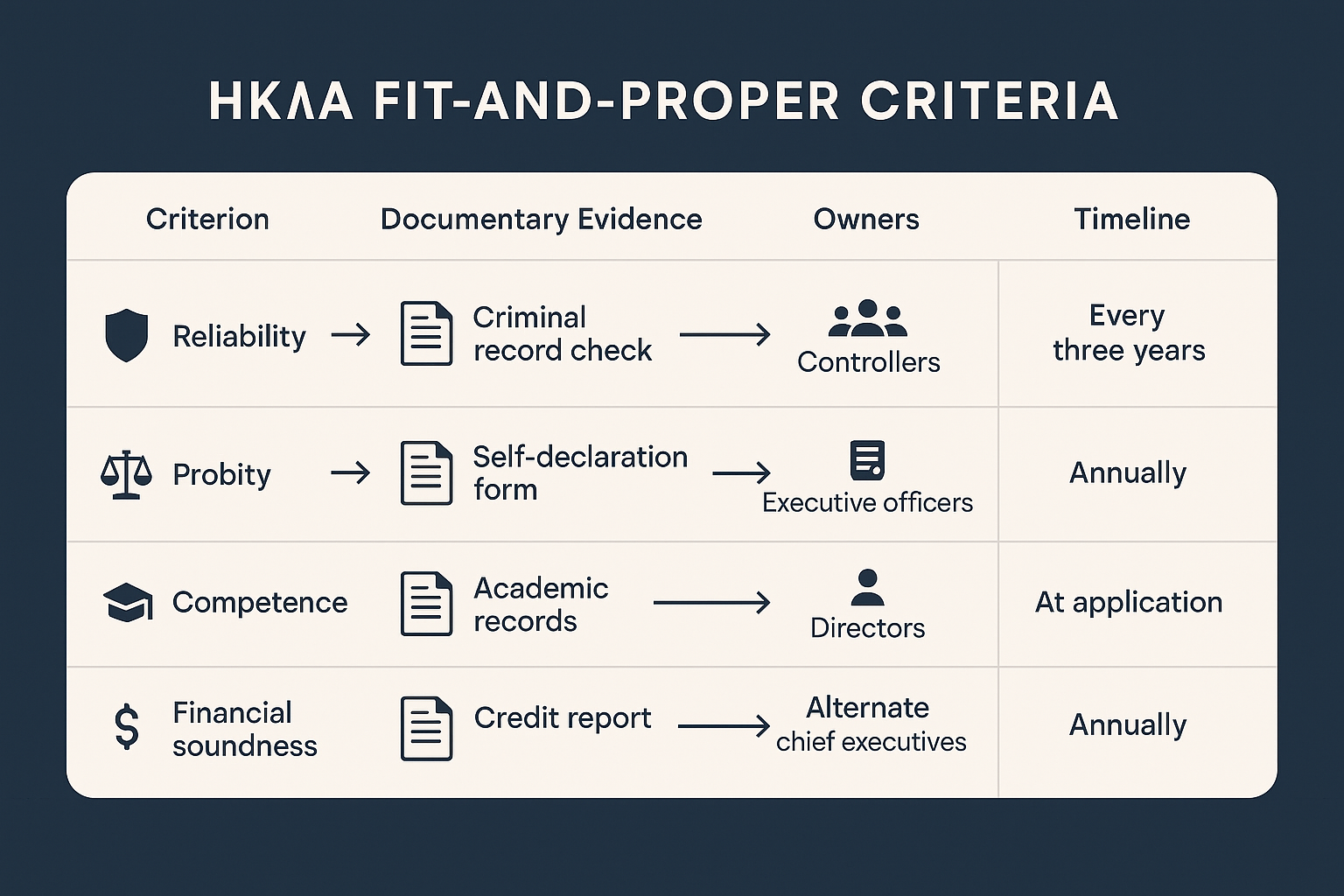
Fit-and-proper: what HKMA will actually look for Expect the HKMA’s stablecoin F&P tests to mirror its established approach under banking/SVF regimes: honesty, integrity, competence, financial soundness, and effective governance of controllers, directors, and senior managers.
Practical checklist (what to prepare before filing):
- Governance and staffing
- Board with at least one independent non-executive director with treasury/market risk experience.
- Designate local senior managers for risk, compliance/MLRO, finance, and technology; maintain “mind and management” in Hong Kong.
- Track record and probity
- Full background checks and regulatory references for controllers and directors; disclose any prior enforcement or insolvency events.
- Competence and resources
- Document treasury expertise for reserve management (FX, high-quality liquid assets, liquidity ladders).
- Evidence of capital adequacy and liquidity buffers sized to peak redemptions (illustrative: 1–3% of circulating supply in same-day cash).
- Risk and control environment
- Three-lines-of-defence model; internal audit plan; independent reserve attestation by an auditor subject to the HK Financial Reporting Council’s oversight.
- Detailed redemption policy (cut-off times, channels, fees), stress-test results, and wind-down plan.
CRS: classify early, avoid surprises CRS (OECD AEOI) hinges on whether you are a Financial Institution (FI). The label changes onboarding, reporting, and data retention.
- Typical stablecoin setups and likely CRS outcomes
- Issuer-only (no wallet/custody): Often a Non-Financial Entity (NFE), unless treasury activities make it an “Investment Entity.”
- Issuer plus proprietary wallet/custody for clients: Likely a Custodial Institution (FI) if you hold digital assets for customers and earn relevant fee/spread income.
- Third-party custodian model: Issuer may be NFE; custodian is the FI.
If you are an FI, you must:
- Classify account holders (individuals and entities), identify controlling persons of passive NFEs, and collect self-certifications/TINs.
- Report annually to the IRD on reportable jurisdictions.
- Align AML/KYC and CRS procedures—name screening, address/TIN validation, and change-in-circumstances monitoring should be one workflow, not two.
AML/CFT and secondary-market visibility HKMA expects monitoring of stablecoins in circulation, including holdings by non-customers. Build:
- On-chain analytics to flag concentration risk, sanctions exposure, mixers, and high-velocity wash patterns.
- Controls for stablecoin transfers (including wallet verification, anomalous velocity thresholds, and blacklisted address blocks).
- Clear segregation of client assets and reconciliations to on-chain ledgers and bank statements.
A note on “cash equivalent” optics If you want treasurers to book your coin as a cash equivalent, lock in:
- Legally enforceable same-day redemption at par in the reference currency.
- High-quality, short-dated reserves with minimal price volatility.
- Frequent public reserve attestations (e.g., monthly) and daily reserve composition snapshots. Anything less will invite haircuts.
What to do this quarter
- Governance: Confirm board composition; appoint local SMFs/ROs; run independent F&P checks.
- Prudential: Finalise reserve policy, counterparties, and stress tests; mandate an external reserve attestation.
- CRS/AML: Decide your CRS status; update onboarding to collect self-certifications/TINs; integrate CRS with AML workflows; deploy chain analytics for non-customer monitoring.
- Legal: Publish redemption terms, stabilisation mechanisms, and wind-down triggers; align disclosures with HKMA expectations.
- Filing pack: Assemble policies, org charts, financials, and assurance reports to hit the 1 August 2025 window.
Useful references
- Hong Kong Monetary Authority (HKMA): https://www.hkma.gov.hk
- Financial Services and the Treasury Bureau (Policy statements on digital assets): https://www.fstb.gov.hk
- OECD CRS overview: https://www.oecd.org/tax/automatic-exchange/common-reporting-standard/
- Reporting on SEC staff guidance re: stablecoins and cash equivalents: https://www.theblock.co
Bottom line Treat fit-and-proper, CRS, and redemption mechanics as a single compliance stack. If one fails, the licence—and market trust—go with it.


