
HKMA Compliance: Custody Trusts & Fiat Stablecoins

HKMA Compliance: Custody Trusts and Fiat Stablecoins — what to fix now, not later
If you plan to issue a fiat‑backed stablecoin in Hong Kong or run a custodial wallet, the HKMA has made two non‑negotiables clear for 2025: prove you can redeem safely, and prove you can custody safely. Everything else—token design, partners, UX—sits on top of that foundation.
What the HKMA is actually asking for
From recent consultations and guideline updates, expect the following pillars to be examined and supervised:
- Issuance and redemption discipline: Robust controls over mint/burn and redemptions, with documented SLAs and liquidity arrangements. If you carry on custody of the stablecoins you issue, you will be under ongoing HKMA supervision.
- Due diligence on the custodial wallet provider: Whether the custodian is an FI or a VASP, you must assess its controls before letting customers use its wallets.
- Controls for unhosted wallets: Additional AML/CFT measures when customers use self‑custody. Think higher friction, not outright bans.
- Investor protection in custody: Segregation of client VAs, adequate audit, complete record‑keeping, and reconciliations.
- Full AML/CFT coverage: End‑to‑end KYC, Travel Rule compliance, sanctions screening, blockchain analytics, and SAR handling.
Note: HKMA guidance clarifies licensees may or may not provide custody to holders of their stablecoins. Your compliance model changes materially depending on that choice.
Custody trust arrangement: the model that withstands audits
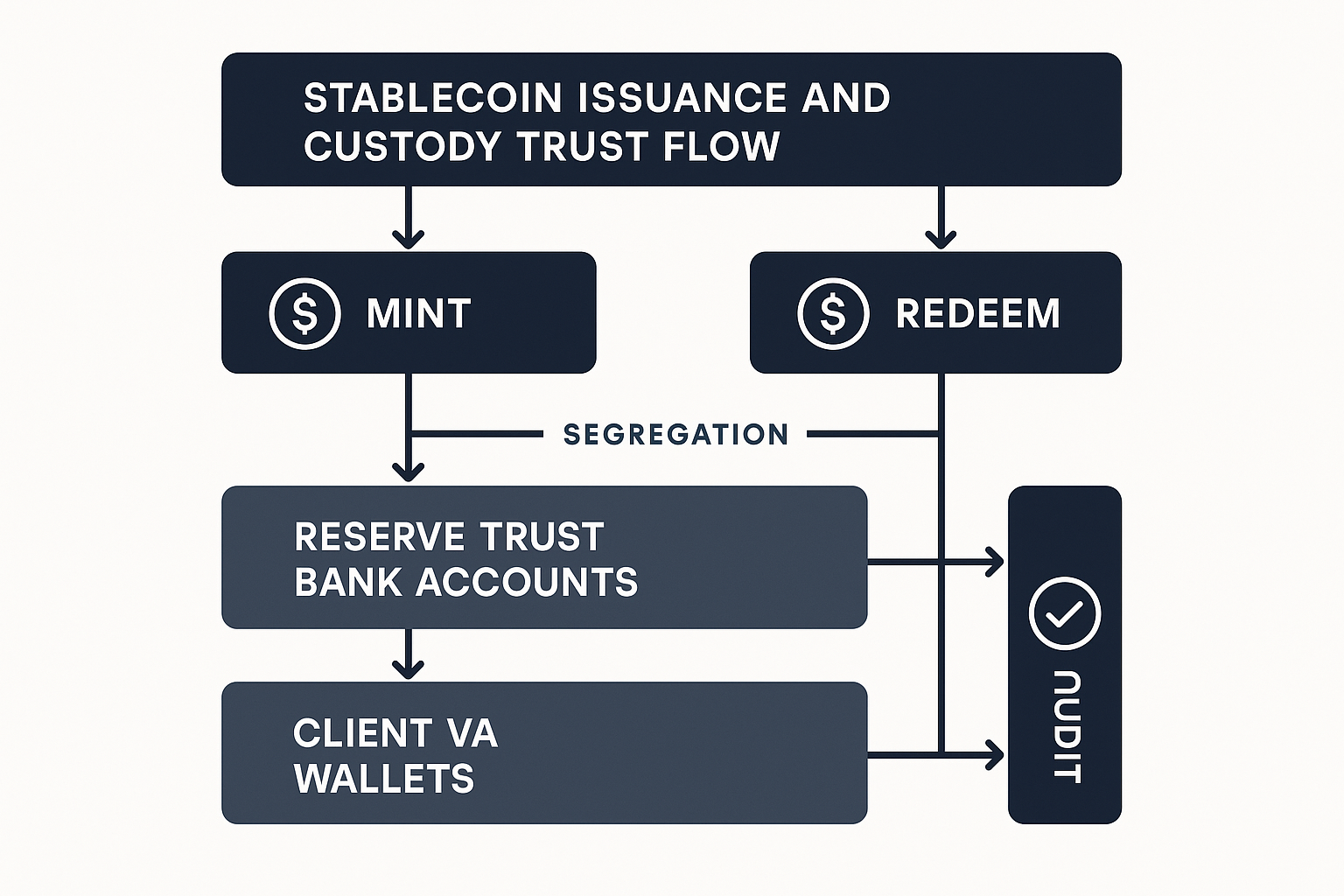
For fiat‑backed stablecoins, you need two clean separations: the reserve assets and client VA holdings.
- Reserve trust: Hold cash and cash‑equivalents in a Hong Kong law trust, with an independent trustee, for the benefit of token holders. Hard‑code redemption priority, investment limits, and insolvency remoteness into the trust deed. Daily bank confirmations; monthly third‑party attestations.
- Client VA custody trust: If you or an affiliate provides custodial wallets, hold client VAs on trust with clear segregation (per‑client or omnibus with sub‑ledgers), MPC or multi‑sig key controls (e.g., 3‑of‑5 with geo and role separation), and breach‑response playbooks. Reconcile wallets at least daily; keep tamper‑evident logs.
Compliance workflow you can implement this quarter
- Onboarding and wallet classification
- KYC/KYB with risk‑scoring.
- Classify wallet type: hosted (your custodian), hosted (third‑party FI/VASP), or unhosted/self‑custody.
- Custodial wallet provider due diligence
- Evaluate licensing status (VASP/FI), SOC 2/ISO 27001, key management, hot/cold splits, incident history, and financial resilience.
- Contract for segregation, audit rights, uptime SLAs, and breach notification timelines.
- Unhosted wallet controls
- On‑chain risk scoring and sanctions screening at address level.
- Allow‑listing for withdrawals; first‑funds provenance checks; small‑value thresholds with escalations.
- Enhanced due diligence for high‑risk geos and mixers; supervisory review for exceptions.
- Issuance/redemption controls
- Mint/burn only against settled fiat in reserve trust accounts.
- Redemptions paid to verified bank accounts only; deny to high‑risk unhosted destinations unless EDD cleared.
- Target KPIs (illustrative): 95% of redemptions T+0, remainder T+1; reconciliation breaks < 0.1% of float.
- AML/CFT operations
- Travel Rule vendor integrated; end‑to‑end data capture.
- Case management with typologies for stablecoin misuse (peel chains, smurfing).
- Illustrative targets: <2% alert false‑positive rate; SAR filing within 3 working days of determination.
- Assurance and reporting
- Monthly reserve attestations; quarterly custody control reports to board.
- Annual independent audit covering reserves, segregation, and ITGC; penetration tests and key ceremony audits.
Practical tips we’ve seen work in Hong Kong
- Put the trustee on your incident‑response tree. If keys are compromised, you’ll need trust instructions ready within hours, not days.
- Keep redemption to bank rails only. It cuts fraud and satisfies “known‑counterparty” expectations.
- Document your “may or may not custody” posture. Regulators move faster when your scope is crisp.
This isn’t theory.
It’s what inspectors will test against.
If you’re deciding between custody models, lock the trust structure first, then build onboarding and redemption controls around it. Questions on trustee selection or wallet DD packs? We help issuers and custodians stand up these controls in Hong Kong. Useful references: HKMA virtual assets resources (hkma.gov.hk), and FSTB’s consultation on virtual asset custodian services (fstb.gov.hk).


