
HK Travel Rule & Source of Funds: Risk-Based Compliance

Hong Kong’s Travel Rule and Source of Funds: how to actually make it risk-based The Travel Rule is no longer a “wait and see” item in Hong Kong. It’s a core AML/CFT obligation under FATF Recommendation 15, and local regulators have acknowledged the very real execution issues — inconsistent global rollout, messaging standards that don’t talk to each other, and the unhosted wallet dilemma. The HKMA’s consultation conclusions on stablecoins reiterate this, pointing licensees to paragraphs 6.25–6.42 of the AML/CFT Guideline for practical handling, and reminding firms that obligations differ across ordering, intermediary and beneficiary institutions. That nuance is where many teams still stumble.
The point isn’t to tick the box. It’s to deploy controls that actually reduce risk without choking your flow.
Where Travel Rule meets Source of Funds (SoF) The Travel Rule forces you to move originator and beneficiary details with a virtual asset transfer. SoF/SOW testing validates where the money came from and how it was earned. Together they answer two questions: “Who is moving value?” and “Is the value clean?” In HK, expect this to extend across stablecoin transfers and, soon enough, to OTC channels given the Government’s consultation to regulate VA OTCs in line with FATF CDD and record-keeping requirements.
A quick role-by-role split
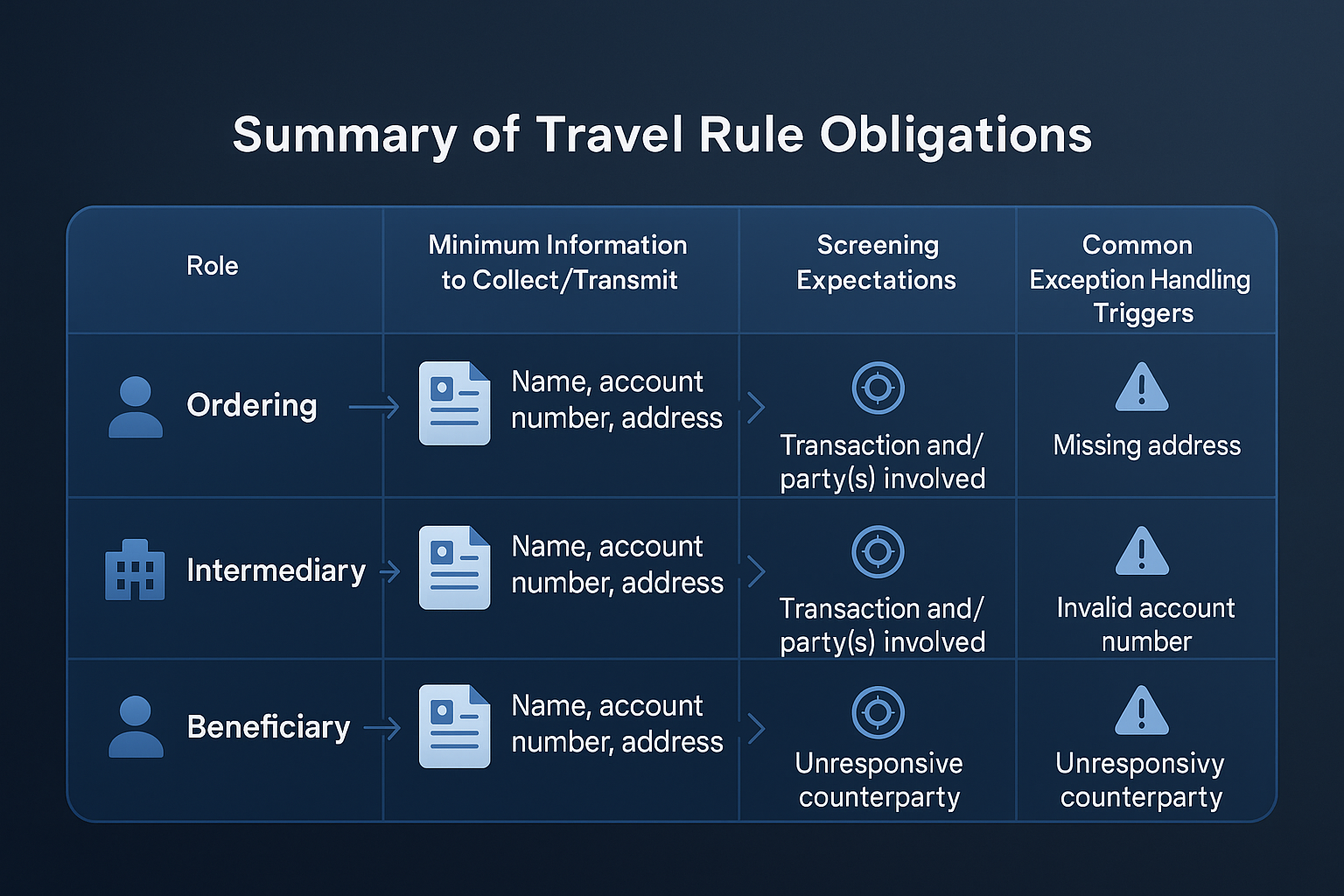
- Ordering institution: Collect and transmit required originator/beneficiary information; screen names; block or hold-and-review when data is missing or counterparty VASP is non-compliant.
- Intermediary: Ensure information continues to travel intact; detect missing fields; reject or follow exception procedures; keep auditable logs.
- Beneficiary institution: Receive, validate, and reconcile data; screen names; apply SoF/SOW triggers when risk indicators fire; reject or return where necessary.
Note: The HKMA has acknowledged “sunrise” problems and unhosted wallets. The standard still applies; the playbook just needs fallbacks.
A pragmatic, risk-based playbook (what to implement now)
- Segment transfers by risk
- Counterparty: Licensed VASP in a Travel Rule-active jurisdiction vs. non-implementing VASP vs. unhosted wallet.
- Corridor: High-risk or sanctioned geographies; chains with higher mixer exposure.
- Asset: Fiat-backed stablecoins used for off-ramp vs. high-volatility tokens.
- Data and messaging standards
- Adopt IVMS101 for data structure and at least one network (e.g., TRISA/TRP) to maximize reach; maintain a fallback secure channel (API + PGP).
- Validate mandatory fields before release; log every send/receive and any gaps.
- Unhosted wallet handling
- Proof-of-control: signed message or micro-transfer challenge; for higher risk, add biometric/KYC refresh or exchange screenshots are not enough.
- Apply limits and enhanced review for repeated high-value unhosted flows.
- SoF/SOW triggers tied to Travel Rule events
- Trigger EDD when: transfer is from/to non-implementing VASP; there’s a Travel Rule data gap; or heuristics show mixer/tumbler exposure.
- Acceptable SoF evidence: payroll slips/tax returns, on-chain provenance reports, exchange withdrawal statements, sale contracts. Escalate if documents contradict on-chain flow.
- Exception governance for the sunrise issue
- Hold-and-request for missing data with time-bound SLAs (e.g., 24–48 hours).
- If counterparties cannot comply, return funds or reject; record attempts and rationale.
- Report STRs where patterns suggest evasion, not mere technical delay.
- Intermediary discipline
- Don’t “passively transit” VA transfers. Validate that required fields remain intact; enrich where you hold better KYC data; retain audit trails.
- Record-keeping, metrics, and board reporting
- Keep complete Travel Rule and SoF/SOW evidence for 6–7 years (per AMLO categories).
- Track KPIs (illustrative): percent of transfers with complete data (>98%), average exception resolution time (<36 hours), EDD conversion-to-STR rate (1–3%), unhosted wallet approval rate by corridor.
Common pitfalls we’re seeing in HK exams
- Capturing Travel Rule data but not screening the names in that payload.
- Treating self-transfers (customer-to-customer-owned wallet) as exempt without proof-of-control.
- No documented rationale when accepting transfers from non-implementing counterparties.
- Stablecoin flows treated as “lower risk by default” without corridor analysis.
30/60/90-day plan
- 30 days: Gap-assess your Travel Rule coverage by role; choose one messaging network and deploy IVMS101; define unhosted wallet proof-of-control; set exception SLAs.
- 60 days: Tie SoF/SOW triggers to Travel Rule exceptions; run tabletop scenarios (ordering/intermediary/beneficiary) and freeze/return workflows.
- 90 days: Automate metrics and board reporting; run an independent QA sample; update customer disclosures to reflect potential delays on missing data.
Compliance should reduce friction, not hide it. By making Travel Rule execution the trigger for deeper SoF/SOW where it matters, you’ll satisfy FATF R.15 expectations, align with HKMA guidance on practical implementation, and avoid surprises as the OTC regime tightens. For reference: see FATF Recommendation 15, the HKMA AML/CFT Guideline sections on Travel Rule practical challenges (paras 6.25–6.42), and the Government’s consultation on OTC VA regulation covering CDD and record-keeping.


