
HK Tokenisation Risk Playbook: StanCOMP Compliance Guide

HK Tokenisation Risk Playbook: StanCOMP Compliance Guide
Introduction Tokenisation is no longer a proof-of-concept in Hong Kong. The Government’s Policy Statement 2.0 signals a legal and regulatory review of tokenisation with an initial focus on bonds, plus a plan to regularise tokenised Government bond issuance to set a global benchmark. Two tokenised Government green bond issuances are already in the market, and supervisors have flagged alignment with the OECD’s Crypto-Asset Reporting Framework (CARF) for tax transparency. This means tokenised securities and fund tokenisation can move forward—if your risk controls match the new reality.
What’s changed in 2025 (and why it matters)
- Policy direction: Policy Statement 2.0 emphasises “L-E-E-D”—streamlined legal/regulatory frameworks, expanding tokenised products (including Government bonds), and supervision aligned with OECD CARF for tax transparency. See background from the HKSAR Government and HKMA on tokenised green bonds (e.g., Feb 2023 and Feb 2024 issuances).
- SFC stance: Tokenised securities remain “securities” under the SFO. Intermediaries must follow existing conduct rules with added tech risk controls (smart-contract audits, wallet controls, custody, BCP). For SFC-authorised investment products, tokenisation is permitted with extra safeguards.
- CARF: Expect data collection on wallet-linked investors, cross-border reporting, and reconciliations between on-chain and off-chain records. See OECD CARF.
The risk map: tokenised securities and funds Use this as your quick diagnostic before you pick a chain, custodian, or distributor.
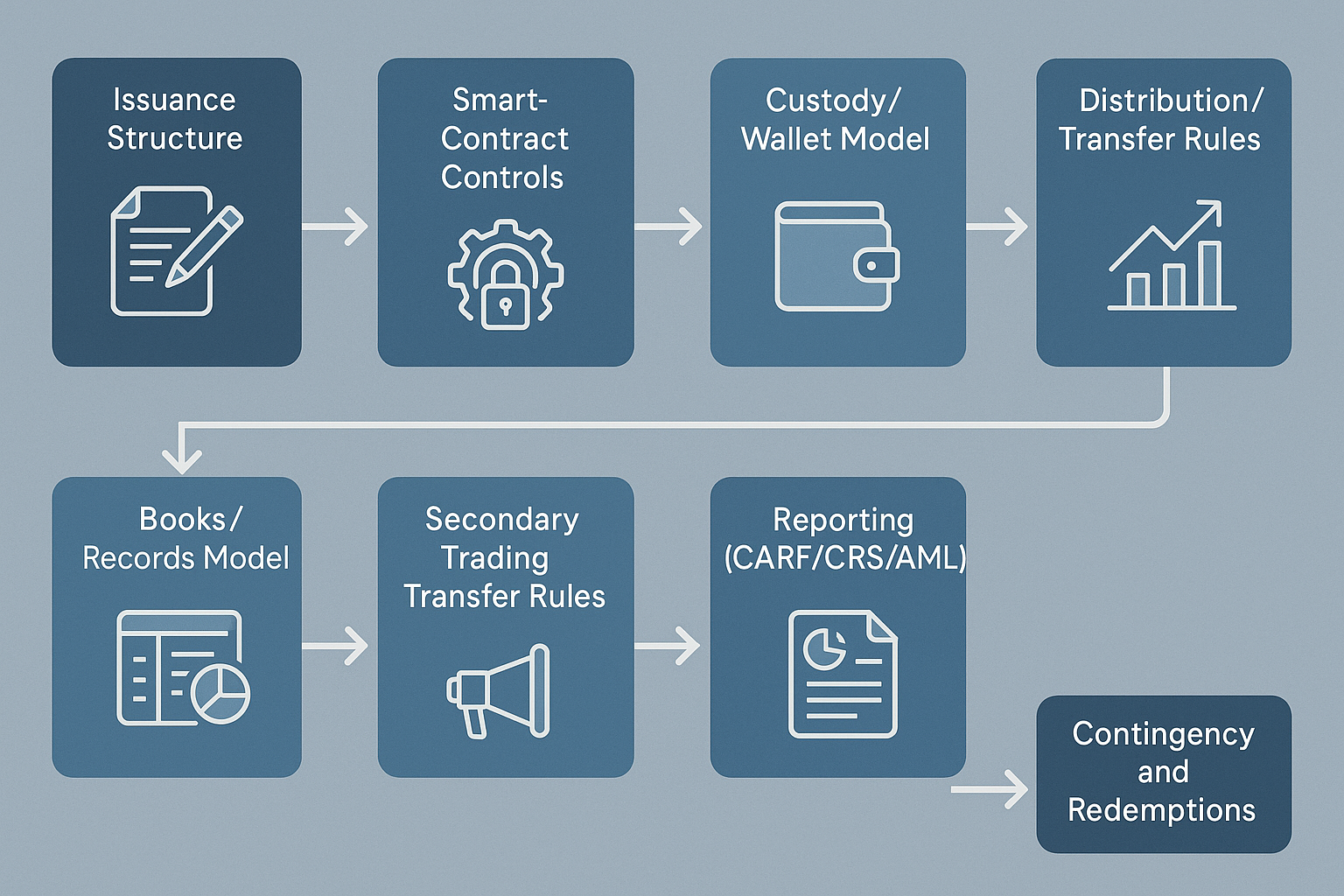
Tokenised securities: SFC compliance anchors
- Licensing and perimeter: Treat as SFO “securities.” Primary issuance/distribution = Type 1; advice = Type 4; asset management (for tokenised notes/funds) = Type 9. Activities on virtual asset trading platforms do not exempt you from SFO licensing.
- Title and record of ownership: Keep a legally robust books-and-records model. If on-chain is not the register of title, ensure the off-chain register prevails and reconciles to on-chain state daily.
- Smart-contract assurance: Independent audits before launch; controlled upgradeability; keys held under dual-control; change management. Run kill-switch and pause scenarios quarterly.
- Custody and wallets: Use qualified custodians where possible. For self-custody investors, adopt wallet whitelisting, travel rule coverage (if applicable), and loss procedures. Segregate client assets with unique wallet paths or omnibus + verifiable sub-ledgers.
- Secondary trading: Transfers only where prospectus/exempt distribution conditions allow (often Professional Investors). If using an ATS, it must be SFC-licensed and capable of enforcing transfer restrictions.
- Disclosures: Explain token-specific risks (smart-contract failure, chain forks, key loss), data residency, and contingency for chain outages.
Tokenised funds: what the SFC expects
- Product scope: Start with plain-vanilla strategies (e.g., MMFs, bond funds) where valuation and liquidity are straightforward.
- Registrar and transfers: A recognised registrar remains the record of unitholders. Token transfers should not settle on-chain unless registrar controls/approves (whitelists, allowlists, transfer agent hooks).
- NAV and dealing: Treat tokens like units—same cut-off, swing pricing rules, and T+ settlement. Publish procedures for chain downtime affecting subscriptions/redemptions.
- Service provider due diligence: Tech audits on tokenisation vendors; SOC 2/ISO 27001 for core providers; legal opinions on token enforceability and conflict-of-laws.
- Wallet UX and KYC: Onboard only KYC’d wallets. For retail funds, ensure wallet tooling and investor comms meet the SFC’s clarity standard.
Practical risk checklist (use this in your IC memo)
| Risk area | Key question | SFC touchpoint | Test you can run next week |
|---|---|---|---|
| Legal title | Which record prevails—on-chain or registrar? | SFO, offering docs | Reconcile 1,000 sample wallets to the register; resolve mismatches in < T+1 |
| Transfer controls | Can a non-whitelisted wallet receive the token? | Intermediaries conduct, distribution rules | Attempt off-policy transfer in UAT; confirm rejection and alerting |
| Smart contracts | Who can upgrade/pause? | Operational risk, disclosures | Tabletop “contract bug” drill; evidence rollback/notice within 4 hours |
| Custody | Are client assets segregated and provable? | Client asset rules | Produce Merkle-proof or address-level segregation report monthly |
| Valuation | Can you strike NAV if the chain halts? | Product handbook, circular | Dry-run NAV under oracle outage; document override inputs |
| Reporting (CARF/CRS) | Do you map wallets to tax residencies? | Tax transparency (CARF) | Generate sample CARF file from live investor data; QA fields |
CARF readiness: data you must capture now
- Wallet-to-investor mapping, including tax residency self-certifications and TINs.
- Transaction-level data with timestamps, asset identifiers, and fair values in base currency.
- Look-through logic for nominees/omnibus investors and periodic reconciliations to the registrar.
- Change-of-circumstances monitoring and reporting within required timelines.
A 90‑day plan that actually gets you live
- Days 1–30: Pick your issuance stack (chain, token standard, registrar model). Commission legal opinions on title and governing law. Kick off smart-contract audits. Map CARF/CRS fields to onboarding.
- Days 31–60: Finalise transfer restrictions and wallet whitelisting. Complete vendor SOC 2 reviews. Run end-to-end UAT for subscription, secondary transfer, redemption, and outage drills.
- Days 61–90: File with the SFC (where required). Freeze code, generate audit attestation, publish token-specific disclosures, and prepare investor comms. Agree on T+ settlement and NAV contingencies with administrators and distributors.
One last point Tokenisation can compress settlement and broaden access, but only if your legal title, controls, and reporting are tighter than in paper markets. Hong Kong is building the rails—use them well.
References
- Policy direction on tokenisation and CARF: Policy Statement 2.0 excerpts referenced above; see also HKMA’s tokenised green bond issuances (Feb 2023 and Feb 2024).
- SFC approach to tokenised securities and tokenised SFC-authorised products: see SFC circulars on tokenised securities-related activities and tokenisation of SFC-authorised investment products (Nov 2023, subsequent updates).
- OECD Crypto-Asset Reporting Framework (CARF): https://www.oecd.org/tax/exchange-of-tax-information/crypto-asset-reporting-framework-and-amendments-to-the-common-reporting-standard.htm
If you want a fast gap assessment, StanCOMP can run a 2-week review covering contract controls, registrar design, and CARF data readiness, with a punch-list you can execute before your next IC.


