
HK Stablecoin Sandbox: IRA & Onboarding Risk Matrix Guide

HK Stablecoin Sandbox: IRA & Onboarding Risk Matrix Guide
If you plan to test stablecoin issuance, redemption or transfers in Hong Kong’s new sandbox environment, get two things right from day one: your Institutional Risk Assessment (IRA) and your onboarding risk matrix. The HKMA’s consultation conclusions on AML/CFT for stablecoins make it clear: institutions participating in a stablecoin transfer must hold essential information to enable transaction monitoring, sanctions screening, and risk mitigation. That includes diligence on the institution providing the custodial wallet and extra controls for unhosted wallets.
What the HKMA is signaling (in plain terms)
- Stablecoin risks mirror other virtual assets: anonymity features, cross-border reach, and usefulness for layering. What’s unique is the ease of transacting with wallets not hosted by AML/CFT-obliged entities.
- Two focal points: (i) due diligence on the FI or VASP that provides your customer’s custodial wallet; and (ii) additional controls when interacting with unhosted wallets.
- Expect a risk-based approach consistent with AMLO requirements on CDD, ongoing monitoring, and sanctions screening. See AMLO (Cap. 615) for baseline obligations: https://www.elegislation.gov.hk/hk/cap615
How to structure your IRA for the sandbox Scope your IRA to stablecoin-specific activities and data flows. Anchor it in three layers: inherent risks, controls, and residual risk.
-
Inherent risk factors (stablecoin-specific)
- Customer: retail vs corporate; PEP exposure; VA-intensive industries; source of wealth tied to VA gains.
- Product/use case: issuance vs redemption vs transfer; cross-chain bridges; stablecoin type (fiat-backed vs algorithmic); peg (USD/HKD/other).
- Delivery channel: VASP custodial wallets vs unhosted wallets; omnibus vs segregated addresses.
- Geography: customer location and counterparty wallet risk (sanctions, high-risk jurisdictions).
- Behavior: velocity, burstiness, round-tripping, links to mixers, gambling, darknet markers.
-
Control set you should evidence
- KYC/KYB with documentary + non-documentary checks (device, IP, telecom).
- Sanctions/PEP/adverse media at onboarding and continuously; on-chain address screening.
- KYT with blockchain analytics; typology rules for layering and bridge/mixer exposures.
- Travel Rule-ready screening and secure data exchange with VASPs; reject unverifiable counterparties.
- Unhosted wallet controls: address ownership proof (signed message or micro-transfer), selfie/liveness for first withdrawal, low initial limits, enhanced SOW/SOF for higher tiers.
- Custodial wallet provider due diligence: licensing/registration status, Travel Rule capability, sanctions framework, hot/cold key management, omnibus segregation and address attestation.
-
Residual risk and governance
- Rate residual risk by customer segment and channel; align with a board-approved risk appetite (e.g., cap unhosted flows to [illustrative] 15–25% of monthly volume; mixers exposure <1%).
- Define triggers: pause rules for sanctions hits, mixer interactions, bridge patterns, and velocity thresholds.
- Refresh IRA annually or on trigger (new chain, new stablecoin, new geography).
Onboarding risk matrix (short, usable, auditable)
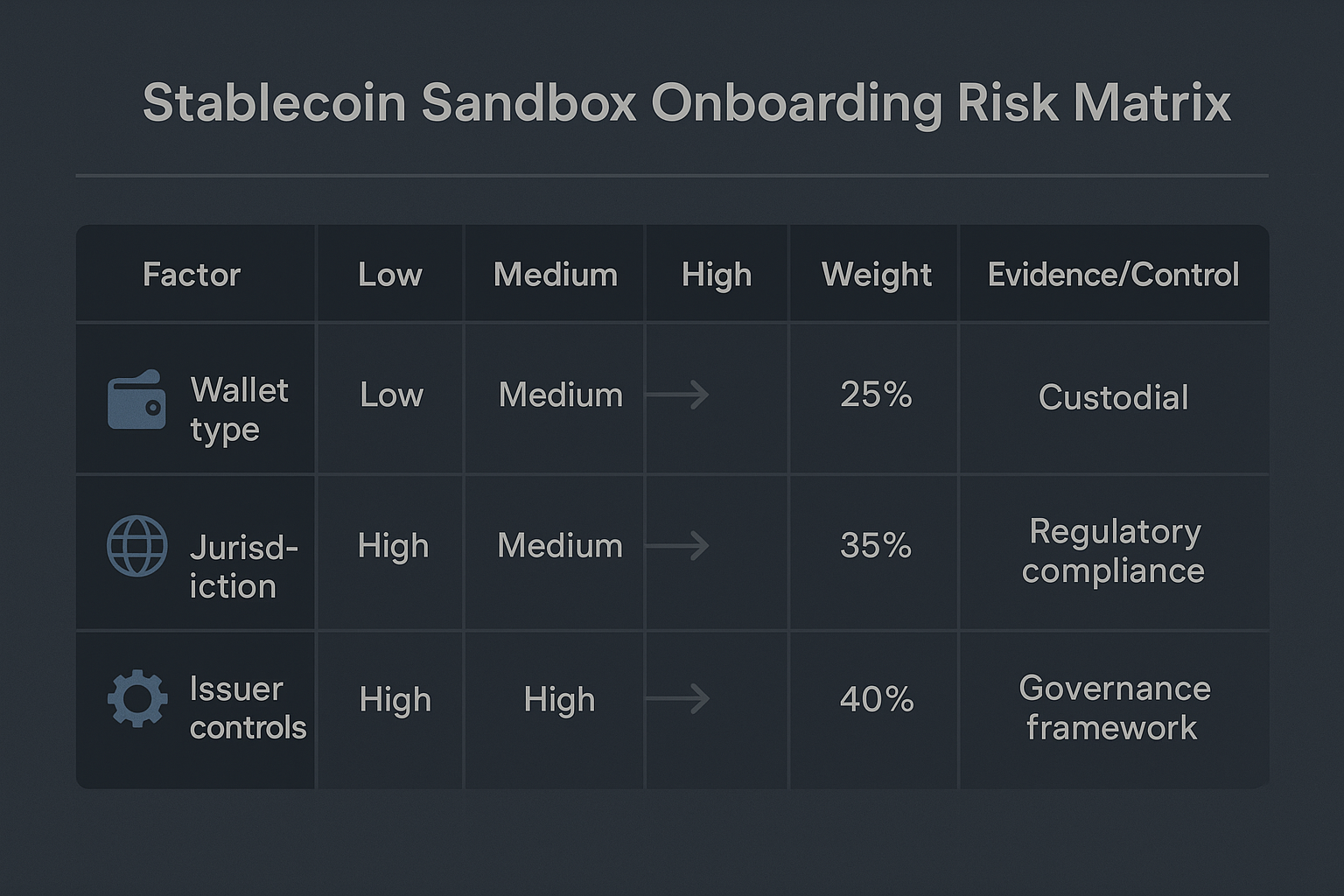
| Factor | Low | Medium | High | Weight (illustrative) | Evidence/Control |
|---|---|---|---|---|---|
| Wallet type | HK-licensed VASP custodial | Foreign VASP with Travel Rule attestations | Unhosted wallet | 25% | VASP due diligence; address verification |
| Jurisdiction | HK/low-risk | Mixed exposure | Sanctioned/high-risk links | 20% | IP/device geo; customer documentation; on-chain heuristics |
| Customer type | HK corporate with clean adverse media | VA-native entities | PEPs/complex trusts | 15% | KYB/KYC, UBO charts, PEP screening |
| Use case | Payroll, merchant settlement | Treasury ops | OTC layering/speculative bursts | 15% | Purpose of account; contracts/invoices |
| Stablecoin type | Fully fiat-backed, transparent reserves | Mixed collateral | Algorithmic/unclear backing | 15% | Issuer disclosures; attestation reports |
| Behavioral signals | Stable patterns | Moderate spikes | Mixers/bridges clustering | 10% | KYT analytics; case notes |
Scoring logic: ≥70 = High risk (EDD + limits), 40–69 = Medium (standard DD + monitoring), <40 = Low (standard).
Operational playbook for transfers
- Route logic:
- VASP custodial → exchange Travel Rule data, screen both beneficiary and address, allow standard limits.
- Unhosted wallet → require address ownership proof, set low default limits, escalate on rapid velocity or chain-hopping.
- For redemptions: re-verify SOF for large first-time redemptions; match fiat rails beneficiary with KYC name; screen beneficiary bank.
What to do this week
- Finalize your IRA with the above factors; get board sign-off and quantify appetite.
- Stand up counterparty VASP due diligence and a denylist for non-compliant Travel Rule peers.
- Implement unhosted wallet onboarding steps and tiered limits before go-live.
- Test end-to-end sanctions/KYT alerts with real chain data and document results.
A sandbox is only as good as your first controls. Set the bar now so production approval isn’t a leap of faith later.


