
HK Stablecoin Sandbox, CBDC & PSO: Compliance Brief 2025

Introduction
If you’re building payments or treasury tools in Hong Kong, 1 August 2025 is your new anchor date. That’s when the Stablecoins Ordinance (SO) kicks in for issuers, while the HKMA continues e‑HKD pilots and firms still sit under the Payment Systems and Stored Value Facilities Ordinance (Cap. 584, commonly “PSO/PSSVFO”) for fiat wallets. The policy stance is clear: test real use cases that fix real frictions — and do it under supervision.
What changed — and why it matters
- Stablecoin regime start date: The SO for licensed stablecoin issuers becomes effective on 1 August 2025 (per the HKMA’s consultation conclusions). Expect licensing, reserve, governance, and disclosure obligations tailored to fiat‑referenced stablecoins.
- Government-backed pilots: Policy Statement 2.0 explicitly welcomes proposals to trial licensed stablecoins, including for improving Government payments and cross‑border settlement. The message: bring credible pilots with measurable outcomes.
- OTC tightening: The proposed VA OTC regime includes website/access‑blocking powers (mirroring AMLO s53ZRB concepts). If you promote stablecoin cash‑in/out retail, expect higher scrutiny and clearer conduct rules.
- CBDC track continues: e‑HKD pilots proceed under the HKMA; wholesale CBDC via mBridge remains focused on cross‑border corridors and on‑chain settlement for institutions.
Helpful links:
- Policy Statement 2.0 (FSTB/HKMA) – support for stablecoin/tokenisation pilots
- HKMA e‑HKD Pilot Programme
- Cap. 584 PSO/PSSVFO (e‑Legislation)
- BIS mBridge overview
How the sandbox/pilot lane really works
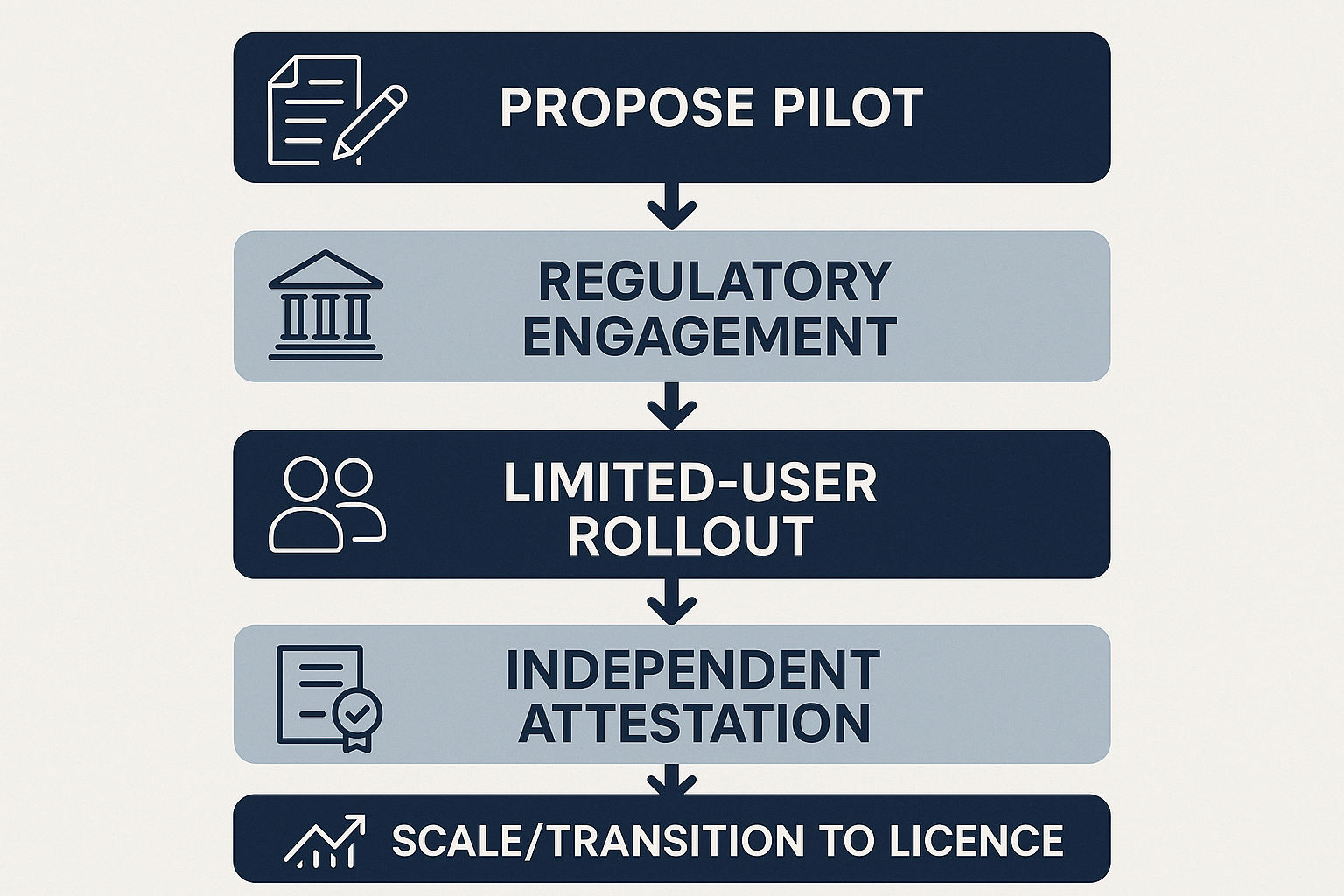
Policy Statement 2.0 invites “licensed stablecoin” use in trials, including potential Government payment experiments. In practice, that means:
- Propose a constrained, data‑rich pilot (e.g., B2B supplier payouts, cross‑border USDC/HKD‑referenced rails, or tokenised collateral for trade).
- Show compliance-by-design: reserve segregation, daily reconciliation, wallet risk controls, travel-rule compatibility if interfacing with VASPs, and tested redemption.
- Commit to metrics. Illustrative: reduce cross‑border settlement cost by 30%, cut payout time from T+2 to T+0, achieve 99.95% end‑to‑end service uptime over 90 days.
CBDC vs stablecoin: choose the right rail
- e‑HKD (retail CBDC): Best for programmable HKD payments once production‑ready; today, it’s still pilot territory but worth integrating into your roadmap.
- mBridge (wholesale): Institutional cross‑border PVP/DVP. If you’re a bank or large PSP with regional flows, test this for treasury and trade.
- Licensed stablecoins: Near‑term path for programmable, always‑on settlement with commercial partners, especially where FX legs or non‑HKD corridors are involved.
Where PSO/PSSVFO still bites
Even if your token is regulated under the SO, your fiat on/off‑ramp and wallet design may trigger Cap. 584.
- Fiat stored‑value wallet for consumer spend
- Likely regime: PSO/PSSVFO SVF licence
- Notes: Float safeguarding, user limits, AML/CFT, tech resilience
- Issuing a fiat‑referenced stablecoin to the public
- Likely regime: Stablecoins Ordinance (SO) issuer licence
- Notes: Backing assets, redemption T+0/T+1 expectations, attestations
- Merchant acquirer settling in HKD and a licensed stablecoin
- Likely regime: Possible dual touchpoints (Cap. 584 for fiat; SO for coin issuer; conduct guidance for facilitator)
- Notes: Clear segregation of fiat vs token flows; disclosure to merchants
- Cross‑border B2B payouts via stablecoin, with HK fiat cash‑out
- Likely regime: SO for issuer; Cap. 584/SVF exposure for cash‑out partner
- Notes: FX, sanctions, and travel‑rule controls at perimeter
Action plan for Q3–Q4 2025
- Scoping and legal mapping
- Identify if you are an issuer, a wallet/SVF, or a facilitator. Map data flows, redemption points, and any fiat touchpoints that trigger Cap. 584.
- Reserve and redemption design
- Define backing asset policy (tenor, custodian concentration, liquidity ladders). Target same‑day redemption windows for retail, with published cut‑off times.
- Controls and attestations
- Implement daily reconciliation and monthly third‑party attestations (illustrative cadence) plus quarterly disclosure packs.
- Pilot pack for regulators
- One‑pager on the use case, risk matrix, consumer disclosures, incident playbooks, and KPIs. Include independent security assessment and BCP test results.
- OTC exposure check
- If you rely on OTCs for distribution or cash‑out, align your marketing and onboarding with the forthcoming VA OTC rules, including potential website‑blocking risks for non‑compliant promotions.
Closing thought
Hong Kong isn’t asking for experiments for experiment’s sake. It wants pilots that compress settlement times, lower costs, and hold up under audit. If you can prove that in a sandbox now, you’ll be ready to scale when the SO lands on 1 August 2025. And you won’t trip on Cap. 584 along the way.


