HK Stablecoin Sandbox: AML & Onboarding Risk Matrix Guide

Introduction: why the sandbox cares about onboarding Hong Kong’s stablecoin sandbox is not just a tech pilot; it’s a supervision dry‑run. HKMA has been clear: if you issue and also custody your own stablecoin, you will be under ongoing supervision with investor protection (segregation of client assets, adequate audit and record‑keeping) and full‑spectrum AML/CFT obligations. See the government’s custodian consultation and HKMA’s stablecoin AML consultation conclusions for the direction of travel. The big implementation question founders ask us: what does a practical onboarding risk matrix look like inside the sandbox?
Short answer: it must cover both the customer and the customer’s wallet.
What HKMA expects in plain English
- Due diligence on the institution providing the custodial wallet for the stablecoin holder (whether a bank or a VASP).
- Additional controls for unhosted wallets at issuance and redemption.
- Ongoing monitoring of tokens in secondary markets, including exposure to stablecoins held by non‑customers.
These points are repeated across the HKMA consultation questions (notably Q2 and Q4) and the section on customers’ wallets and secondary market monitoring. Links for context: HKMA website, FATF VA/VASP guidance, SFC AML/CFT guideline for VASPs, and FSTB virtual assets policy page.
The onboarding risk matrix (sandbox-ready) Use a simple 1–5 score per factor with weighted totals. The weights below are illustrative to make your calibration discussions concrete.
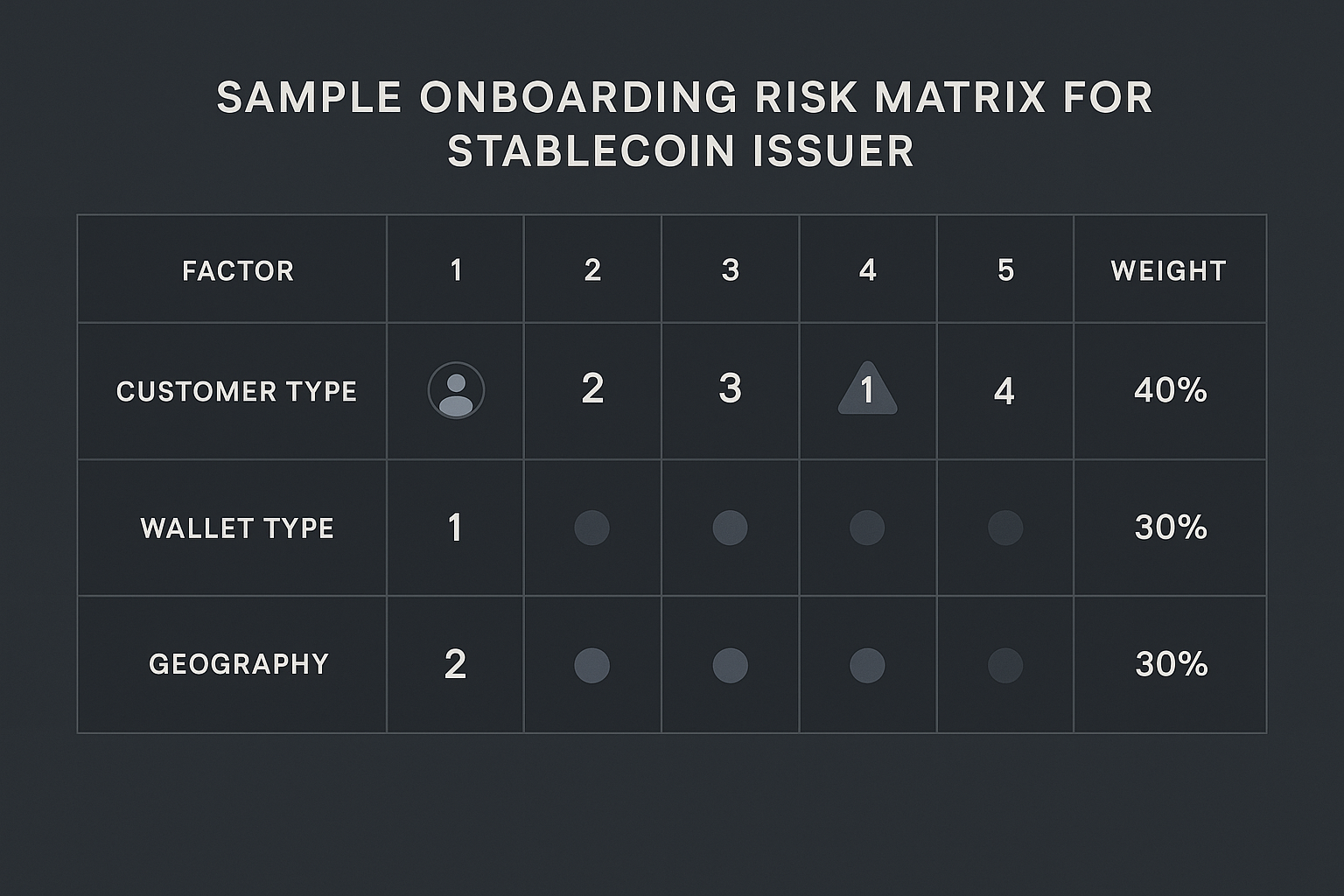
| Factor | Low risk (1) | Medium (3) | High (5) | Weight (illustrative) |
|---|---|---|---|---|
| Customer type | Regulated FI in HK | Regulated VASP (non-HK) | Private corporate/individual | 25% |
| Wallet type | Hosted at HK bank/VASP you have assessed | Hosted VASP with partial info sharing | Unhosted/self-custody | 25% |
| Geography | HK, FATF “regular” cooperation | Mixed exposure | Sanctions/high-risk jurisdictions | 15% |
| Source of funds/wealth | Audited, verified banked flows | Limited docs | Cash‑intensive/VA‑native, unverifiable | 10% |
| On‑chain risk (KYT) | Clean history, no sanctions | Some mixing exposure | Sanctions/mixer/marketplace red flags | 15% |
| Intended use | Payroll/B2B settlements | Trading/OTC | Cross‑jurisdictional P2P with privacy tools | 10% |
Example thresholds (illustrative only): ≤2.0 low, 2.1–3.4 medium, ≥3.5 high. In the sandbox, document why you set each threshold and show data from your first 100 onboardings.
Controls for unhosted wallets Unhosted wallets are explicitly called out by HKMA as higher risk due to anonymity and layering potential. Don’t ban them blindly; gate them.
- Proof-of-ownership: require a signed message or micro‑transfer from the self-custody address plus liveness check.
- Address screening and whitelisting: KYT the address and maintain per‑customer address whitelists; re‑screen on material changes.
- Friction and limits: lower load/redeem caps (e.g., HKD 50k/day; illustrative), slower settlement, and enhanced review for the first N transfers.
- Travel Rule alignment: if interacting with a VASP, collect/transmit originator/beneficiary info per FATF; decline if the counterparty VASP can’t reciprocate.
- Deny‑list capability: technical ability to block redemptions and freeze when legally required. Design this before issuance, not after.
Ongoing monitoring, including non‑customers Stablecoins circulate. The issuer’s AML lens must extend beyond direct customers to secondary market flows and redemptions by non‑customers.
- Secondary market sweeps: continuous KYT on token flows touching your treasury, issuer wallets, market‑maker pools, and redemption desk.
- Non‑customer redemptions: treat the institution hosting the redeemer’s wallet as your primary due diligence target. No verified host? Apply unhosted controls plus enhanced CDD on the redeemer.
- Segregation and auditability: keep client VA segregated and maintain reconciled ledgers that map on‑chain addresses to customer records for audit.
What to do this month
- Finalise your risk matrix, weights, and thresholds; test against 20–50 historical cases (synthetic if needed) and document outcomes.
- Sign information‑sharing MOUs with your top three hosted VASP partners for wallet‑holder verification.
- Implement proof‑of‑ownership and address whitelisting for unhosted wallets before your first sandbox mint.
- Build event‑driven monitoring (sanctions hit, mixer proximity, velocity spikes) with clear playbooks for pause, review, suspend.
- Draft Board‑approved policies covering issuance, redemption, unhosted wallets, and non‑customer monitoring; align to HKMA/FATF language verbatim where relevant.
A closing note Getting licensed will hinge on whether your onboarding and wallet controls are explainable, repeatable, and evidenced. Fancy dashboards help. Clear decisions with logs win.