
HK SFC Wallet Compliance: Hot vs Cold for VATPs
StanCompliance
January 9, 2026
Hong Kong SFC
VATP licensing
hot wallet
cold wallet
virtual asset custody
AML/CFT
private key management

HK SFC Wallet Compliance: Hot vs Cold for VATPs
If you operate a virtual asset trading platform (VATP) in Hong Kong, your wallet design is not just a tech choice. It’s a licensing decision.
Below is how the SFC frames hot vs cold custody today, what examiners actually look for, and how to make decisions you can defend.
What the SFC expects (and where it’s written)
- VATP Guidelines (Part X): The SFC’s Guidelines for Virtual Asset Trading Platform Operators set custody expectations around private key management, cybersecurity, segregation, incident response, and business continuity. See Part X here: Guidelines for Virtual Asset Trading Platform Operators (SFC).
- Custody regime coming for standalone custodians: The SFC’s public consultation on virtual asset custodian services signals alignment with VATP custody requirements and explicitly highlights private key management, cybersecurity, and business continuity, plus the need for an external assessor during licensing for key-safekeeping custodians. Consultation paper: SFC consultation on custody (overview) and fintech@sfc.hk for process queries.
- AML/CFT wallet risk management: The AML/CFT Guideline specifies different due diligence for customers using custodial wallets (by an FI/VASP) versus self-hosted/unhosted wallets, with additional controls for unhosted wallets. See: SFC AML/CFT Guideline for LCs and VATPs and the SFC/HKMA joint circular on intermediaries’ virtual asset-related activities.
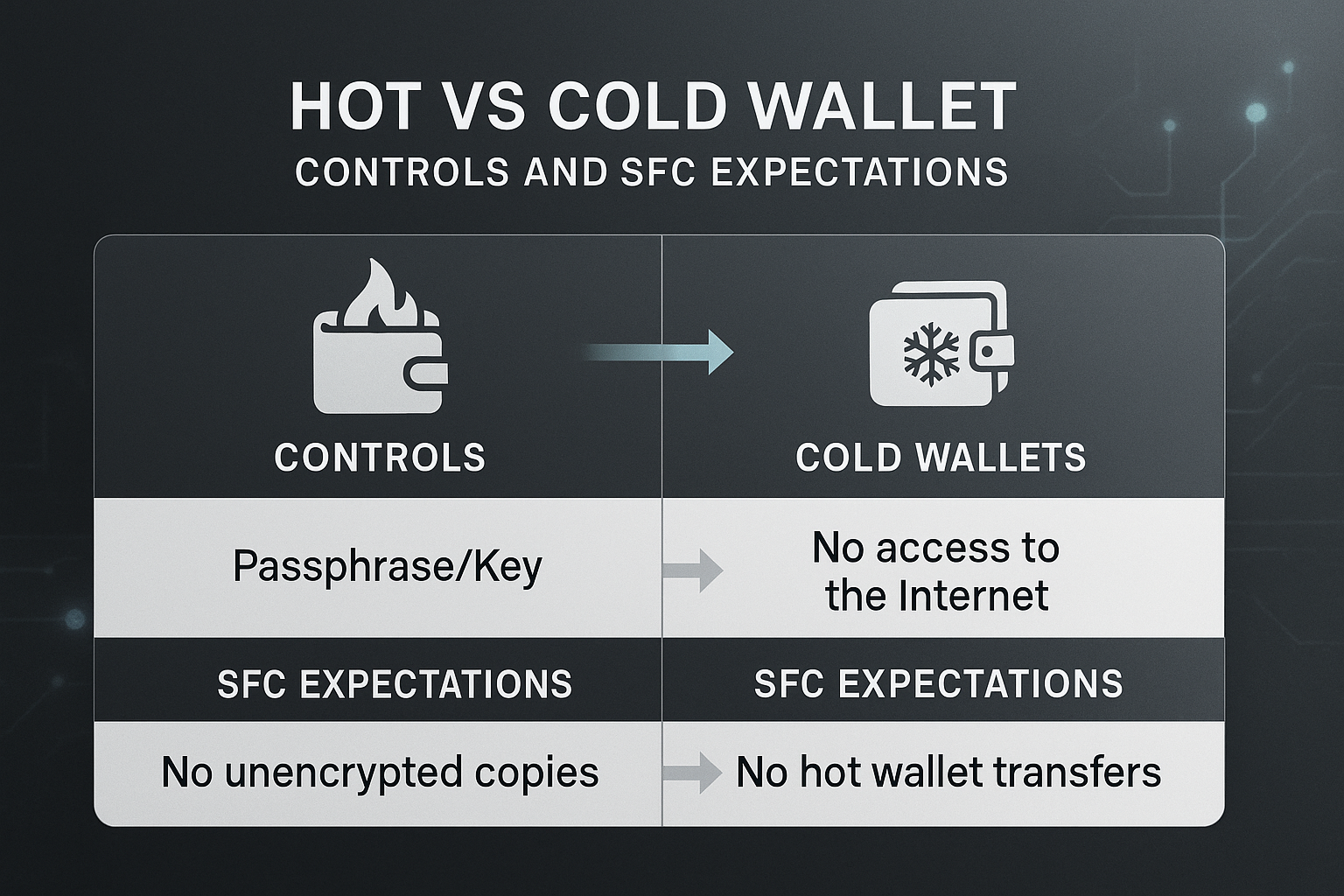
Hot vs cold: what “good” looks like under SFC scrutiny
- Cold wallet (offline)
- Role: Primary storage for client assets; designed to be offline with tightly controlled access.
- SFC lens: Strong segregation, documented key ceremonies, dual-control, tamper-evident processes, periodic reconciliations, robust disaster recovery.
- Hot wallet (online)
- Role: Operational liquidity for withdrawals and market operations.
- SFC lens: Minimise exposure, set daily limits, continuous monitoring, real-time alerting, insurance or compensation arrangements commensurate with residual risk.
Practical split and controls (what we see passing)
- Calibrate exposure: Keep hot wallet balances to operational necessity only. Many applicants model “low single-digit percent” of client assets in hot wallets (illustrative: 1%–3%), with auto-sweeps to cold. Document the methodology; don’t just pick a number.
- Enforce withdrawal workflows: Risk-based tiers, velocity checks, address whitelisting, and human-in-the-loop approval for unusual patterns.
- Key management specifics:
- Use multi-party controls (e.g., multi-signature or MPC) with hard separation of duties.
- Formal key ceremonies with independent witnesses, video evidence, and immutable logs.
- Secure key components in HSMs or equivalent with tamper response and strict access reviews.
- Insurance/compensation framework: Map coverage to wallet types and residual risks. Be prepared to justify any uninsured exposure and how you’d make clients whole.
- BCP and incident response: Prove you can fail over custody operations without exposing private keys. Tabletop exercises matter.
AML/CFT: wallets are not all equal
- Custodial wallets (by FIs/VASPs): Perform counterparty due diligence on the custodian, assess jurisdictional risk, and obtain comfort on their controls.
- Self-hosted/unhosted wallets: Apply additional controls—enhanced blockchain analytics, travel rule adherence, source of funds checks, and stricter withdrawal whitelisting. Document exceptions with a senior sign-off.
Governance and external assessment
- Expect an external assessor at licensing if you safekeep private keys (the SFC flagged this for custodians and aligns standards with VATPs).
- Give the assessor an auditable trail: architecture diagrams, control matrices mapped to Part X, penetration test results, and evidence of reconciliation/incident drills.
What to do this quarter
- Set (and justify) a hot-wallet cap tied to actual withdrawal data; implement auto-sweeps.
- Run and record a full key ceremony; refresh access reviews; rotate any stale key shares.
- Rehearse a compromise scenario end-to-end, including client comms and cold-wallet restoration.
- Tighten unhosted wallet controls in line with the AML/CFT Guideline; document the rationale.
- Line up your external assessor early; close gaps before filing.
The punchline Cold-first, hot-only-as-needed. If you can explain every control to a regulator in three sentences—and back it with logs—you’re on the right path.
Key documents:
- SFC Guidelines for Virtual Asset Trading Platform Operators (Part X): https://www.sfc.hk/-/media/EN/assets/components/codes/files-current/web/guidelines/Guidelines-for-Virtual-Asset-Trading-Platform-Operators/Guidelines-for-Virtual-Asset-Trading-Platform-Operators.pdf
- SFC AML/CFT Guideline (LCs and VATPs): https://www.sfc.hk/en/Rules-and-standards/Anti-money-laundering-and-counter-financing-of-terrorism/Guidelines
- SFC/HKMA joint circular on intermediaries’ VA-related activities: https://www.sfc.hk/en/News-and-announcements/Policy-statements-and-initiatives/Virtual-assets
- SFC consultation on VA custodian services and external assessor expectation: https://www.sfc.hk/en/Regulatory-functions/Intermediaries/Virtual-assets (and fintech@sfc.hk for queries)


