HK SFC VATP Compliance: Real-Time Monitoring by StanCOMP

HK SFC VATP Compliance: Real-Time Monitoring by StanCOMP
The SFC isn’t just asking VATPs to “monitor.” It expects continuous, risk-based surveillance across order books, on-chain flows, custody movements, and client behavior — with documented triggers, escalation, and outcomes. If you operate in Hong Kong’s regime that commenced in June 2023, you’re already under the microscope.
And in 2025, the lens got sharper.
What changed in 2025 (and what’s coming next)
- The SFC’s Guidelines for Virtual Asset Trading Platform Operators (see Part X) harden expectations around market surveillance and AML/CTF controls. Link: Guidelines for VATP Operators (PDF).
- The SFC/HKMA joint circular on intermediaries’ VA activities underscores investor protection and distribution safeguards that spill over into exchange onboarding/monitoring when dealing with intermediaries. Link: Joint circular on VA-related activities.
- The SFC’s 7 April 2025 circular on SFC-authorised funds with VA exposure reinforces data lineage, valuation, and risk monitoring expectations that VATPs servicing those funds must be ready to support. Link: SFC circulars (7 Apr 2025).
- FSTB’s 2024 consultation to bring VA OTC trading into scope signals that OTC venues and brokers will face licensing-style AML/CTF and surveillance obligations similar to VATPs. Link: FSTB virtual assets policy page.
- Custody will not be a blind spot: the joint FSTB/SFC consultation to regulate VA custodian services points to segregation, incident reporting, and audit-ready controls. Link: FSTB public consultations.
- Stablecoin policy work and AML consultation conclusions emphasise that participants in stablecoin transfers must exchange essential information for transaction monitoring, sanctions screening, and risk mitigation. Link: HKMA stablecoin consultation conclusions.
Bottom line: real-time monitoring is no longer optional or “best effort.” It’s table stakes.
What the SFC expects your “real-time” to actually catch
- Market abuse: wash trading, spoofing/layering, pump-and-dump patterns, cross-market manipulation, insider dealing indicators.
- On-chain AML: exposure to sanctioned or high-risk wallets, mixers/tumblers, darknet services, cross-chain obfuscation patterns.
- Fiat/VA flow anomalies: rapid in-and-out, structuring, mule behavior, velocity spikes post-onboarding, “smurfed” deposits.
- Custody events: unexpected address changes, hot–cold transfer anomalies, withdrawal spikes, threshold breaches.
- Investor protection: leverage/derivatives misuse, suitability breaches when dealing with intermediaries or retail boundaries.
How StanCOMP implements real-time monitoring for VATPs and OTCs
- Event bus architecture: We wire your matching engine, wallet infrastructure, payment rails, and case system into a streaming pipeline with sub‑minute detection. Typical alert latency: under 60 seconds (illustrative).
- Combined market + chain analytics: We correlate order-book behavior with blockchain risk scores and travel rule payloads to reduce false positives.
- Stablecoin-aware screening: We ingest stablecoin transfer metadata where available to support sanctions screening and beneficiary origin validation consistent with evolving Hong Kong policy.
- OTC coverage: We extend the same controls to OTC desks/shops, including counterparty profiling, quote-to-trade drift checks, and cash/VA reconciliation.
- Audit-by-design: Every alert has lineage (rule version, data source, timestamp) and an outcome trail aligned with AMLO/JFIU reporting.
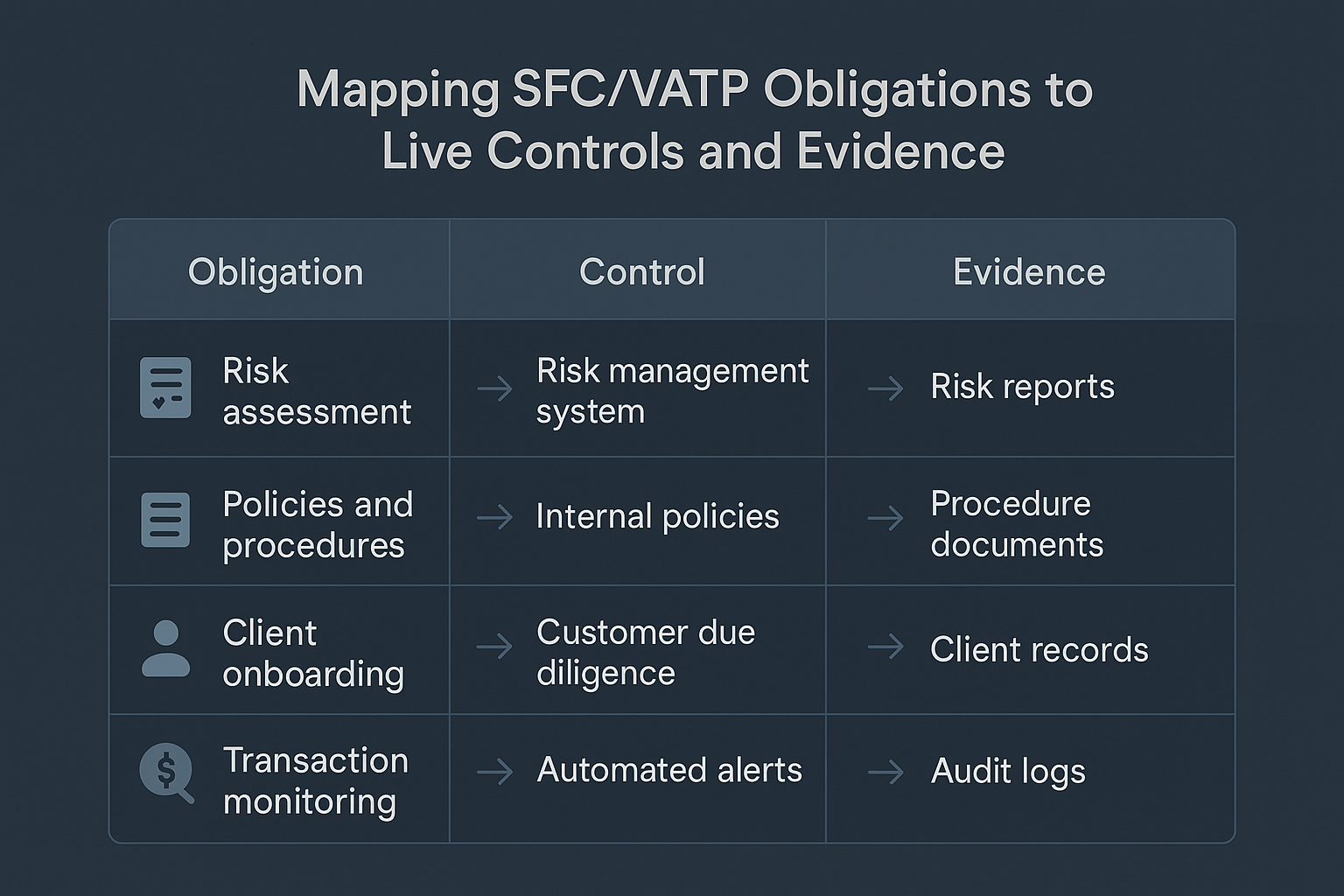
- Obligation: Detect manipulative trading (Guidelines Part X) Control: Real-time spoofing/wash-trade detector on order events Evidence: Alert logs, case notes, eComms review linkage, rule tests
- Obligation: AML/CTF ongoing monitoring (AMLO) Control: On-chain wallet screening + behavioral velocity rules Evidence: Risk scores, STR decisioning trail, SAR/JFIU references
- Obligation: Sanctions/transfer information for stablecoins Control: Sanctions hits + travel rule payload validation (IVMS-like) Evidence: Payload archive, screening outcomes, escalation timestamps
- Obligation: Custody safeguards (custodian consultation trajectory) Control: Hot–cold reconciliation + anomaly thresholds Evidence: Segregation reports, exception tickets, incident drills
A practical 90‑day plan
- Days 0–15: Gap assessment against SFC VATP Guidelines and joint circulars; data inventory for matching engine, wallets, fiat rails; define risk taxonomy.
- Days 16–45: Deploy event bus and baseline rules; connect to blockchain analytics and sanctions providers; pilot alert playbooks with investigators.
- Days 46–75: Calibrate thresholds; add cross-market manipulation models; integrate Travel Rule payload checks for stablecoins.
- Days 76–90: Run red-team scenarios (spoofing, mixer exposure, custody anomaly); finalize governance (KRI dashboard, breach matrix, board MI).
What good looks like (illustrative targets)
- Alert latency: ≤60s for high-severity events
- False positive rate: <30% after 60 days of tuning
- Coverage: ≥95% of deposit/withdrawal addresses risk-scored
- Escalation: Tier-1 triage ≤10 minutes; STR decision ≤24 hours for criticals
Compliance notes and links you should bookmark
- SFC Guidelines for VATP Operators (Part X): https://www.sfc.hk/-/media/EN/assets/components/codes/files-current/web/guidelines/Guidelines-for-Virtual-Asset-Trading-Platform-Operators/Guidelines-for-Virtual-Asset-Trading-Platform-Operators.pdf
- Joint circular on intermediaries’ VA activities: https://www.sfc.hk/en/news-and-announcements/policy-statements-and-announcements/joint-circular-on-intermediaries-virtual-asset-related-activities
- SFC circulars (7 Apr 2025 funds with VA exposure): https://www.sfc.hk/en/news-and-announcements/circulars
- FSTB virtual assets policy/consultations (OTC, custodians): https://www.fstb.gov.hk/en/financial-services/policy-initiatives/virtual-assets.html
- HKMA stablecoin consultation conclusions: https://www.hkma.gov.hk/eng/news-and-media/press-releases/2024/01/20240131-3/
If you’re building or upgrading monitoring in Hong Kong, get the architecture right once. Then prove it works — in real time, with evidence. StanCOMP can help you do both.