HK RWA Licensing: Fit-and-Proper Compliance Guide 2025

HK RWA Licensing: Fit-and-Proper Compliance Guide 2025
Tokenisation moved from pilot to production in Hong Kong. With tokenised government bonds and a stated push to expand RWAs and financial product tokenisation under Policy Statement 2.0, founders now face a blunt question: who needs to be “fit and proper” — and what does that mean for your licence application?
Short answer: more people than you think, and the bar is higher than last year.
What “fit and proper” means in 2025 (for RWA, OTC VA, and custody)
Across the Government’s consultations, the principle is consistent: no licence or registration without fit-and-proper personnel and governance.
- OTC VA dealers: proposals require a Money Laundering Reporting Officer (MLRO) and other fit-and-proper personnel responsible for compliance and competence. Expect demonstrable knowledge, experience, and a proper corporate governance structure. See the consultation on OTC VA trading by the Financial Services and the Treasury Bureau (FSTB) for details.
- Virtual Asset Custodians: fit-and-proper applies to substantial shareholders and individuals carrying out custodian functions. The SFC will consider conduct, integrity, competence, financial soundness, and risk management; the intent is to align with existing VATP licensing criteria under the Anti-Money Laundering and Counter-Terrorist Financing Ordinance (AMLO). Market development items (e.g., staking) are being considered, with added conduct and risk controls.
- Banks: where banks engage relevant individuals in VA custody, they must also ensure those individuals are fit and proper.
References: FSTB’s virtual asset policy and consultations: https://www.fstb.gov.hk/en/financial-services/policy-initiatives/virtual-assets/ and Policy Statement 2.0 highlights via HKSAR announcements.
This is where most applications stall.
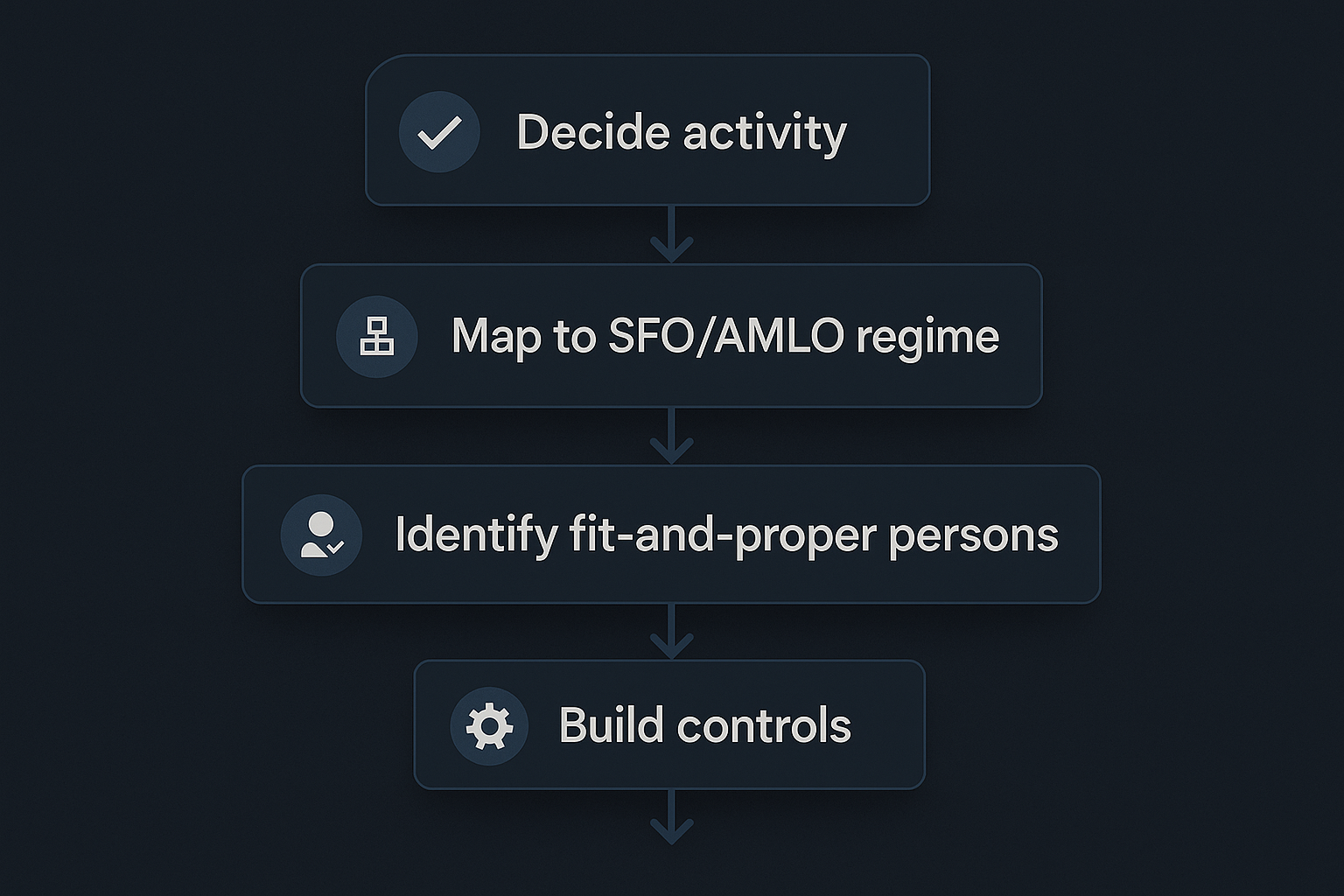
Map your RWA model to licences first
- Tokenisation arranger (securities): if you arrange or distribute tokenised securities (e.g., bonds, funds, private credit), SFO licences may be in scope (Type 1/4/9 depending on activity).
- RWA trading venue: non-security VA trading falls under the VATP regime (AMLO). Security token trading may require an ATS (Type 7) plus relevant SFO types.
- Virtual asset custody: prepare for the dedicated VA custodian service regime under AMLO; the SFC has signalled alignment with VATP standards.
- OTC VA distribution: the proposed OTC regime will bring dealers into scope under AMLO, with MLRO and governance requirements.
The fit-and-proper pack (what the SFC looks for)
| Criterion | What to show on day one | Common pitfalls |
|---|---|---|
| Honesty, integrity, reputation | Clean regulatory/criminal checks; disclosure of past roles | Incomplete disclosures; undisclosed Singapore/Malaysia actions |
| Competence/experience | Role-specific CVs; VA/RWA operations playbooks; product risk notes | “Generic crypto experience” with no custody or settlement depth |
| Financial soundness | Audited financials; capital plans; insurance quotes | Thin runway; no client asset insurance exploration |
| Governance | Board minutes; MIC/RO matrices; three-lines-of-defence | MLRO reporting to ops lead (independence issue) |
| Risk & AML | End-to-end AML manual; Travel Rule; STR playbook to JFIU | No on-chain analytics; weak sanctions/PEP screening |
Note: numbers you attach to capacity planning can be illustrative but defensible. For example, “initial monitoring coverage: 100% of VA transfers; alert review SLA: 24 hours; two FTE analysts per 1,000 monthly alerts (illustrative).”
MLRO: non-negotiables for OTC VA and custodians
- Direct reporting line to the Board or an independent committee.
- Proven AML/CFT knowledge and VA-specific typologies (mixers, chain-hopping, OTC cash risks).
- Travel Rule implementation aligned with AMLO expectations; counterparty due diligence for VASPs.
- Documented JFIU STR procedures, with decision logs.
- On-chain analytics in transaction monitoring; model governance for alert tuning.
- Training cadence: at least semi-annual firm-wide; quarterly for high-risk teams (illustrative).
Custody-specific controls for RWA tokens
- Segregation: client-by-client wallet segregation with daily reconciliation.
- Key management: HSM/MPC, dual (or 4-eyes) controls, geo-key split, break-glass procedures.
- Settlement ops: cut-offs, failed-settlement playbook, attestations for off-chain assets backing tokens.
- Insurance: crime and specie policies; clarify hot/warm/cold coverage.
- Staking (if permitted in final rules): opt-in only, client disclosures, slashing/lock-up risk controls, validator due diligence.
What to do this month
- Run a fit-and-proper gap assessment for substantial shareholders, directors, MLRO, and custody ops leads.
- Finalise governance maps (Board/MIC/RO), escalation paths, and independence statements.
- Build the AML/CFT package: Travel Rule workflow, blockchain analytics, STR playbook, training plan.
- For RWA tokens, document the legal link between token and asset (trust deed, custodian confirmations, audit trails).
Final word
Hong Kong supports RWAs — regular tokenised bond issuances and a maturing VA framework underscore that. But licences will hinge on people and proof. Get the fit-and-proper story airtight, and the rest of your application stands a far better chance.