
HK Risk-Based Compliance for e-HKD & CRS | StanCOMP

HK risk-based compliance for e-HKD and CRS: what to fix before 2030
Hong Kong is tightening the rails around digital assets and data-sharing—without killing innovation. The HKMA’s e-HKD pilots are deepening, the SFC/HKMA perimeter for OTC and custodians is firming up, and the FATF’s June 2025 signal to prepare AML/KYC upgrades by 2030 gives everyone a hard horizon. If you run a bank, VA intermediary, custodian, or OTC desk in Hong Kong, this is the window to rebuild your risk-based approach (RBA) so it covers CBDC-era payments and Common Reporting Standard (CRS) reporting—cleanly, and once.
The direction is clear. Hong Kong’s Policy Statement 2.0 commits to efficient risk management and liquidity, with regular reviews and engagement to keep rules aligned with tech and market change. The FSTB’s consultations on OTC and custody stress giving the SFC and HKMA sufficient “regulatory handle,” plus information sharing to investigate suspected non-compliance. And globally, the FATF wants regulators and institutions to start gap analyses now, with 2030 as the upgrade finish line.
This isn’t a paperwork exercise.
It’s a data and control redesign.
What “risk-based” means for e-HKD and CRS
A few ground rules:
- e-HKD is a central bank digital currency under the HKMA—not a “virtual asset.” That said, your group could still be in SFC/HKMA scope for VA OTC or custody depending on your business lines.
- CRS obligations attach to Reporting Financial Institutions (RFIs). If an e-HKD wallet/account is held at a bank or custodian qualifying as an RFI, CRS diligence and reporting may apply. Map product features carefully.
Useful links:
- HKMA e-HKD overview: https://www.hkma.gov.hk/eng/key-functions/digital-ecosystems/central-bank-digital-currency/e-hkd/
- FSTB — VA policy initiatives, OTC and custody consultations: https://www.fstb.gov.hk/en/financial-services/policy-initiatives/virtual-assets.html
- SFC — VA trading platforms: https://www.sfc.hk/en/Regulatory-functions/Intermediaries/Virtual-asset-trading-platforms
- FATF Recommendations: https://www.fatf-gafi.org/en/publications/Fatf-recommendations.html
- IRD — AEOI/CRS in Hong Kong: https://www.ird.gov.hk/eng/tax/dta_aeoi.htm
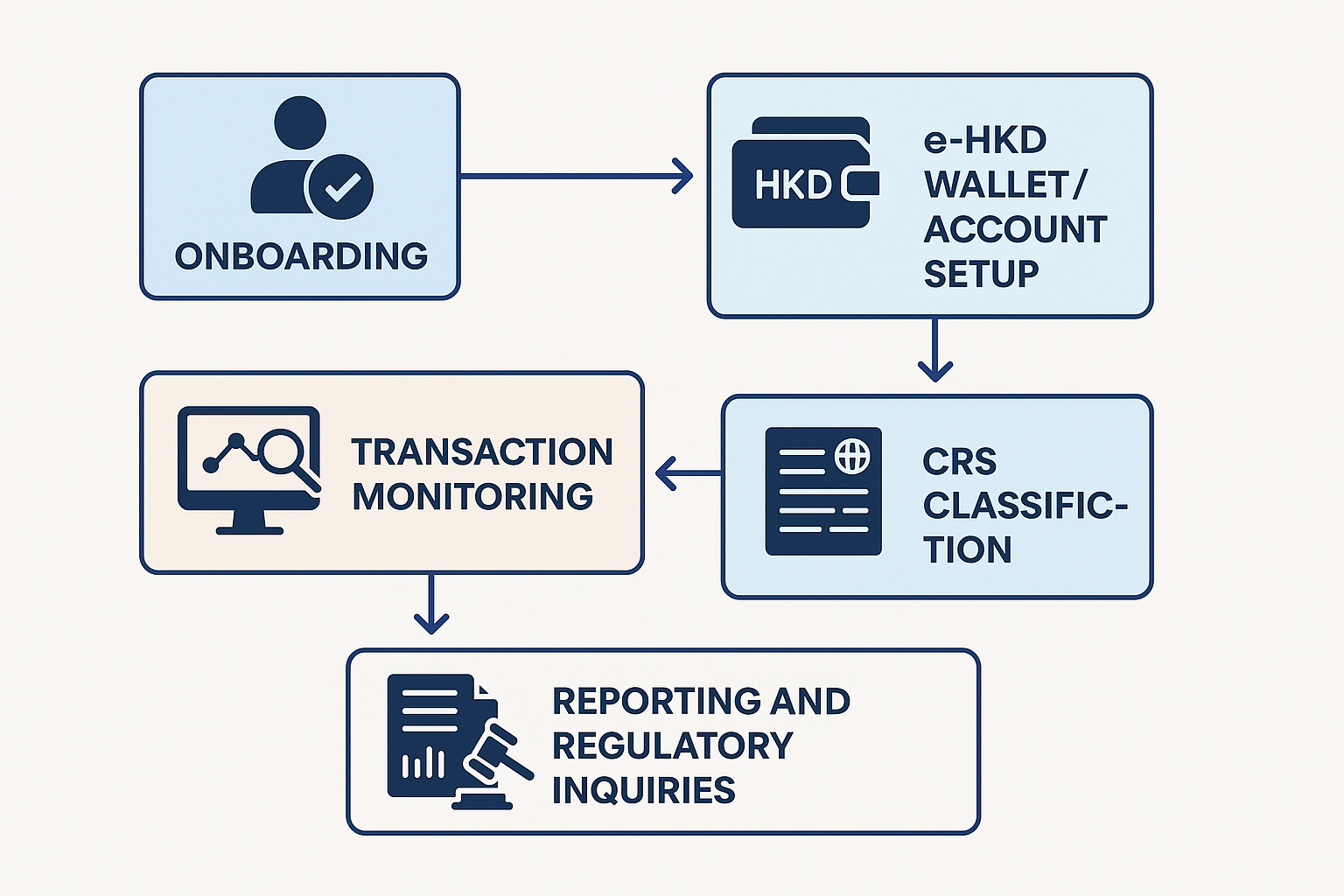
A simple, pragmatic RBA blueprint
- Customer risk
- Segment by residency, occupation/industry (e.g., cash-intensive MSMEs), and source of funds. Add CBDC-specific flags (e.g., programmable-payment use, high-velocity wallet patterns).
- Product/channel risk
- Distinguish e-HKD retail wallets vs. integrated treasury features; branch vs. API onboarding; linkages to VA services (OTC/custody) within the same group.
- Geographic risk
- CRS relies on tax residency; maintain robust address and TIN validation for cross-border clients using e-HKD rails domestically.
- Transaction risk
- Calibrate alerts for micro-structuring and wallet-to-wallet layering. Build rules for programmable triggers (e.g., escrow release) that can mask illicit flows.
Controls that work in Hong Kong’s 2025–2030 runway
| Pillar | e-HKD use-case | CRS angle | Controls to implement now |
|---|---|---|---|
| Onboarding | Retail wallet via bank | Determine RFI status | Collect self-certification at account setup; validate TINs; store residency evidence versioned |
| Activity | SME supplier payments (programmable) | No direct change, but affects risk | Scenario models for scheduled/milestone disbursements; velocity and counterpart clustering |
| Linkages | Bank + group OTC desk | Separate regimes may apply | Legal entity mapping; Chinese walls; SFC/HKMA-perimeter inventory and referral controls |
| Investigations | Regulatory inquiries | AEOI + AML | Case files that export both AML and CRS artefacts; audit trails aligned to SFC/HKMA requests |
| Governance | Policy refresh | FATF 2030 | Annual RBA refresh tied to tech changes; board-approved roadmap to 2030 |
A 90-day plan we’ve seen succeed
- Weeks 1–3: Perimeter map
- Catalogue all e-HKD touchpoints, VA OTC/custody lines, and which entities are RFIs. Decide which products trigger CRS.
- Weeks 4–6: Data model and taxonomy
- Standardize tax residency fields, documentary evidence, wallet identifiers, and transaction metadata needed for AMLO, CRS, and potential SFC/HKMA requests—once, centrally.
- Weeks 7–10: Controls build
- Deploy enhanced eKYC (address/TIN validation), programmable-payment risk rules, and alert feedback loops. Define escalation paths when e-HKD flows touch VA services.
- Weeks 11–13: Testing and auditability
- Run red-team scenarios (e.g., micro-structuring via programmable splits). Produce mock regulator packs referencing HKMA/SFC consultations and FATF guidance.
Why this fits Hong Kong’s trajectory
- It aligns with Policy Statement 2.0’s call for efficient risk management and liquidity support while staying innovation-friendly.
- It anticipates OTC and custody regulation, ensuring the SFC/HKMA have a clear “handle” over your group’s data and governance.
- It satisfies the FATF June 2025 push to start AML/KYC gap analyses targeting 2030 completion.
Bottom line: build an e-HKD-and-CRS-ready RBA now, so 2030 is a non-event—not a scramble. If you want a sanity check, we can review your perimeter map and 90‑day plan in one working session and tell you exactly where the gaps are.


