
HK Retail Stablecoins: KYT & Custody Insurance Guide

HK Retail Stablecoins: KYT & Custody Insurance Guide
If you’re preparing a retail stablecoin product in Hong Kong for 2025, two questions will decide how quickly you clear licensing reviews and audits: how you run Know Your Transaction (KYT), and how you insure custody. Both are now front-and-centre in the HKMA’s and FSTB’s consultation conclusions, which emphasise due diligence on custodial wallet providers and extra safeguards for unhosted wallets, plus segregation, audit and full AML/CFT for any issuer that also custodies its own stablecoin.
Start here.
What regulators expect right now
- Identify the holder, even at retail: Citing FATF’s cautious approach, Hong Kong signals that at the start of its stablecoin framework, any stablecoin holder may be subject to identification and verification. See the AML/CFT consultation conclusions on stablecoins (e.g., paras 2.17 and Q2).
- Custodial wallet providers are in-scope: Whether a bank or a VASP, the entity providing the custodial wallet must perform due diligence and implement additional controls to mitigate unhosted wallet risks. This applies both at issuance and redemption.
- Issuer-custodian oversight: If a stablecoin issuer carries on custody of the stablecoins it issues, it will be under HKMA’s ongoing supervision, with investor protection via client asset segregation, adequate audit, record-keeping, and the full AML/CFT suite. See the Public Consultation on Legislative Proposal to Regulate Virtual Asset Custodian Services.
Links:
- HKMA/FSTB stablecoin AML/CFT consultation conclusions: https://www.hkma.gov.hk/eng/key-functions/international-financial-centre/virtual-assets/
- Public Consultation on Legislative Proposal to Regulate Virtual Asset Custodian Services: https://www.fstb.gov.hk/en/press/legco/financial-services/index.html
- SFC Guideline on AML/CFT for VASPs (Travel Rule and wallet controls): https://www.sfc.hk/en/Regulatory-functions/Intermediaries/Anti-money-laundering-and-counter-financing-of-terrorism
KYT that actually passes inspection
For retail flows, the bar is real-time, risk-based, and explainable.
- Sanctions and watchlist controls at address and transaction level, including smart-contract blocklist/freeze events from major stablecoin issuers (e.g., on-chain freeze/blacklist logs).
- Counterparty risk scoring using two independent analytics providers and an internal rules layer; tune thresholds by token, chain, and channel (off-ramp vs P2P).
- Travel Rule compliance for VA transfers at or above the applicable threshold under AMLO/SFC guidance; auto-orchestrate Travel Rule messaging and block if beneficiary VASP identity cannot be verified.
- Unhosted wallet controls: ownership verification (SCA challenge-sign), allowlists, and velocity limits for first 30 days.
- Scenario analytics: mixing/tumbler detection, sanctioned exchange exposure, phishing/drainer patterns, exploit tags, OFAC 50% rule logic, and rapid ingestion of ad-hoc risk advisories within 24 hours.
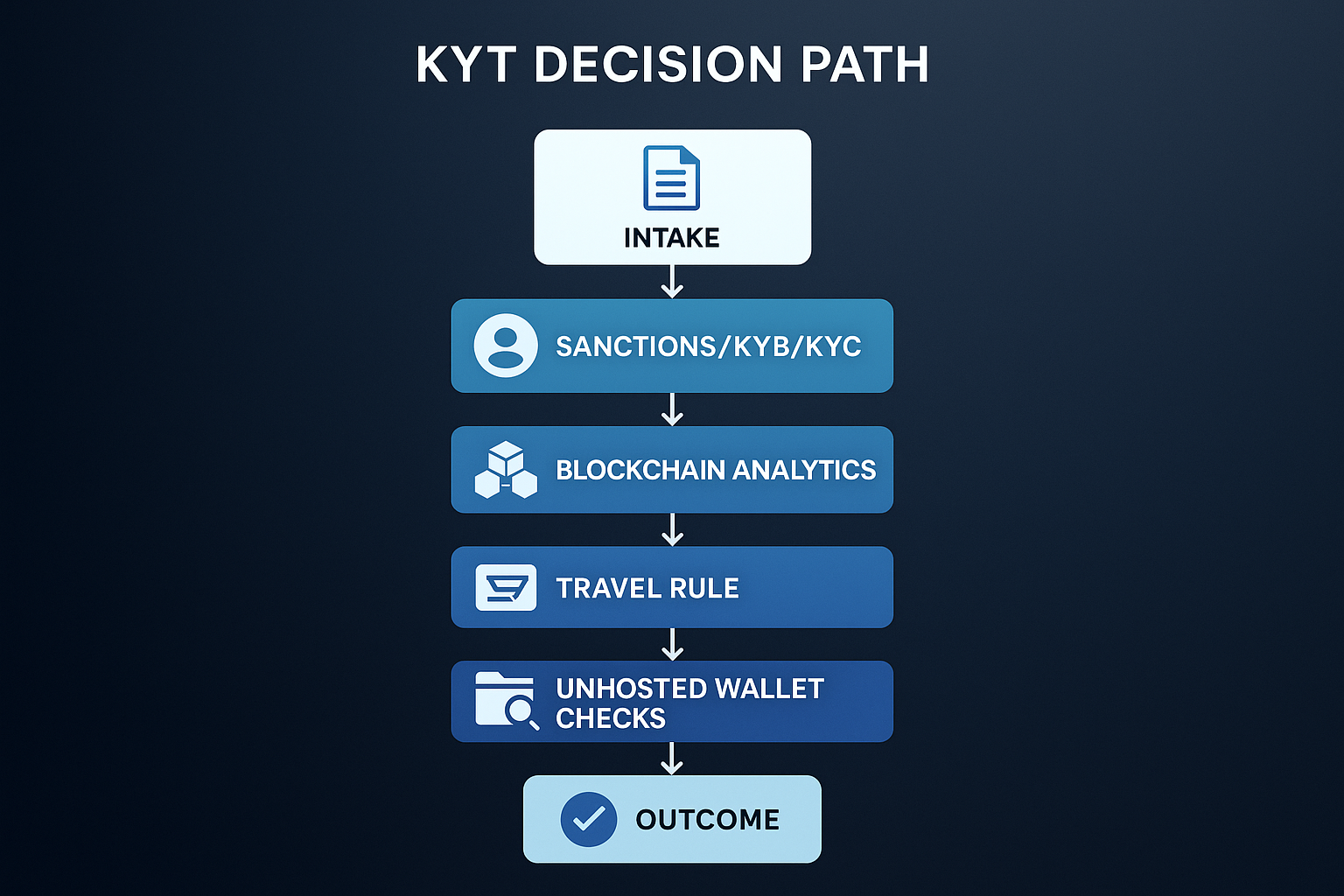
Table: What examiners will ask for
| Control | Why it matters | Evidence you should have |
|---|---|---|
| Dual-provider chain analytics | Model risk and coverage gaps | Contracts, coverage matrix, alert benchmarking, model-tuning logs |
| Travel Rule enforcement | FATF-aligned VA transfers | Message logs, counterparty-VASP due diligence, rejection stats |
| Unhosted wallet verification | Retail de-risking | Address-proof records, allowlist approvals, velocity rule configs |
| Smart contract freeze/blacklist monitoring | Stablecoin-specific risk | Event subscriptions, incident runbooks, case audit trails |
| QA and backtesting | Reduce false positives | Monthly tuning reports, precision/recall metrics (illustrative target: 85% precision) |
Virtual asset custody insurance: what’s realistic in 2025
- Structures you can actually buy: crime (including employee dishonesty and social engineering), cold-storage specie, and cyber. Hot-wallet limits are lower; cold storage gets better capacity.
- Typical market terms (illustrative): USD 20–100m aggregate limits; USD 1–5m deductibles; hot wallet sublimit at 10–20% of total; proof-of-reserves attestations as underwriting conditions.
- Key clauses to negotiate:
- Client asset segregation and bankruptcy-remote trust language aligned with the custodian regime.
- Clear definition of “computer fraud” for smart contract admin-key abuse.
- Off-chain reserve/cash management exclusions if you are also the issuer—bridge with a separate financial institutions bond and a reserve attest.
- Who is insured: if you custody as an issuer, ensure you (issuer), the custodian entity, and end-customers (as loss payees) are appropriately named. Auditors will ask.
Unhosted wallets: minimum viable controls
- Prove address ownership before first withdrawal and on material changes.
- Tier limits: new addresses capped to low daily limits for 30 days; raise only after clean KYT history.
- Ban direct flows to known mixers or sanctioned contracts; require intermediate clean hops if policy permits.
What to do this quarter
- Run a KYT gap analysis against the controls above; fix Travel Rule orchestration and unhosted verification first.
- Lock in an insurance broker with VA specialty; test the market with separate cold/hot schedules and provide SOC 2 + key-management docs.
- Document how you meet issuer-custodian expectations: segregation ledger maps, reconciliation cadence, auditor access, and incident playbooks.
If you want a sanity check before you face an onsite, we’re happy to review your KYT tuning and insurance wording against the latest HKMA/SFC expectations.


