
HK KYT Playbook: Stablecoin & RWA Tokenisation Compliance

HK KYT Playbook: Stablecoin & RWA Tokenisation Compliance
Hong Kong just made Know Your Transaction (KYT) non‑negotiable for any serious stablecoin or tokenisation play. With the licensing regime for stablecoin issuers commencing on 1 August 2025 under the Government’s Policy Statement 2.0, the bar is no longer “good faith monitoring.” It’s precision: reserve integrity, real‑time risk flags, and audit‑proof trails. At the same time, Hong Kong is explicitly incentivising RWA tokenisation and payment use cases, but with institutional controls baked in.
This is what that looks like in practice.
What changes on 1 Aug 2025
- Licensing for stablecoin issuance comes with robust requirements on reserve asset management, stabilisation, redemption processes, and prudential risk management (see the Government’s Policy Statement 2.0).
- HKMA/FSTB’s consultation conclusions on AML for stablecoin transfers set the expectation that all participants in a stablecoin transfer have essential information to run transaction monitoring, sanctions screening, and risk mitigation end‑to‑end.
- SFC-licensed VASPs and intermediaries must align KYT with existing AML/CFT and sanctions obligations, including Travel Rule, ongoing monitoring, and suspicious transaction reporting. See HKMA’s AML/CFT Guideline and SFC’s AML Guideline for VASPs.
In short: issuance is licensed; movements are surveilled; records must stand up to inspection.
KYT data model that actually works
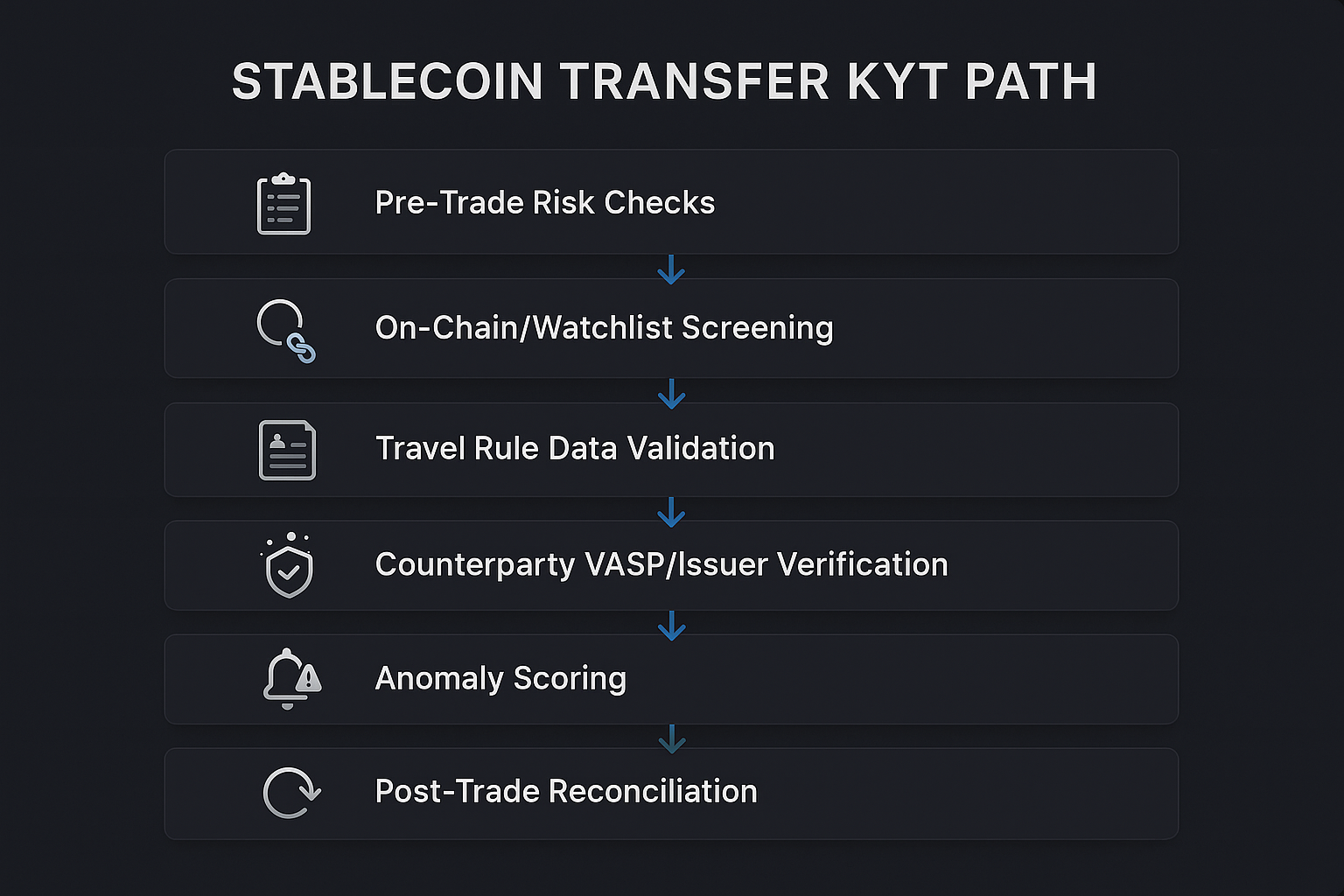
Table: Core controls and actionable triggers
| Control | Why it matters (HK) | Minimum data | Alert triggers (illustrative) |
|---|---|---|---|
| Sanctions & watchlist screening | Mandatory under HKSAR UN Sanctions/OSCO; applies to issuers, VASPs, custodians | Wallets, names, entities; jurisdiction; on-chain tags | High‑risk wallet or sanctioned nexus; ≥2 hops from known mixer |
| Wallet risk scoring | Consultation conclusions expect participants to monitor transfer risk across the chain | Source/destination addresses; chain analytics score | Score >75/100; sudden cluster change; new smart contract with no code audit |
| Counterparty verification | Only interact with licensed issuers/VASPs where applicable | Licence status, LEI, website attestations | Unknown or revoked licence; spoofed domain or mismatched attestations |
| Travel Rule compliance | Required for VASPs; stablecoin transfers between VASPs need originator/beneficiary data | Name, account/wallet, address/ID; VASP identifiers | Missing beneficiary data >1,000 HKD equiv.; checksum mismatch |
| Redemption/Reserve checks (issuers) | Policy Statement 2.0 focuses on reserve integrity and redemption | Reserve composition; custodian confirmations; mint/burn ledger | Mint without reserve inflow; redemption backlog >T+1; reserve concentration >25% single bank |
| Geo‑device anomalies | Stops mule networks and compromise events | IP/device, session metadata | Device first‑seen + high‑value; TOR/VPN + cross‑border hop |
| RWA provenance checks | Tokenisation requires source‑of‑asset validation and sanctions on obligors | Underlying asset docs, SPV registers, servicer data | Underlying obligor on a sanctions or adverse list; title gap; unenforceable pledge |
Numbers marked “illustrative”: threshold for high‑risk score (>75/100), reserve concentration (>25%), and Travel Rule trigger (>HKD 1,000 equiv.).
RWA tokenisation: the extra layers
- Two dimensions of diligence: you KYT the token flows, and you KYB/KYC the asset stack (originator, SPV, custodian, servicer, paying agent).
- Provenance must be machine‑readable. Store hashes of title, custody receipts, and offering docs on‑chain; keep originals off‑chain with notarised access logs.
- Sanctions travel upstream. Screen ultimate obligors and cashflow payers, not just token holders.
- Reconciliation rhythm: T+1 ledger-to-asset cash reconciliation; T+0 exception flagging if coupon/paydown fails.
A simple operating cadence that passes inspection
- Pre‑trade: block sanctioned/wallet‑risk >75; verify counterparty licence; validate Travel Rule payload.
- Real‑time: screen every hop; apply anomaly score; hold if score >80 or Travel Rule missing.
- Post‑trade (T+0/T+1): reconcile mints/burns to reserves (issuers) and token movements to cash events (RWA).
- Governance: independent QA on alerts weekly; model risk review quarterly; playbooks for false positives.
- Records: retain KYT decisions, screenshots, and data lineage ≥7 years; exportable within 5 business days upon request.
- Reporting: SAR promptly; monthly metrics to senior management (e.g., alert rate, time‑to‑decision, false‑positive ratio). Target time‑to‑decision <30 minutes for payment flows (illustrative).
- Testing: red‑team scenarios quarterly (bridged stablecoin from mixer; sanctioned obligor discovered post‑issuance).
Where to anchor your policies
- Government Policy Statement 2.0 (stablecoin issuance from 1 Aug 2025; RWA/tokenisation support).
- HKMA AML/CFT Guideline and circulars on virtual assets and wire‑transfer info.
- SFC AML Guideline for VASPs and licensed corporations; FATF Travel Rule.
Last word
Treat KYT as product infrastructure, not a compliance bandaid. Build the data pipes now, and the 1 August switch‑on won’t be a scramble—it will be a competitive edge.


