
HK FATF Compliance: Fit-and-Proper & EDD for VASPs

Introduction
If you’re running or planning a Virtual Asset Service Provider (VASP) in Hong Kong, two things will make or break your license journey with the SFC: proving your people are fit-and-proper, and running Enhanced Due Diligence (EDD) that actually works. The regulators have been clear: Hong Kong is aligning tightly with the Financial Action Task Force (FATF) standards on AML/CTF, customer due diligence (CDD), and record keeping. The recent consultations on virtual asset custodians and OTC dealers reinforce this direction.
Why FATF matters in Hong Kong
Hong Kong, as Hong Kong, China, is a member of the FATF, the inter-governmental body that sets global AML/CTF standards. Local regimes for VATPs, custodians, and OTC dealers are built to reflect FATF requirements on CDD, ongoing monitoring, and record keeping, with an added layer of investor protection (e.g., safe and segregated custody, financial soundness, and conflict management).
- FATF overview: https://www.fatf-gafi.org/
- SFC consultations: Custodians and OTC trading proposals emphasize FATF-aligned AML/CTF controls, CDD, and record keeping.
Fit-and-Proper: who is in scope and what the SFC looks for
Under the proposals for virtual asset custodians—as with VATPs and other SFO intermediaries—licensing hinges on fit-and-proper assessments that extend beyond the firm to people who control and operate it.
Who must be fit-and-proper:
- The applicant entity
- All substantial shareholders
- Individuals carrying out VA custodian functions
- At least two Responsible Officers (ROs) approved by the SFC (or two Executive Officers approved by the HKMA, where applicable)
What the SFC considers:
- Good standing and financial integrity (e.g., not subject to bankruptcy or liquidation proceedings)
- Competence, honesty, and sound reputation
- Governance and adequate systems to meet regulatory obligations
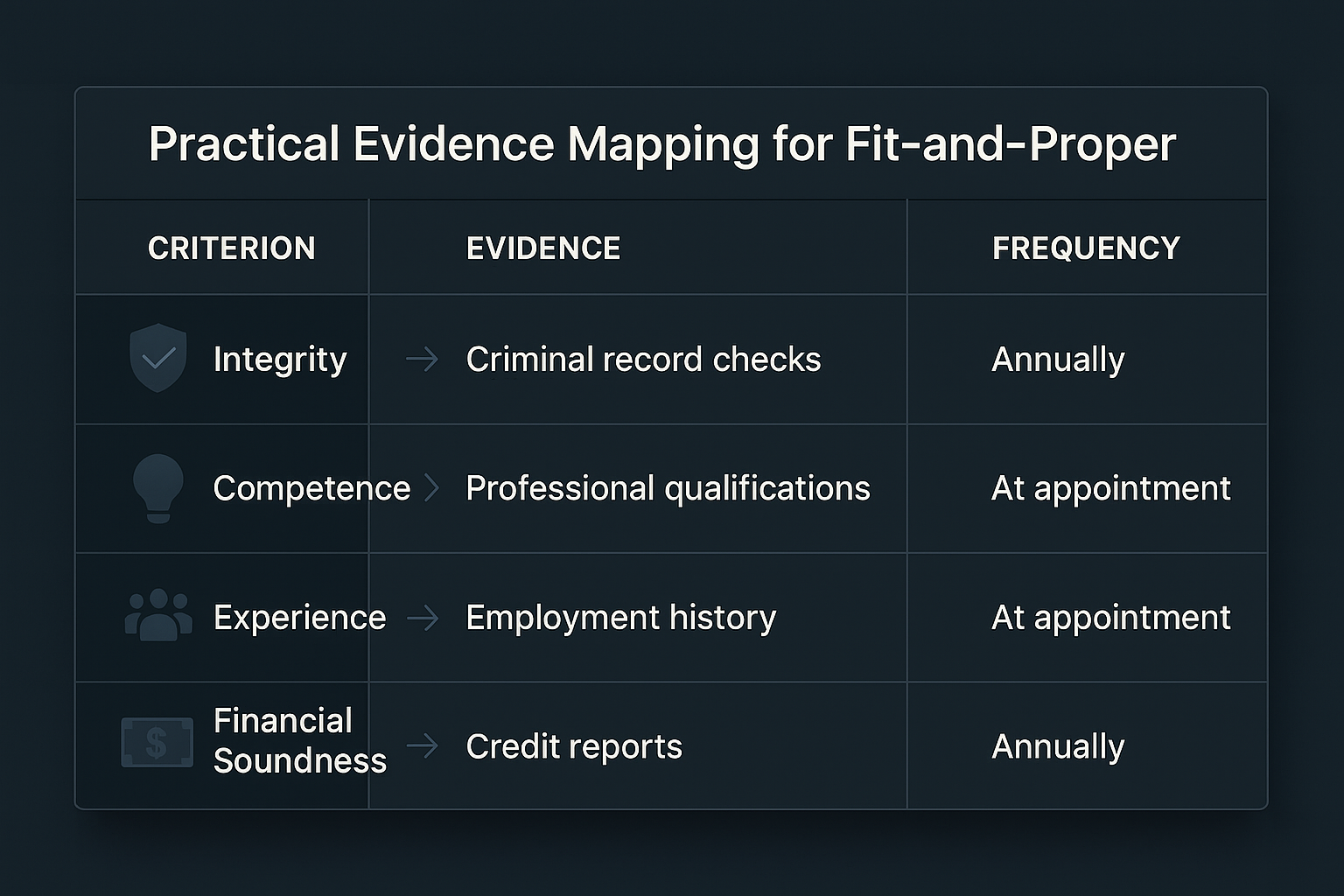
- Criterion: Financial integrity | Evidence: Bankruptcy and winding-up searches; bank reference letters; audited financials for principals (where applicable) | Frequency: At onboarding, then annually
- Criterion: Reputation and honesty | Evidence: Criminal record declarations; regulatory checks; litigation searches in HK/main operating jurisdictions | Frequency: At onboarding; refresh on trigger events
- Criterion: Competence | Evidence: CVs, role-specific training logs, job descriptions mapping to controlled functions | Frequency: At onboarding; ongoing CPD tracking
- Criterion: Governance | Evidence: Board/committee charters, compliance policies, three-lines-of-defense documentation | Frequency: On implementation; annual review
EDD for VASPs: when to escalate and what to collect
FATF expects risk-based EDD where higher ML/TF risks exist. Hong Kong’s VASP regime mirrors that: CDD is baseline; EDD is mandatory for higher-risk customers, products, or geographies, and must be documented and kept on record.
EDD triggers to hard-code into your workflow:
- Politically Exposed Persons (PEPs) and close associates
- Customers from or connected to higher-risk jurisdictions (e.g., FATF grey/black-listed)
- Complex ownership or opaque structures (trusts, layering)
- Large-value or unusual on-/off-ramp behavior; mixing services; privacy tools
- Counterparty VASP without robust Travel Rule capabilities at or above the applicable threshold
EDD measures that hold up to scrutiny:
- Source of wealth and source of funds verification with independent corroboration (payroll, tax returns, audited statements)
- On-chain tracing for high-risk deposits/withdrawals; sanctions screening at address and entity levels
- Senior management approval for onboarding/continuation
- Tighter transaction limits, enhanced monitoring scenarios, and more frequent periodic reviews
What this means for custodians and OTCs
The consultations on virtual asset custodian services and OTC trading propose licensing regimes with explicit AML/CTF obligations, including CDD and record keeping. Expect the fit-and-proper standard to apply to substantial shareholders and operational staff performing custody functions, and the requirement to appoint at least two SFC-approved ROs. OTC operators should prepare for the same FATF-aligned baseline: documented CDD, EDD for higher-risk profiles, and robust record keeping.
Do this now
- Map roles to controlled functions; nominate two ROs and evidence their competence.
- Build an EDD playbook with trigger conditions, documentary standards, and approval thresholds.
- Implement Travel Rule capability with counterparty due diligence and fallback procedures.
- Install on-chain analytics for address risk scoring and case management integration.
- Refresh customer risk assessments and align monitoring scenarios to real VA typologies.
- Tighten records: ensure CDD/EDD and decision logs are retained, retrievable, and auditable.
Conclusion
Licensing is no longer just about a strong tech stack. In Hong Kong’s FATF-aligned framework, fit-and-proper people plus credible EDD are the price of admission—and survival. Get these two pillars right, and the rest of your compliance program has room to breathe.
References and further reading:
- FATF: https://www.fatf-gafi.org/
- SFC VATP regime overview: https://www.sfc.hk/en/Rules-and-standards/Virtual-asset-activities
- Public Consultation (Custodians): emphasize fit-and-proper and two ROs; CDD and record keeping
- Public Consultation (OTC trading): AML/CTF requirements aligned to FATF, investor protection, CDD and record keeping


