
HK EDD & Real-Time Monitoring Under FATF 2025 and PSSVFO

HK EDD & Real‑Time Monitoring: What FATF’s June 2025 Update Means for Hong Kong Under PSSVFO
If you run a payment company, SVF licensee, OTC, or a soon‑to‑be stablecoin participant in Hong Kong, June 2025 changes the playbook. FATF’s new data standards raise the bar for what must travel with a transfer and how fast you detect and stop bad flows. Under Hong Kong’s Payment Systems and Stored Value Facilities Ordinance (PSSVFO) and the city’s evolving digital asset regime, this isn’t optional—it’s table stakes.
What changed on 18 June 2025 (FATF)
- Standardized data for P2P cross‑border payments ≥ USD/EUR 1,000: sender and recipient full name, account number or unique transaction ID, and residential address (city, country). See FATF adoption note (18 June 2025).
- Selective domestic coverage: jurisdictions may apply similar requirements to higher‑value or batch domestic transfers, with possible delayed data retrieval.
- Recipient verification tech is now expected: tools that verify payee banking details to reduce misdirected payments and fraud.
- Stablecoin angle: Hong Kong’s consultation conclusions on AML for stablecoins emphasize that transfers should carry essential information for sanctions screening, transaction monitoring, and risk controls—aligning market infrastructure with the above data expectations.
Why this matters in Hong Kong
- PSSVFO (Cap. 584) supervises SVF licensees and designated retail payment systems under the HKMA. Expect supervisors to test for the new data fields, end‑to‑end sanctions screening, and real‑time interdiction. Reference: HKMA PSSVFO framework.
- The Anti‑Money Laundering and Counter‑Terrorist Financing (Amendment) Ordinance 2022 established licensing for virtual asset trading platforms (VATPs) with full AML/CFT obligations—relevant where fiat on/off‑ramp meets token flows.
- The Government’s public consultation on virtual asset custodian services signals the next phase: custody, stablecoin rails, and payment‑adjacent services should prepare to meet payment‑grade monitoring and information‑sharing, not just exchange‑style Travel Rule concepts.
What to do now: the EDD and monitoring playbook
- Map required data fields:
- Must‑collect for cross‑border ≥ USD/EUR 1,000: full names, unique transaction ID, sender and recipient city/country.
- For stablecoin transfers, ensure message formats can carry screening‑grade beneficiary data (not just wallet addresses).
- Introduce recipient verification before release:
- Confirmation‑of‑payee style checks for bank transfers.
- For stablecoins, recipient identity or address‑ownership attestation where feasible.
- Run real‑time controls:
- Sanctions and watchlist screening on sender, recipient, and payment narratives.
- Velocity and structuring rules (e.g., ≥ 3 transfers of US$950 within 24 hours to high‑risk corridors—illustrative).
- Smart holds: auto‑pause transactions that fail data completeness or name‑matching thresholds.
- Trigger EDD when:
- Cross‑border stablecoin payouts ≥ threshold lack full beneficiary data.
- Links to sanctioned geographies, mixers, or high‑risk VASPs.
- Corporate recipients mismatch registration data or show adverse media.
- Repeat name‑mismatch with manual overrides (e.g., 2+ within 7 days—illustrative).
- Evidence everything:
- Keep event‑time decision logs, screening snapshots, and data lineage for regulator reviews.
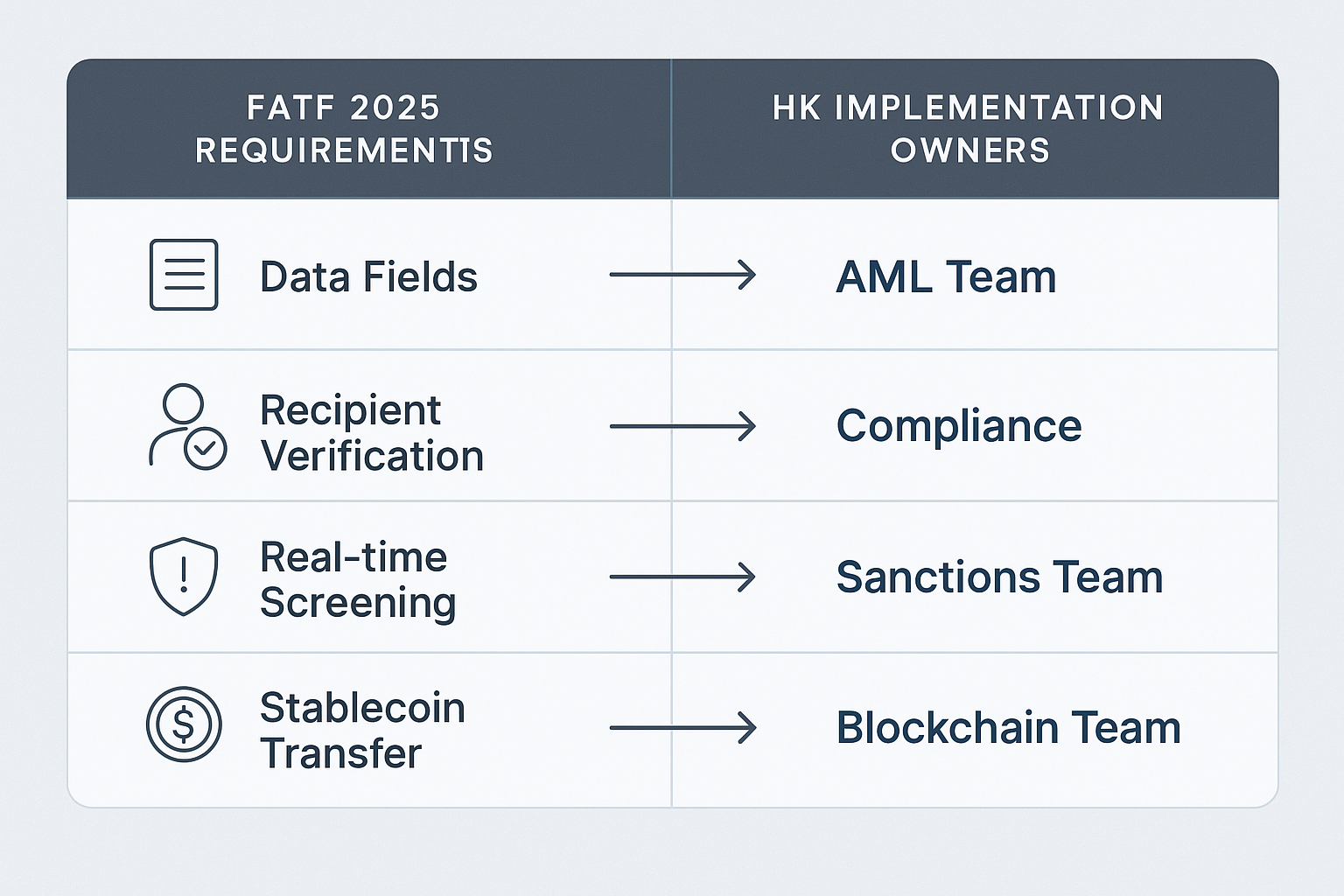
- Data fields (names, ID, city/country): Product/Engineering to update schemas and APIs; Compliance to define mandatory fields and fallback flows.
- Recipient verification: Risk/Compliance to set matching thresholds; Tech to integrate name‑check or wallet‑ownership tools.
- Real‑time screening: Ops to tune rules; Vendor management to validate sanctions/PEP list freshness; QA to back‑test alert precision.
- Stablecoin transfer info sharing: Legal/Compliance to align participation agreements; Engineering to adopt interoperable message standards.
Tactical 90‑day plan
- Update data models and payment/VA transfer messages to carry the new FATF fields.
- Procure or enable recipient verification tooling; pilot in one corridor first.
- Calibrate real‑time rules using last 6–12 months of transactions; target <10% false positives (illustrative) without missing known typologies.
- Refresh sanctions screening stack and add beneficiary narrative scanning.
- Amend policies: EDD triggers, data‑completeness SLAs, and exception handling.
- Communicate changes to customers (what extra data is collected and why).
One last point.
If your transfers can’t carry the data, your monitoring will fail—no model fixes missing fields.
Useful links:
- FATF Recommendations (June 2025 update): www.fatf-gafi.org
- PSSVFO (Cap. 584) overview: www.hkma.gov.hk
- AML/CTF regime for VATPs and VA policy updates: www.fstb.gov.hk and www.sfc.hk
Need a gap assessment or vendor shortlisting? StanCOMP has implemented these controls with SVF licensees, OTCs, and VA platforms in Hong Kong. We can show you what “good” looks like—end‑to‑end, in production.


