
HK Digital Asset Licences: Fit & Proper & Smart Audits

HK Digital Asset Licences: Fit & Proper & Smart Audits
Hong Kong’s pivot from “Virtual Assets” to “Digital Assets” isn’t cosmetic. With retail access, pilot tokenisation (including green bonds), and the SFC’s 2025 ASPIRe roadmap on staking, borrowing/lending, and derivatives, the bar for being licensed is rising. If you’re pursuing a VATP licence or preparing for a custodian regime, “fit and proper” now extends deep into your codebase.
Fit and proper isn’t a paperwork ritual. It’s an operating standard.
What “fit and proper” means in 2025 (beyond the form)
Under the VATP regime (in force since June 2023), anyone operating a platform must be licensed by the SFC and pass a fit-and-proper test covering integrity, competence, AML/CTF, investor protection and financial soundness. The SFC retains supervisory, investigative and intervention powers. See the Guidelines for VATP Operators (Part X is key for ongoing obligations): https://www.sfc.hk/-/media/EN/assets/components/codes/files-current/web/guidelines/Guidelines-for-Virtual-Asset-Trading-Platform-Operators/Guidelines-for-Virtual-Asset-Trading-Platform-Operators.pdf
Two more anchors shape expectations:
- Intermediaries’ VA activities (Dec 2023 joint circular): clear expectations on product due diligence, custody, and tech risk controls. Link: https://apps.sfc.hk/edistributionWeb/gateway/EN/circular/doc?refNo=23EC67
- SFC-authorised funds with VA exposure (Apr 2025 circular): heightened governance, valuation, and custody segregation standards that echo into platform and custodian practice. Link: https://apps.sfc.hk/edistributionWeb/gateway/EN/circular/doc?refNo=25EC21
And as the Government consults on a dedicated regime for VA custodians, the same fit-and-proper lens will apply to standalone custody providers.
Fit-and-proper, translated into evidence
Below is what reviewers actually look for and what tends to land well in practice.
| Dimension | What the SFC expects | Evidence that helps (illustrative) |
|---|---|---|
| Governance & integrity | Honest, competent controllers; effective board oversight | Board with an INED who has VA risk experience; quarterly risk committee minutes with challenge to token listing decisions |
| Competence & controls | Sound systems, cyber resilience, outsourcing oversight | SOC 2 Type II for core systems; annual red-team test; vendor scorecards with exit plans |
| AML/CTF | Strong onboarding, monitoring, sanctions screening | Name screening hit-rate reporting; VA travel rule implementation metrics; typology-based alerts and QA results |
| Investor protection | Token due diligence, disclosures, fair trading, segregated custody | Independent smart contract audit reports for listed tokens; market surveillance rules; hot/cold wallet policy with daily reconciliation |
| Financial resources | Capital adequacy and runway | 12-month liquidity plan; stress tests (e.g., 30% volume shock) with recovery playbooks |
Why smart contract auditing sits inside “fit and proper”
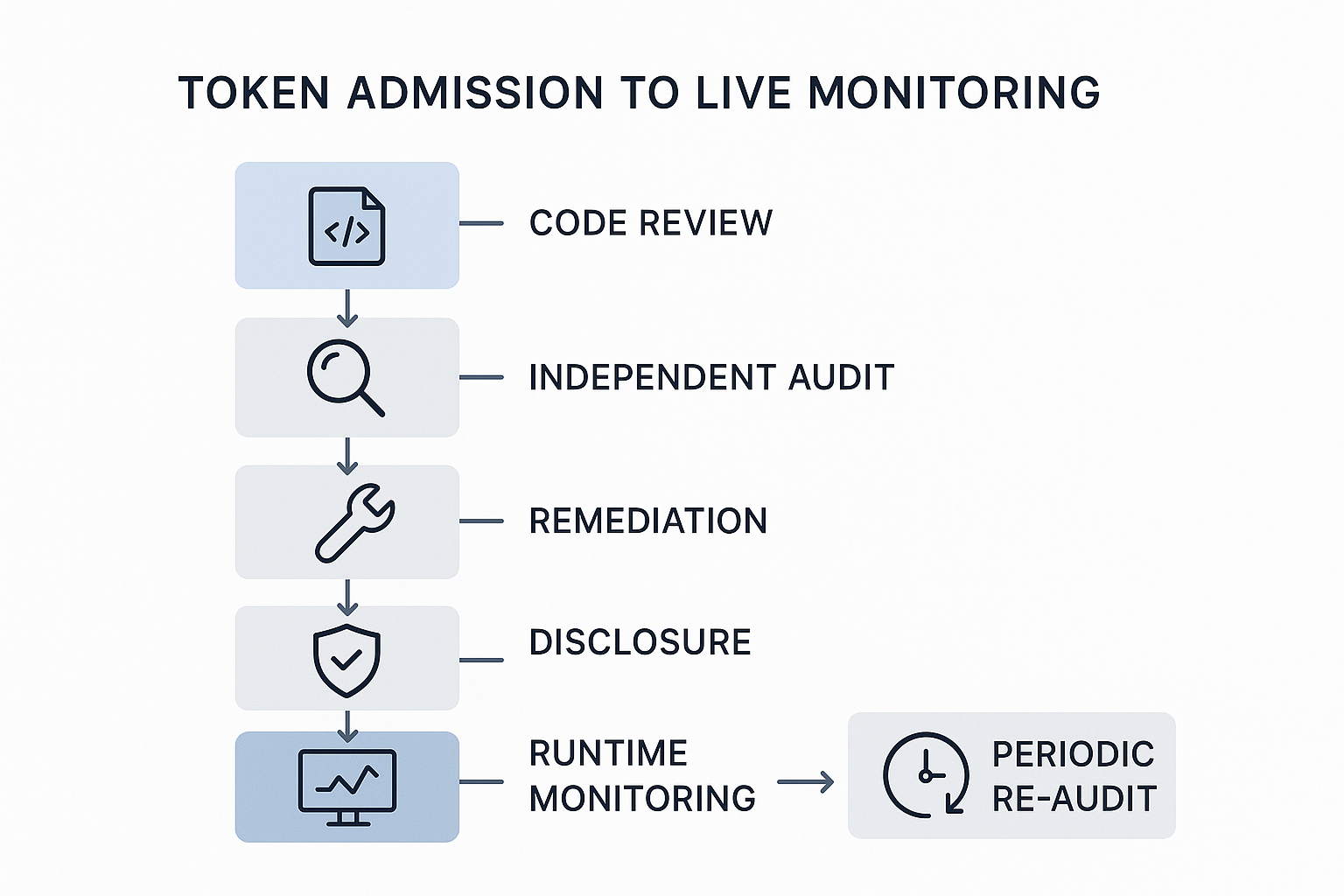
Token admission and ongoing monitoring require you to understand code risk—not just read a whitepaper. Practically, SFC reviewers expect independent smart contract audits (and re-audits after material changes) before admitting a token for retail trading, and enhanced checks for features like staking, bridges, or upgradeable proxies. The Dec 2023 joint circular also pushes intermediaries to own tech risk management, while the Apr 2025 fund circular tightens the standard for due diligence and custody—both point to the same place: audited code, documented findings, and compensating controls when residual risk remains.
Pro tip: treat audits as a control set, not a PDF. Pair them with runtime monitoring and incident drills.
A 90‑day readiness sprint (what to do now)
- Map your perimeter: inventory every on-chain component (listing, custody smart contracts, staking wrappers, bridges). Tag those with admin keys or upgrade rights.
- Build an auditor panel: at least two independent firms with complementary strengths (EVM vs. Cosmos; formal verification vs. manual review). Pre-negotiate 2–3 week turnaround SLAs.
- Shift-left code QA: require threat modelling per contract, unit tests with >85% branch coverage (illustrative), and static analysis in CI. Escalate “critical/high” findings to the risk committee.
- Runtime controls: on-chain anomaly alerts (pause on abnormal mint/burn or role changes), time-locked admin actions, and multi-sig with quorum independent of engineering.
- Evidence pack: token due diligence sheets referencing audit findings, remediation status, chain risk (e.g., MEV, reorg risk), and disclosure language for retail users.
- Drill and disclose: run a live-severity incident drill; document RTO/RPO, communications tree, and playbook for trading halts and withdrawals.
Context matters: terminology and scope
The Government now uses “Digital Assets” to align with global usage, but many rules still say “Virtual Assets.” Read both. Also, expect the upcoming custodian framework to hard-code segregation, governance and tech standards that mirror (or exceed) VATP obligations.
Bottom line
In Hong Kong, being fit and proper now includes being code-literate. If your board can explain your admin-key model, if your audits tie to listing decisions, and if your custody controls pass a red-team test, you’re on the right track. If not, fix that before you file.


