
HK Crypto Custody & Risk: SFC VATP Compliance Guide

Hong Kong’s custody rules are tightening—and that’s good news for serious operators. The SFC and FSTB have proposed a dedicated regime for virtual asset (VA) custodians, with requirements aligned to what SFC‑licensed VATPs already face on private key management, cybersecurity, and business continuity. If you run a platform, OTC, or independent custodian in Hong Kong, here’s how to be audit‑ready before the rules land.
Why this matters now
- The FSTB/SFC consultation proposes regulating VA custodians that safekeep private keys (or similar instruments) and requiring them to appoint an external assessor during licensing—mirroring the “swift licensing” track used for VATPs.
- The SFC will align custodian obligations with the Guidelines for Virtual Asset Trading Platform Operators (see Part X), including custody, wallet design, incident management, and BCP/DR. Source: SFC Guidelines for VATPs (Part X) and consultation materials.
- The policy direction follows international standards from IOSCO, the FSB, and the Basel Committee as reiterated in Hong Kong’s Policy Statement 2.0.
References worth bookmarking
- SFC Guidelines for Virtual Asset Trading Platform Operators (Part X – Custody): https://www.sfc.hk/-/media/EN/assets/components/codes/files-current/web/guidelines/Guidelines-for-Virtual-Asset-Trading-Platform-Operators/Guidelines-for-Virtual-Asset-Trading-Platform-Operators.pdf
- Joint circular on intermediaries’ VA-related activities (SFC/HKMA): https://www.sfc.hk/en/News-and-announcements/Policy-statements-and-announcements/Joint-circular-on-intermediaries-virtual-asset-related-activities
- IOSCO Crypto and Digital Asset Market Recommendations: https://www.iosco.org/library/pubdocs/pdf/IOSCOPD740.pdf
- FSB Global Regulatory Framework for Crypto-asset Activities: https://www.fsb.org/publications/
- Basel Committee—Prudential treatment of cryptoasset exposures: https://www.bis.org/bcbs/publ/d554.htm
What “good” looks like under SFC expectations
- Private key management
- Governance: Defined key ceremony procedures, segregation of duties, and board‑approved wallet policy.
- Technology: Hardware security modules (HSMs) or MPC with threshold signing; tamper‑evident audit trails; environmental and logical access controls.
- Operations: Dual (or more) approver workflows; change management for wallet policies; offsite recovery of key material with periodic restore tests.
- Location: Document the jurisdiction and legal rights over key material and backup sites; confirm vendor export controls and data sovereignty.
- Cybersecurity
- Framework: Map controls to ISO/IEC 27001/27002 or NIST CSF; perform red‑teaming and regular penetration testing.
- Monitoring: 24/7 SOC coverage; SIEM use cases tailored to wallet infra; anomaly detection for signing policies.
- Hardening: Secure build pipelines; code signing; least‑privilege service accounts; EDR on signing hosts and ops endpoints.
- Business continuity and incident response
- Define RTO/RPO for custody functions (e.g., RTO ≤ 4 hours for withdrawal processing—illustrative).
- Run semi‑annual DR tests including MPC shard/HSM replacement and cold‑start key restoration.
- Maintain an incident runbook covering on‑chain exploits, compromised signers, and exchange integration failures; pre‑draft customer and SFC notifications.
- Client asset safeguards
- Segregation: Clear on‑chain segregation policy (omnibus vs segregated addresses) with daily reconciliations to books/records.
- Valuation and reconciliation tooling with thresholds for break investigation (e.g., >0.05% variance—illustrative).
- Outsourcing: Due diligence, oversight, and exit plans for third‑party custodians or wallet tech providers.
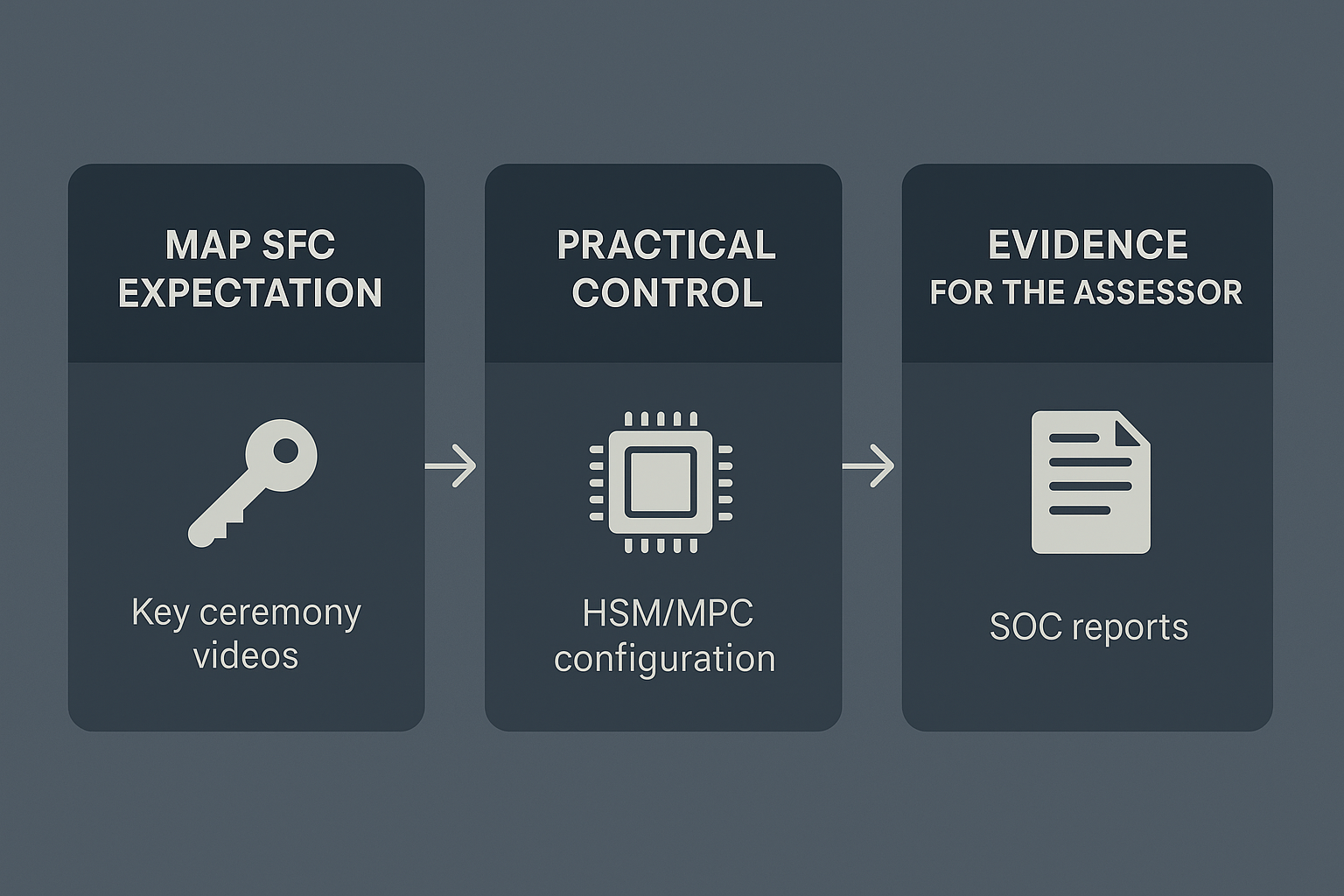
Risk assessment checklist (build this before you apply)
- Threat model specific to your wallet architecture (hot, warm, cold, MPC/HSM).
- Data‑flow diagram from deposit to withdrawal settlement, including admin paths.
- Control testing plan: key ceremonies, withdrawal approvals, incident drills.
- Third‑party risk: contracts, right‑to‑audit, sub‑custody concentration analysis.
- Compensation arrangements/insurance rationale and coverage gaps (if any).
- Regulatory engagement log; point of contact with SFC FinTech Unit (fintech@sfc.hk).
Common pitfalls we see
- Treating MPC as a silver bullet without robust shard governance and recovery.
- No end‑to‑end withdrawal kill‑switch tied to anomaly signals.
- DR tests that skip real signing hardware or rely on theoretical restores.
- Ambiguous asset segregation that breaks during network congestion or fee spikes.
- Incomplete documentation for the external assessor, slowing “swift” licensing.
What to do this quarter
- Week 1–2: Gap‑assess against VATP Guidelines Part X; appoint an external assessor early.
- Week 3–6: Remediate key management and monitoring gaps; run a live incident simulation.
- Week 7–10: Execute DR test with full key restoration; fix reconciliation breaks.
- Week 11–12: Package evidence, governance minutes, and policies for submission.
Bottom line: Build for auditability. If your custody stack can survive a lost signer, a compromised admin, and a data center outage—and you can prove it—you’re ready for Hong Kong’s next chapter.


