HK Crypto Compliance: Workflow, Audits & Hot Wallet AML

Hong Kong Crypto Compliance in 2025: Workflow, Audits, and Hot Wallet AML That Actually Works
If you operate a VASP in Hong Kong—or plan to handle stablecoins—you don’t have time for vague advice. Below is the practical workflow we implement with clients at StanCOMP, tightened to reflect HKMA consultation conclusions on stablecoin AML/CFT and the SFC’s VATP expectations under AMLO.
One thing upfront: regulators now expect you to prove how decisions are made, not just that tools exist.
The end-to-end workflow (what to implement now)
-
Governance and scope
- Map activities: brokerage, exchange, OTC, custody, stablecoin redemption/issuance support, staking-type features.
- Assign accountable owners: MLRO, Head of Wallet Security, Token Admission Chair. Document RACI.
-
Onboarding and Travel Rule
- KYB/KYC with enhanced checks for entities interacting with stablecoins at issuance/redemption touchpoints.
- Implement Travel Rule for VA transfers between VASPs; include originator/beneficiary data capture and validation.
- Maintain refusal-and-rollback playbook if counterparty VASP cannot exchange Travel Rule data.
-
Wallet risk management: custodial vs unhosted
- HKMA’s consultation conclusions on stablecoin AML/CFT support two expectations: do due diligence on the custodial wallet provider; apply additional controls for unhosted wallets and when counterparties aren’t AML-supervised. Where classification is uncertain (and it often is), address screening and risk mitigation are mandatory.
- Practically: auto-classify with analytics, then require operations to confirm on exceptions before release of funds.
-
Hot wallet controls (security + AML)
- Security: use MPC or HSM-backed hot wallets with dual control; cap hot wallet exposure (illustrative: ≤3% of customer assets) and enforce hourly/daily withdrawal ceilings.
- AML: real-time address screening pre- and post-transaction, velocity rules, and “unknown wallet” friction (e.g., first-time self-hosted wallet → cooling period + enhanced screening).
- Sanctions: screen against UN/HK lists at minimum; most HK platforms add OFAC and EU lists to avoid secondary risk.
-
Smart contract and token due diligence
- Require an independent smart contract audit for tokens with upgradeable or complex logic; map admin keys, pause functions, and proxy patterns.
- Maintain continuous monitoring for critical contracts (events, abnormal state changes); don’t rely on a one-off PDF.
-
Monitoring and investigations
- Configure heuristics per asset and customer segment. Examples (illustrative):
- Stablecoin cash-out to unhosted wallet > HKD 100,000 within 24h from first deposit.
- High-risk exchange cluster exposure > 10% of weekly inflows.
- Mixers/tumblers any-time match = hard block + EDD review.
- Escalate, case-note, SAR if needed. Maintain playbooks with time SLAs (e.g., T+1 for high-severity alerts).
- Configure heuristics per asset and customer segment. Examples (illustrative):
-
Audit trail and board reporting
- Evidence every control: change logs, rule rationales, sampling results, and exception approvals.
- Quarterly board pack: metrics, breaches, remediation status, lessons learned.
What’s new for stablecoins in HK
- HKMA consultation conclusions emphasize two things for transfers/redemptions:
- Do DD on the institution providing the custodial wallet for the stablecoin holder.
- Apply additional controls for unhosted wallets; where you can’t complete DD to a satisfactory standard (e.g., provider not AML-supervised), screen wallet addresses with appropriate technology and mitigate higher ML/TF risk.
- Industry challenge acknowledged: reliably classifying unhosted vs custodial wallets is hard. HKMA expects practical mitigation—don’t hide behind tool limitations. See table below.
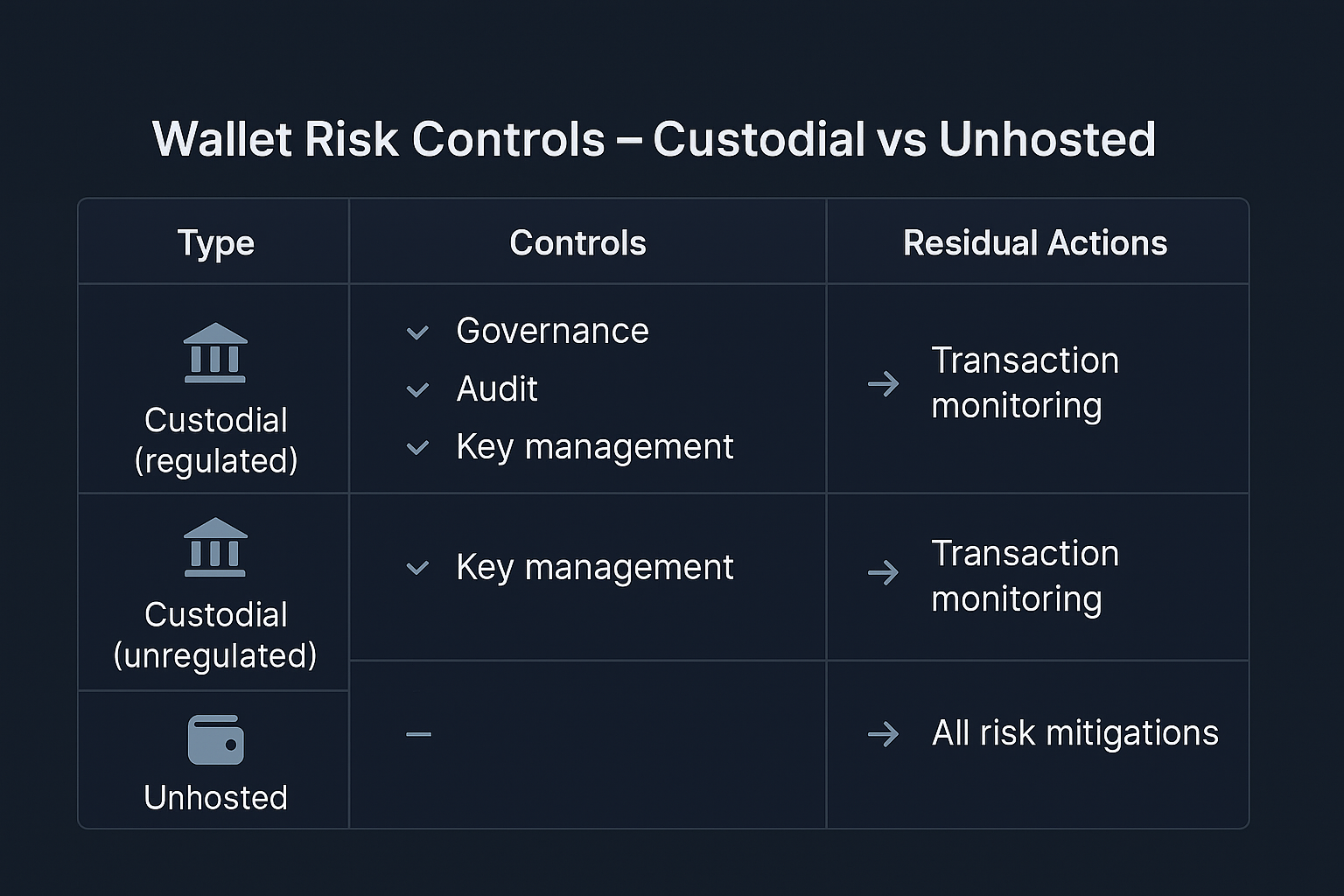
- Custodial (regulated FI/VASP):
- Controls: KYB on provider, Travel Rule data exchange, bilateral sanctions attestations, allowlist counterparties.
- Residual actions: ongoing counterparty due diligence; periodic address health checks.
- Custodial (unregulated/unknown supervision):
- Controls: enhanced KYB, contractual AML clauses, heightened screening, lower thresholds, manual release.
- Residual actions: restrict limits or prohibit until supervision confirmed.
- Unhosted/self-custody:
- Controls: address risk scoring, ownership verification steps (micro-transfer challenge), cooling-off, velocity caps.
- Residual actions: deny if score exceeds set threshold; SAR where appropriate.
- Ambiguous/unclassified:
- Controls: treat as unhosted; trigger enhanced screening and approvals.
- Residual actions: reassess when more data available.
Smart contract auditing that satisfies SFC/VASP expectations
- Scope: code quality, privilege model, upgrade paths, oracle dependencies, pause/kill switch governance.
- Minimums we advise:
- Two independent audit passes for upgradeable contracts or those holding customer funds.
- Admin key policies: multi-sig/MPC, geographic split, and on-chain timelocks for upgrades.
- Runtime monitoring tied to incident response; pre-authorized halt procedure with board oversight.
Hot wallet AML: the controls examiners ask to see
- Risk-based withdrawal tiers tied to KYC depth and transaction history.
- First-send guardrails: deny or hold if address risk score > set threshold or if sanctions proximity alerts fire.
- Behavioral analytics: unusual time-of-day patterns, chain-hopping to obfuscation services, stablecoin mint/burn anomalies.
- Evidence: retained screenshots/logs of the exact screening results at decision time.
Tooling stack that passes muster (illustrative vendors; pick equivalents that fit your size)
- Travel Rule: TRISA-compatible gateway or commercial API.
- Screening/analytics: at least two chain coverage providers to reduce false negatives.
- Key management: MPC wallet with policy engine and webhook alerts to AML system.
- Case management: system that ties alerts to SAR workflow and audit export.
Bottom line
Build for verification, not aspiration. HKMA and SFC don’t just want policies; they want proof your workflow catches real risk in hot wallets, stablecoin flows, and smart contracts—consistently.
Further reading: HKMA’s stablecoin policy and consultation materials (aml/cft expectations, wallet risk), and SFC VATP guidelines on token admission and ongoing monitoring.