HK Compliance: Wholesale Stablecoins & Tokenised Securities

HK Compliance: Wholesale Stablecoins & Tokenised Securities
The market is finally asking the right question: how do wholesale stablecoins and tokenised securities co-exist under Hong Kong rules without tripping over licensing, custody, and AML? If you’re building payment rails, digitising balance sheets, or running a VASP, the answer is: architect for both from day one.
Why wholesale stablecoins matter now Hong Kong’s Policy Statement 2.0 expressly backs stablecoin and tokenisation projects, including exploring payment use cases and even testing licensed stablecoins for Government disbursements. That’s a signal. The direction of travel is institutional rails first, retail later.
Wholesale models fit neatly: permissioned networks, identifiable participants, and clear redemption mechanics. They also align with the regulators’ core priorities: reserves, redemption, custody, and AML/CFT.
Regulatory perimeter in one page
- HKMA stablecoin regime (proposed/rolling out): Issuers of fiat-referenced stablecoins will be licensed by the HKMA. If an issuer also custodies its coins, it will be supervised on custody too — with segregation of client assets, audit, record-keeping, and full AML/CFT obligations. See HKMA/FSTB consultation conclusions and related government papers.
- Custody focus: The government’s virtual asset custodian proposal extends investor protection expectations (safekeeping, segregation, audits) across VA custodians. Expect alignment in internal controls whether you are an FI or a VASP.
- Unhosted wallet controls: Where FIs or VASPs provide custodial wallets to stablecoin holders, they must implement additional controls to mitigate risks from unhosted wallets interacting with their ecosystem (ownership verification, sanctions screening, Travel Rule messaging).
- Tokenised securities: The SFC already treats tokenised securities as “securities” under the SFO. Primary issuance, distribution, custody, and ongoing obligations follow traditional rules, with added tech risks (smart contract audits, on-chain/off-chain record reconciliation). See SFC circulars on tokenised securities and tokenised products.
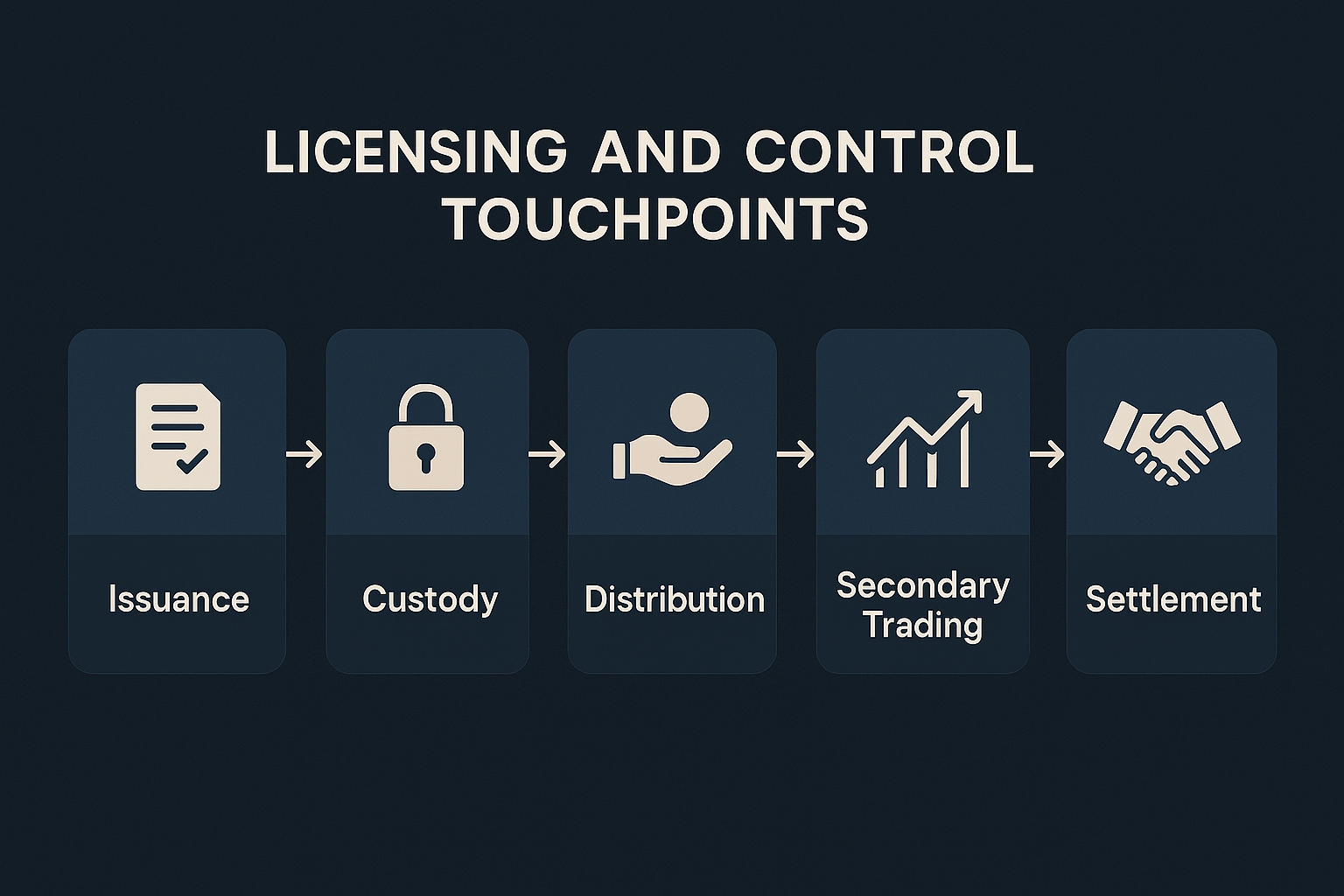
What this means for your design choices
- Separate “money” from “assets”: Use a licensed stablecoin for payment-versus-delivery and a tokenised security for the instrument. Do not bundle them into a quasi-deposit token unless you plan to be an HKMA licensee.
- Permissioned first: For wholesale settlement, operate on permissioned networks with known counterparties and pre-vetted addresses. This materially simplifies AML/CFT and unhosted wallet risk.
- Custody is the keystone: Whether you’re an issuer, a bank, or a VASP, assume the custody bar is the same: segregation, reconciliations, external audit, business continuity, incident reporting, and hot/cold key governance.
Quick comparison: wholesale stablecoin vs tokenised security
- Purpose
- Stablecoin: Payment and settlement medium (wholesale rails)
- Tokenised security: The financial instrument itself (bond, fund, equity)
- Primary regulator
- Stablecoin: HKMA (issuer licensing; AML/CFT and custody if issuer custodies)
- Tokenised security: SFC (SFO rules; intermediaries and product authorisation where applicable)
- Backing/coverage
- Stablecoin: Reserve assets; daily reconciliation; robust redemption policy
- Tokenised security: Underlying legal claim per prospectus/terms; registrar/CS facility
- Wallets
- Stablecoin: Custodial wallets by FIs/VASPs with added unhosted wallet controls
- Tokenised security: Custody under SFC/HKMA expectations; off-chain register remains golden source in many setups
- AML/CFT
- Both: Full AML/CFT; Travel Rule for VAs; sanctions and on-chain analytics for external flows
Controls that regulators expect to see on day one
- Unhosted wallet risk: Proof-of-ownership procedures, allowlists/denylists, KYT/on-chain analytics, and Travel Rule compliance before release/credit.
- Reserves and redemption (stablecoins): Segregated reserves with high-quality assets, independent attestations, and clear T+X redemption timelines (documented).
- Smart contract assurance (tokenisation): Independent audits, upgrade governance, incident response, and reconciliation between DLT state and off-chain books.
- Operational resilience: Key management with quorum, disaster recovery, and tested playbooks for contract pauses or forks.
Practical next steps
- Choose your path: Issuer (HKMA), exchange/VASP (SFC), or custodian (emerging regime). Mixing roles increases scrutiny.
- Ring-fence flows: Keep retail and wholesale channels, and hosted vs unhosted wallet flows, on separate pipelines with distinct controls.
- Pilot with purpose: Pick a use case that solves a real pain point — e.g., T+0 settlement for tokenised commercial paper between two PIs — and design controls to production standard, not “sandbox light.”
Hong Kong wants credible, production-grade rails. Build like you expect an inspection tomorrow — because when payments go on-chain, they usually come with a supervisor. Links: HKMA, SFC, and Government policy statements on stablecoins, tokenisation, and VA custody proposals.