
HK Compliance: Wholesale Stablecoins & PSO Sandbox Guide

Introduction Wholesale stablecoins are finally moving from whitepapers to workflows in Hong Kong. The Government’s Policy Statement 2.0 explicitly backs stablecoin and tokenisation pilots (including potential Government payment trials), and the HKMA’s stablecoin sandbox is live. If you’re an issuer, bank, PSP, or a treasury team planning cross-border settlement, the key question is simple: how do you build within the Payment Systems Ordinance (Cap. 584) and the upcoming stablecoin regime without tripping over retail rules?
What changed in 2025
- Policy backing: Policy Statement 2.0 reiterates support for stablecoin payment use cases and invites proposals to test licensed stablecoins in Government payments. See the Financial Services and the Treasury Bureau’s framing and HKMA materials.
- Regulatory plumbing: The Payment Systems and Stored Value Facilities regime under Cap. 584 already covers (i) designated retail payment systems, (ii) clearing and settlement systems, and (iii) stored value facilities. Stablecoins can intersect any of the three depending on structure and users.
- Sandbox clarity: Through the HKMA stablecoin sandbox, participants have highlighted real-world issues like distributors relying on third-party custodians to hold stablecoins—so custody chains and accountability must be explicit.
Wholesale vs retail: why it matters Keep your stablecoin strictly institutional and you reduce consumer-facing obligations. Let it drift into public acceptance and you may trigger stored value or retail payment system oversight.
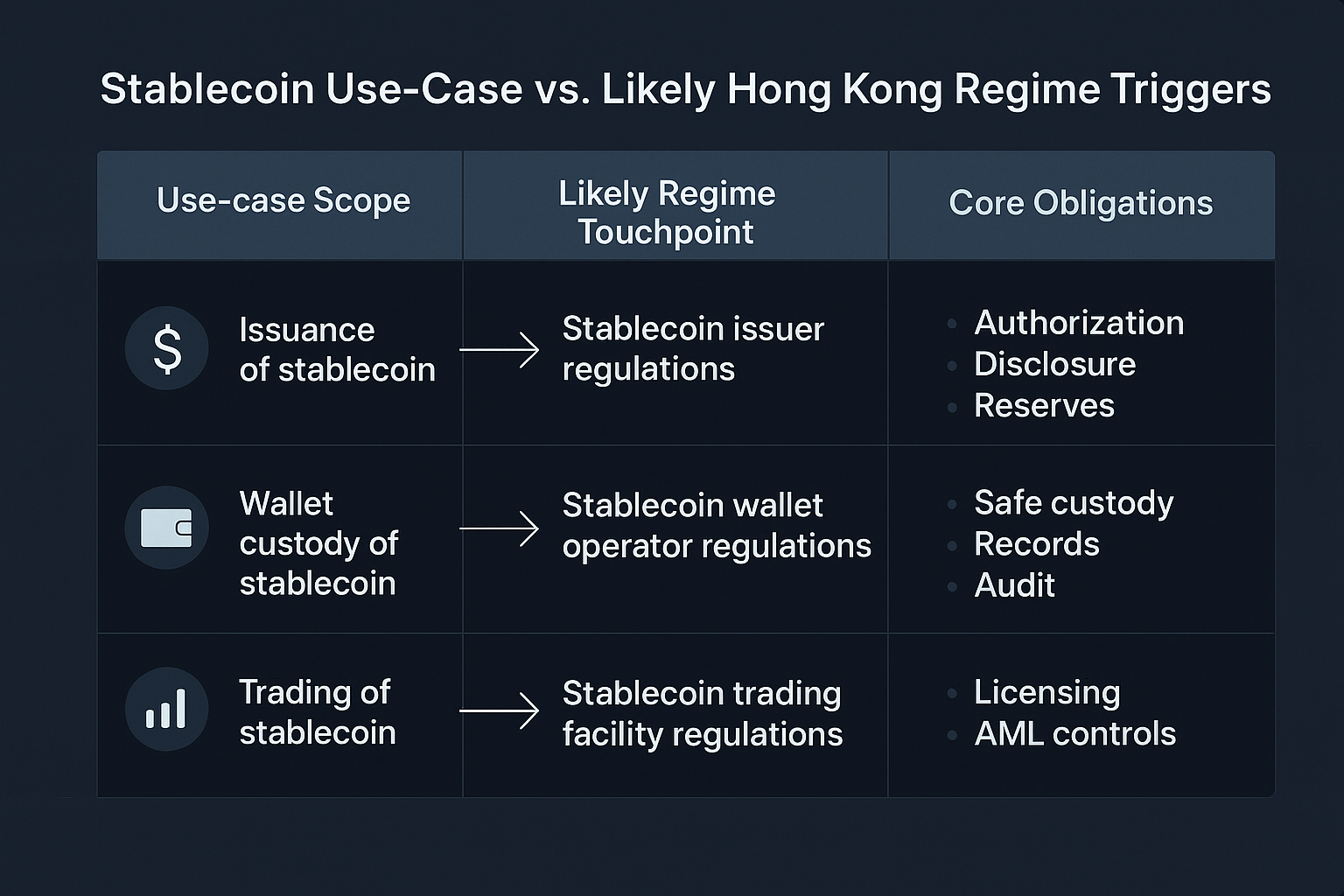
- Column 1: Use-case scope (Bank-to-bank RTGS-like settlement; Tokenised collateral between licensed institutions; Corporate cross-border payables; Public-facing merchant acceptance)
- Column 2: Likely regime touchpoint (Clearing and settlement system; DRPS under Cap. 584; SVF if pre-paid value held for the public; Upcoming stablecoin issuer licensing)
- Column 3: Core obligations (Designation and FMI standards; Operational resilience and reporting; SVF float safeguarding, user protection; Reserve backing, redemption, governance, disclosures)
- Column 4: Notes (Whitelist participants; Avoid consumer interfaces; No “stored value” feature for the public; Redemption T+0/T+1 in fiat; clear segregation)
Where the Payment Systems Ordinance bites
- Stored Value Facility (SVF): If you preload HKD/USD value into a wallet that the public can spend at multiple merchants, you’re likely an SVF. A “coin-only” transfer app can still be an SVF if it functions as pre-paid value for goods/services.
- Designated Retail Payment System (DRPS): A network that processes retail payments at scale—stablecoin or not—can be designated and overseen by the HKMA.
- Clearing and Settlement Systems: A closed-loop interbank/wholesale settlement rail might fall under the FMI limb of Cap. 584 instead of retail oversight.
Put differently: wholesale rails with a tight whitelist and no consumer-facing features are easier to justify outside SVF, but can still be designated and supervised.
How the HKMA stablecoin sandbox actually works
- Purpose: To iterate design, reserve models, custody, and redemption mechanics ahead of the formal licensing regime for fiat-referenced stablecoins (FRS). It is not a licence or a legal safe harbour.
- Expectations we see in practice:
- Reserves: High-quality, short-dated assets with daily reconciliation and independent attestations.
- Redemption: Clear, predictable timelines (illustrative: T+0 in HK hours for institutional redemptions ≤ a set threshold).
- Custody: If a distributor uses a third-party custodian or sub-custodian, responsibilities and SLAs must be unequivocal—aligning with HKMA’s sandbox feedback on third-party custody chains.
- AML/CFT: Institution-only models are still subject to robust CDD, travel rule where applicable, and sanctions screening.
- Disclosures: What backs the coin, who redeems, and on what terms.
Cross-border reality check The US SEC’s 2024 staff guidance indicated certain “covered” USD stablecoins aren’t treated as securities and issuers handling issuance/redemption don’t need SEC registration. Helpful for counterparties—but it does not change Hong Kong’s oversight under Cap. 584 or the incoming FRS regime.
Structuring moves that reduce friction
- Keep it wholesale: Whitelist licensed institutions and large corporates; avoid merchant acceptance until your perimeter is clear.
- Separate roles: Distinct entities for issuance, distribution, and custody with written accountability maps.
- Avoid SVF triggers: No general-purpose consumer wallet, no pre-loading for the public, and no loyalty/float features that look like stored value.
- Reserve governance: Board-approved policy, independent attestation, and stress scenarios disclosed quarterly.
- Interoperability: Build for RTGS linkages and tokenised deposits without marketing to retail.
What to do next
- Map your design against Cap. 584 and the forthcoming FRS licensing requirements.
- Engage the HKMA sandbox early with a concrete pack: product memo, reserve policy, redemption playbook, custody diagrams, AML/CFT program, and audit arrangements.
- If planning government or quasi-public use, anchor to Policy Statement 2.0’s call for proposals on licensed stablecoins in Government payments.
- If you distribute someone else’s stablecoin, diligence the full custody chain and ensure you can evidence control and segregation.
If you’re unsure whether your model is SVF, DRPS, FMI, or squarely in the future FRS regime, get that regulatory mapping done first. It saves months later.
References and further reading
- HKMA stablecoin sandbox announcement and FAQs: https://www.hkma.gov.hk
- Policy Statement 2.0 on the Development of Digital Assets in Hong Kong: https://www.fstb.gov.hk
- Payment Systems and Stored Value Facilities Ordinance (Cap. 584): https://www.elegislation.gov.hk
- Consultation conclusions on stablecoin/AML matters and custody observations: https://www.hkma.gov.hk
- Context on US SEC staff guidance for USD stablecoins (Bloomberg summary): https://www.bloomberg.com


