
HK Compliance: VA OTC, RT Monitoring & PMS Licence

Hong Kong VA OTC licensing is coming: what to do now on RT monitoring and PMS registration
Hong Kong is moving to license virtual asset (VA) over‑the‑counter (OTC) businesses under the Anti‑Money Laundering and Counter‑Terrorist Financing Ordinance (AMLO, Cap. 615). The Financial Services and the Treasury Bureau (FSTB) has consulted the market on a new licensing regime for VA OTC providers, taking reference from the existing SFC VA trading platform regime and the money service operator (MSO) model. The headline: AML/CTF standards will tighten, and real‑time transaction monitoring (RTM) will become table stakes.
If you run an OTC desk, kiosk network, or a retail “cash-for-crypto” shop, use the transition window to harden controls — including whether you also need a Precious Metals and Stones (PMS/DPMS) registration.
What the FSTB’s VA OTC consultation means
- Licensing under AMLO: VA OTC service providers will need a licence, with AML/CTF obligations aligned to established regimes (see the consultation references and AMLO here: Cap. 615 on e‑Legislation; FSTB public consultation page).
- Scope is fiat-VA heavy: The consultation notes that most OTC activity involves buying/selling VA with fiat. VA-to-VA deals at OTC shops are uncommon. Expect supervision to focus on fiat on/off‑ramp risks.
- Core obligations (by reference to VATP/MSO standards): customer due diligence (CDD), ongoing monitoring, record‑keeping, suspicious transaction reporting, sanctions screening, staff training, and independent audit/review. Expect fitness and propriety, premises controls, and systems expectations.
Note: These are proposals. Details may shift in the bill and subsequent guidelines. Track FSTB updates and, when available, licensing conditions or codes from the designated authority.
Real‑time transaction monitoring: the practical playbook
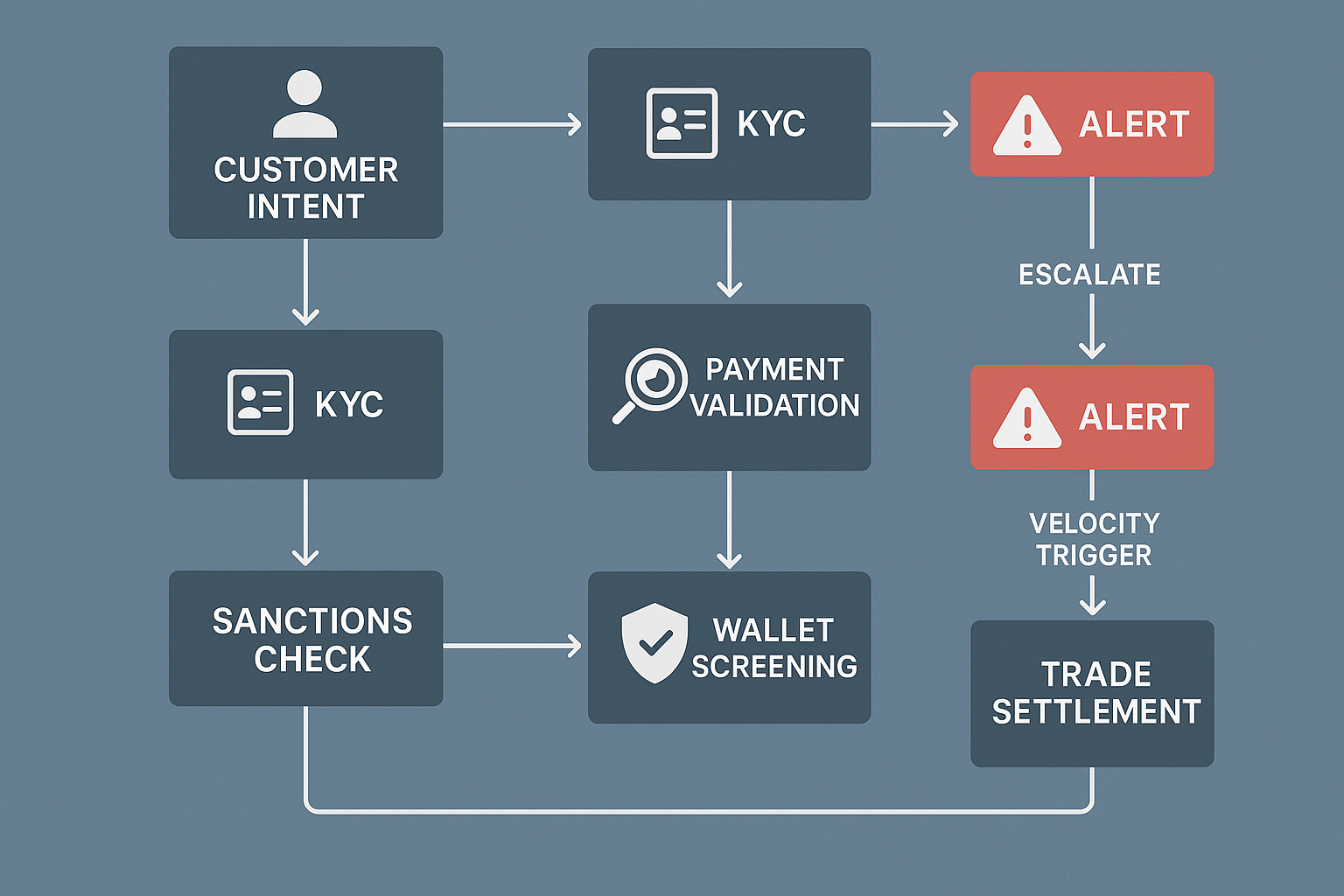
Batch reviews won’t cut it once you’re licensed. Build RTM that covers both fiat and on‑chain risks:
- Identity and payments
- Name, sanctions, PEP, and adverse media screening at onboarding and continuously thereafter.
- Payment verification (same‑name checks) and anomaly detection for deposits/withdrawals.
- On‑chain risk analytics
- Wallet screening before first use; risk‑score ongoing flows to/from the wallet.
- Flag exposure to mixers, darknet markets, scam clusters, and sanctioned addresses.
- Behavioral thresholds (illustrative)
- Auto‑hold and enhanced due diligence (EDD) if: single cash trade ≥ HKD 100,000; cumulative daily ≥ HKD 250,000; or on‑chain risk score ≥ 70/100.
- Velocity triggers: >3 trades in 60 minutes or >5 wallets linked to one customer in 24 hours.
- Case management and SLAs
- Tier 1 alerts triaged within 15 minutes, Tier 2 within 2 hours (illustrative).
- End‑to‑end audit trail: who reviewed, what data, decision rationale, SAR number/date if filed.
- Governance and testing
- Monthly calibration of rules; quarterly model validation; annual independent AML audit.
- Keep a run‑book for regulator queries and site inspections.
Where PMS/DPMS licensing fits in
Many OTC operators also touch bullion, coins, or jewellery — or accept large cash. Under AMLO’s Dealers in Precious Metals and Stones (DPMS) regime, you must register with the Customs and Excise Department (C&ED) if you carry on a DPMS business in Hong Kong. There are two categories:
- Category A: not engaging in cash transactions at or above HKD 120,000.
- Category B: engaging in such cash transactions — triggers full AML/CTF requirements (CDD, ongoing monitoring, record‑keeping, screening, and reporting). See C&ED DPMS guidance.
If you retail bullion alongside crypto or take cash ≥ HKD 120,000, you may need Category B. Map your product and cash profile now; dual regimes mean dual obligations.
Side‑by‑side view (at a glance)
| Topic | VA OTC (proposed under AMLO) | DPMS (PMS registration) |
|---|---|---|
| Regulator | FSTB‑designated under AMLO (legislation pending) | C&ED |
| Trigger | Providing VA OTC services (fiat↔VA common) | Carrying on DPMS business; Category B if cash ≥ HKD 120,000 |
| Key AML duties | CDD, ongoing monitoring, sanctions screening, SARs, records, training, independent review | Same core AML set for Category B; Category A lighter but still subject to registration/record rules |
| Systems expectation | RTM across fiat and on‑chain flows | Risk‑based monitoring of cash and trade patterns |
Practical next steps for 2025
- Do a regulatory gap assessment: map your OTC flows against AMLO/VATP/MSO standards; identify quick wins vs. system changes.
- Build RTM now: deploy wallet screening, sanctions/PEP tools, case management, and alert SLAs before licensing opens.
- Decide on DPMS scope: if you sell bullion/jewellery or accept large cash, register with C&ED and implement Category B controls.
- Document everything: AML program, customer risk scoring, scenario rationale, testing results, and board oversight minutes.
Regulation is tightening, but it’s navigable.
If you want a crisp readiness review, StanCOMP has helped OTCs and DPMS dealers stand up RT monitoring, policy stacks, and inspection‑ready records without breaking day‑to‑day operations. Start with a two‑week gap assessment and a remediation plan you can actually execute.
References:
- AMLO (Cap. 615): https://www.elegislation.gov.hk/hk/cap615
- FSTB consultations: https://www.fstb.gov.hk/en/public-consultation/index.html
- SFC VATP information: https://www.sfc.hk/en/Rules-and-standards/Hong-Kong-licensed-virtual-asset-trading-platforms
- DPMS (C&E Department): https://www.customs.gov.hk/en/service-enforcement-information/dpms/index.html


