
HK Compliance: Stablecoin Issuance, KYT & Wholesale 2025

Hong Kong 2025: Stablecoin Issuance, KYT and the Wholesale Track
Hong Kong has drawn the line in ink. Licensing for stablecoin issuers starts on 1 August 2025, backed by a policy framework that expects real reserve discipline, clear stabilisation mechanics, credible redemption, and prudential risk controls. The Government has also invited proposals to pilot licensed stablecoins in public sector payments—signalling intent, not just theory.
That’s the opportunity. The hard part is getting the AML/KYT and wallet perimeter right from day one.
Issuance: What the 1 Aug 2025 regime practically demands
Under Policy Statement 2.0, issuers must operate to a prudential standard: reserve asset management, stabilisation mechanisms, redemption processes, and risk management are not optional. The AML/CFT layer is equally explicit from the stablecoin consultations: institutions involved in custody for holders must be subject to due diligence, and additional controls are required for unhosted wallets. Also, monitoring secondary markets—and even stablecoins held by non‑customers—is necessary to discharge AML/CFT obligations.
What to build now:
- Governance and legal seat: set up the licensed entity in Hong Kong with a board risk committee and a documented redemption policy.
- Reserves and assurance: ring‑fenced reserves held with authorised institutions, daily reconciliations, and independent attestations (e.g., monthly, independent accountant) [illustrative].
- Redemption rails: operational capacity for timely redemption and stress scenarios; publish clear fees and timeframes.
- Counterparty due diligence: perform enhanced due diligence on any financial institution or VASP providing custodial wallets to your users.
- Sanctions and AML program: align with AMLO (Cap. 615) and the UN Sanctions Ordinance (Cap. 537); document a risk‑based approach for non‑customer (secondary market) monitoring.
References: FSTB Policy Statement 2.0; AMLO Cap. 615; UN Sanctions Cap. 537; SFC AML/CFT Guidelines for VASPs.
KYT is the new perimeter
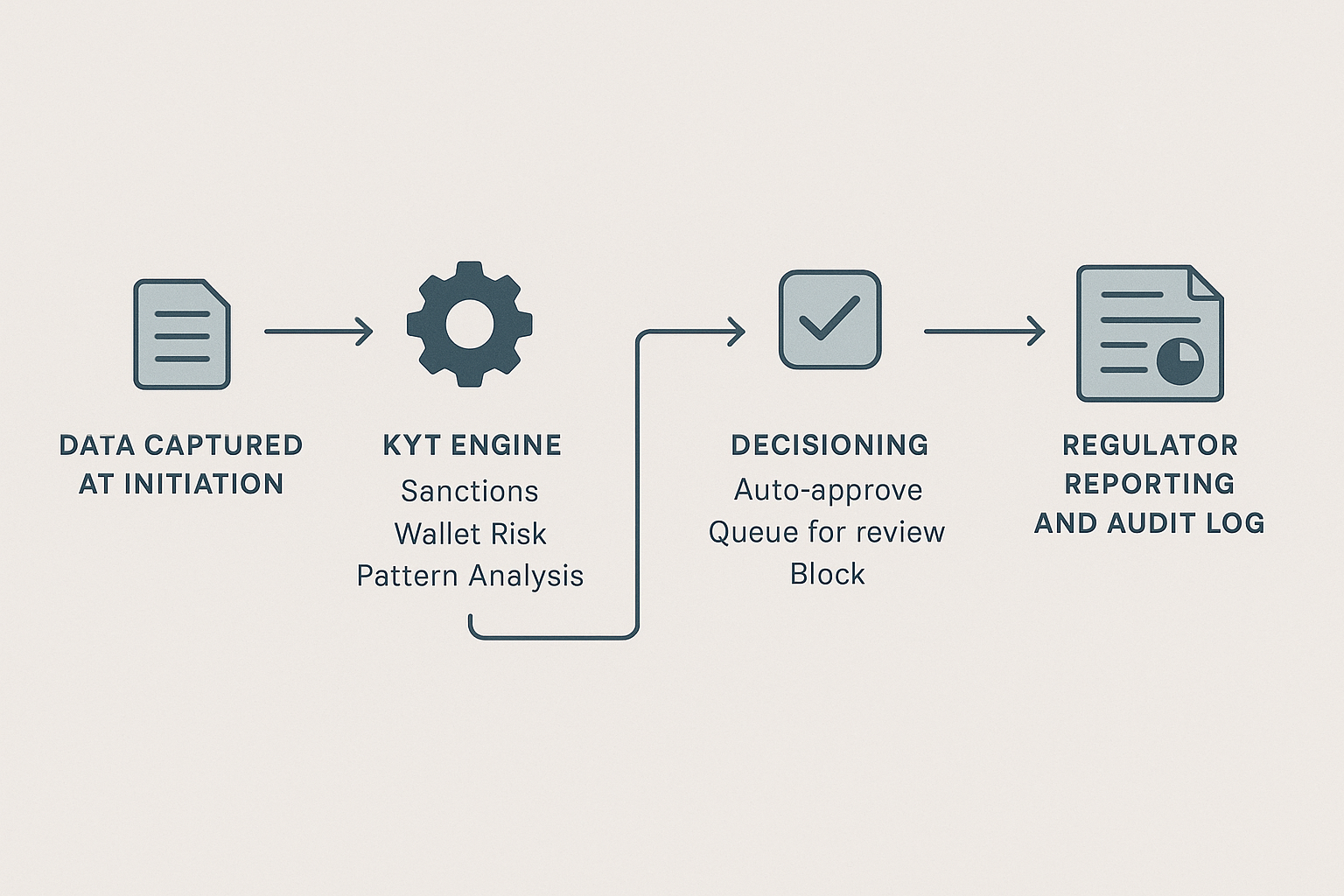
Stablecoin transfers must carry enough information for transaction monitoring and sanctions screening. Practically, treat Know Your Transaction (KYT) as a first‑class control for both primary issuance/redemption and secondary market flows.
Minimum viable data for risk-based KYT:
- Originator and beneficiary identifiers (or VASP references), including the custodial wallet provider when applicable.
- Transaction purpose/type codes and asset identifiers (token symbol/contract).
- Wallet risk scores (on‑chain heuristics), clustering and exposure mapping (e.g., known mixers, sanctioned entities, high‑risk services).
- Velocity, amount patterns, and counterparty jurisdiction flags.
Add rules that trigger enhanced review for interactions with unhosted wallets, high‑risk DeFi protocols, or sudden balance spikes.
Unhosted wallet controls (without killing UX)
Regulators expect “additional controls” for unhosted wallets. Use a layered approach:
- Tiered limits: cumulative and per‑transaction caps for outbound transfers to unhosted wallets.
- First‑use checks: ownership attestation (e.g., signed message), risk score threshold, and trial micro‑transfer.
- Velocity/behaviour rules: pause and review on unusual spikes, cross‑exchange hopping, or interaction with flagged contracts.
- Travel Rule interoperability: when counterparty is a VASP, exchange originator/beneficiary info; when unhosted, record robust substitute identifiers and rationale.
- Ongoing secondary‑market monitoring: maintain exposure dashboards for your token across chains, even when holders are not your customers.
Wholesale stablecoins: design for settlement first
Wholesale use cases—inter‑institution settlement, tokenised asset delivery‑versus‑payment, and intraday liquidity—need narrower perimeters and stronger bilateral governance. If you’re aiming at banks, FMIs, or large corporates:
- Closed user group: restrict to licensed institutions with signed participation and netting agreements.
- Pre‑trade due diligence: KYC/KYB on participants; verify licence status (SFC/HKMA) and sanctions posture.
- Deterministic redemption and cut‑offs: align with RTGS windows and collateral policies.
- On‑chain controls: whitelist smart contracts, enforce allow‑lists for wallets, and pre‑approve use cases (e.g., DvP for tokenised bonds).
- Interoperability: plan for co‑existence with e‑HKD pilots or cross‑border projects (e.g., mBridge) without making speculative promises.
What to do this quarter
- Gap‑assess against issuer licensing expectations and draft your reserve, redemption, and disclosures.
- Stand up your KYT stack (chain analytics, Travel Rule messaging, rules engine) and write playbooks for secondary‑market alerts.
- Decide your wallet policy: permitted VASPs, unhosted limits, and evidence you’ll collect at first use.
- If targeting wholesale, start with a two‑bank pilot and a single DvP workflow. Prove settlement finality before scaling.
August is close. Build for auditability now so you can ship with confidence.
If you need a sanity check on controls or a dry‑run with regulators, StanCOMP is happy to help founders and banks avoid unforced errors. Links: HKMA, SFC, FSTB, AMLO Cap. 615, UN Sanctions Cap. 537.


