HK Compliance: SOW, KYT & Onboarding Risk Matrix Guide

HK Compliance: SOW, KYT & Onboarding Risk Matrix Guide
If you’re onboarding clients into a VASP, OTC desk, or payment business in Hong Kong, 2025 is the year to tighten three things: Source of Wealth (SOW), Know Your Transaction (KYT), and a risk-based onboarding matrix that actually drives decisions. The regulator’s direction is clear: transparency, traceability, and targeted mitigation. Recent consultation conclusions on stablecoins reiterate this, aligning requirements with international standards and making wallet-type due diligence non-negotiable.
What SOW Should Look Like (Now) SOW is not “proof of funds.” It’s the credible narrative of how a customer accumulated their wealth, supported by objective documents. For Hong Kong-facing clients, aim for a triangulated pack:
- Income-based: Latest IRD tax demand notes, employer letters, MPF statements; pay slips covering 6–12 months.
- Asset-based: Land Registry extracts and sale/purchase agreements; bank statements evidencing proceeds; broker statements for equities.
- Business-based: Audited accounts (last 2 years), BR/CI, major contracts; director/shareholder proof.
- Crypto-derived: On-chain evidence of acquisition, staking/mining rewards; exchange account histories; fiat off-ramps to named bank accounts.
Practical rule of thumb (illustrative): escalate if >50% of wealth is crypto-derived AND historical fiat off-ramps are limited (<HKD 1m cumulative). Do not accept “airdrops” or ICO allocations at face value without provenance.
KYT: Beyond the Travel Rule KYT should operate at three layers:
- Pre-trade: Counterparty wallet screening and ownership assertions. For unhosted wallets or those from providers not yet subject to AML/CFT supervision, you must screen addresses using appropriate tools and mitigate any higher ML/TF risk identified.
- In-flight: Travel Rule payloads for VA transfers so participants have the essential information for transaction monitoring, sanctions screening, and risk mitigation. See SFC’s AML/CFT expectations for VASPs: https://www.sfc.hk/en/Rules-and-standards/Anti-money-laundering-and-counter-financing-of-terrorism
- Post-trade: Behavioral analytics—velocity, structuring, peel chains, interaction with OFAC/EU/HKSAR-sanctioned clusters, and mixers.
Illustrative alerting thresholds:
- Sanctions adjacency: >1% inbound exposure to sanctioned clusters over 90 days → EDD and SAR consideration.
- Mixer exposure: Any direct mixer hop within 2 legs → hold/return unless risk-cleared.
- Stablecoin anomalies: Repetitive USDT redemptions via non-licensed venues → EDD; verify issuer/custodian routing.
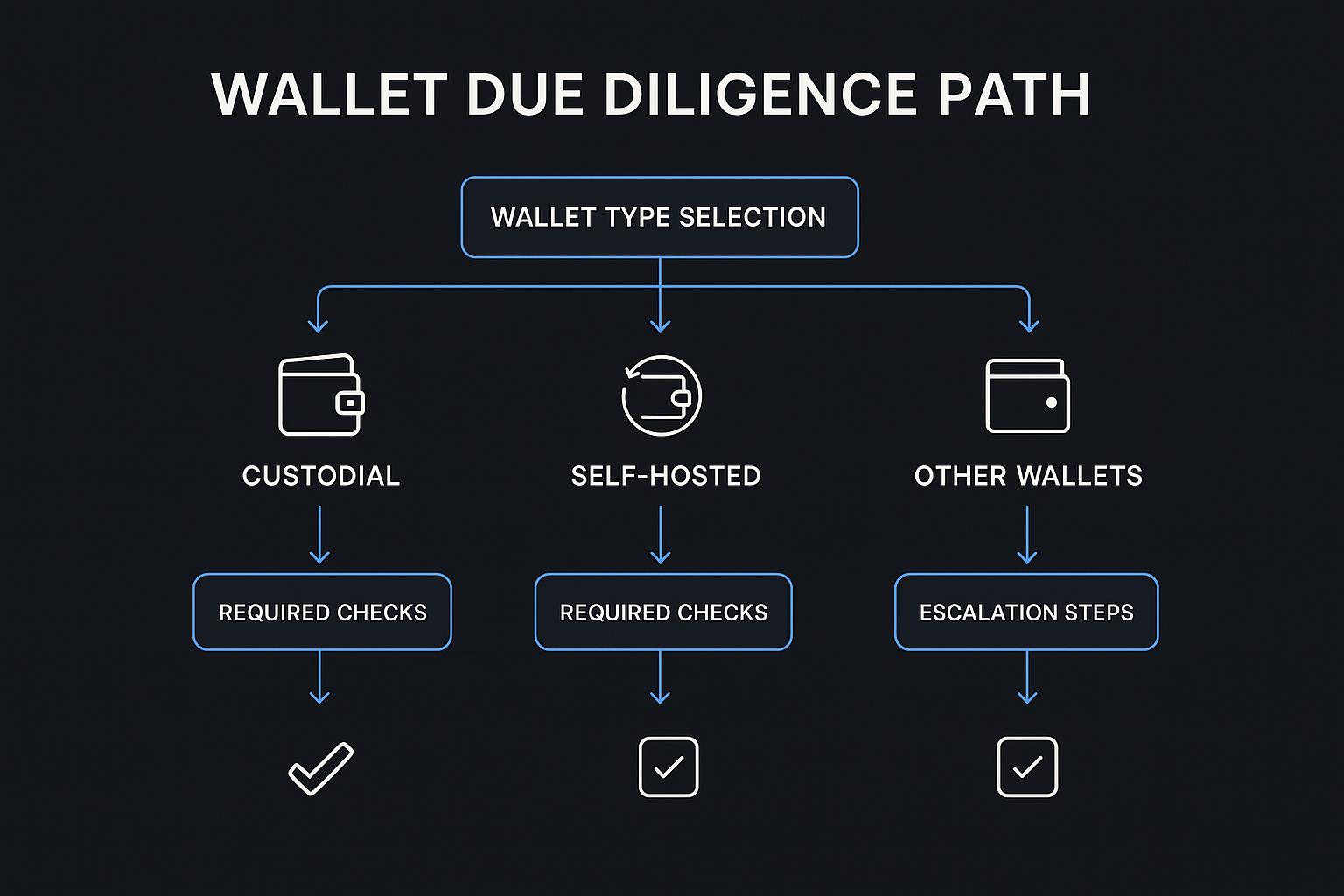
Wallet Types Matter The AML/CFT Guideline differentiates wallets:
- Custodial wallet from regulated FI/VASP: perform standard CDD with reliance logic where permissible.
- Self-hosted wallet used by an FI/VASP: collect sufficient ownership and control assertions; KYT must be active.
- Other wallets (e.g., unhosted or custodians not under AML/CFT supervision): mandatory screening and documented risk mitigation (limits, holds, approvals).
Onboarding Risk Matrix (Illustrative) Use a points-based matrix that ties CDD/KYT outcomes to concrete controls.
| Risk factor | Low | Medium | High | Control response |
|---|---|---|---|---|
| Customer type | HK salaried + banked | SME director with mixed income | Offshore trust/DAO rep | EDD, IC approval for High |
| Geography | HK, SG | Non-FATF but low-risk | Sanctioned/grey-list adjacency | Block prohibited; add limits |
| Wallet type | Regulated custodian | Self-hosted with proof | Unhosted/no proof | Pre-fund screening; holds |
| SOW profile | Audited/IRD-backed | Asset sale with gaps | Crypto-majority w/ weak trail | Independent verification |
| KYT patterns | Clean history | Minor risk adjacencies | Mixers, darknet, peel chains | Return funds; SAR assessment |
Stablecoins: Extra Touchpoints With Hong Kong moving to license stablecoin issuers—covering business activities, financial resources, and risk management—VASPs should:
- Verify issuer status and attestation cadence.
- Monitor redemption paths and concentration of custodians.
- Apply higher scrutiny to non-licensed issuers or cross-chain bridged tokens.
What to Do This Quarter
- Implement pre-deposit wallet screening for every first-time address.
- Refresh SOW templates to force a narrative + documents; reject generic “trading profits.”
- Calibrate KYT thresholds; document why 1%, 2%, or 5% is your line.
- Update your onboarding matrix; link scores to limits, approvals, and ongoing review cadence.
- Re-test Travel Rule interoperability across counterparties before Q1 audits.
The goal isn’t box-ticking. It’s to be able to explain, in two minutes, why you onboarded, what you monitored, and how you mitigated. In Hong Kong, that explanation is your real license to operate.
References
- SFC AML/CFT (VASPs and LCs): https://www.sfc.hk/en/Rules-and-standards/Anti-money-laundering-and-counter-financing-of-terrorism
- Anti-Money Laundering and Counter-Terrorist Financing Ordinance (Cap. 615): https://www.elegislation.gov.hk/hk/cap615
- HKMA stablecoin policy direction and supervision updates: https://www.hkma.gov.hk/eng/ (see Fintech and virtual assets sections)