
HK Compliance: Smart Contract Audits & Onboarding Risk

Introduction Smart contract audits are no longer a “nice-to-have” code review in Hong Kong. In 2025, they directly shape how you onboard counterparties, set limits, and justify stablecoin flows to regulators. The HKMA’s recent stablecoin AML/CFT consultation conclusions underline this shift: institutions must receive essential information for transaction monitoring, sanctions screening and risk mitigation throughout a stablecoin transfer. If you’re a bank, VASP, or custodian, your onboarding risk matrix should ingest smart contract findings and wallet-type risk — or you’ll miss material red flags.
Why audits matter for AML/CFT (not just security) A clean audit reduces technical risk, but AML/CFT risk hinges on how the contract behaves in the wild:
- Upgradeability and admin keys: Who can change logic? Can they bypass transfer restrictions or freeze balances? These are counterparties for CDD.
- Token mechanics: Mint/burn, pause, blacklist, and redemption hooks influence sanctions controls and chargeback-like risks.
- Oracle/liveness dependencies: If price or redemption logic relies on a thin oracle set, market manipulation risk can spill into suspicious activity patterns.
- Proxy patterns and pausable modules: Emergency modes may reroute flows to admin-controlled wallets. Treat those wallets as high-risk unless covered by institutional CDD.
HKMA has acknowledged limits in reliably classifying unhosted vs custodial wallets on-chain, but still expects higher-risk wallets to be screened with appropriate technological solutions and for institutions to mitigate identified ML/TF risk. This means you need a way to translate audit signals into onboarding decisions.
A compact onboarding risk matrix that uses audit signals Feed contract and wallet insights into a single risk view. Keep it lightweight but defensible.
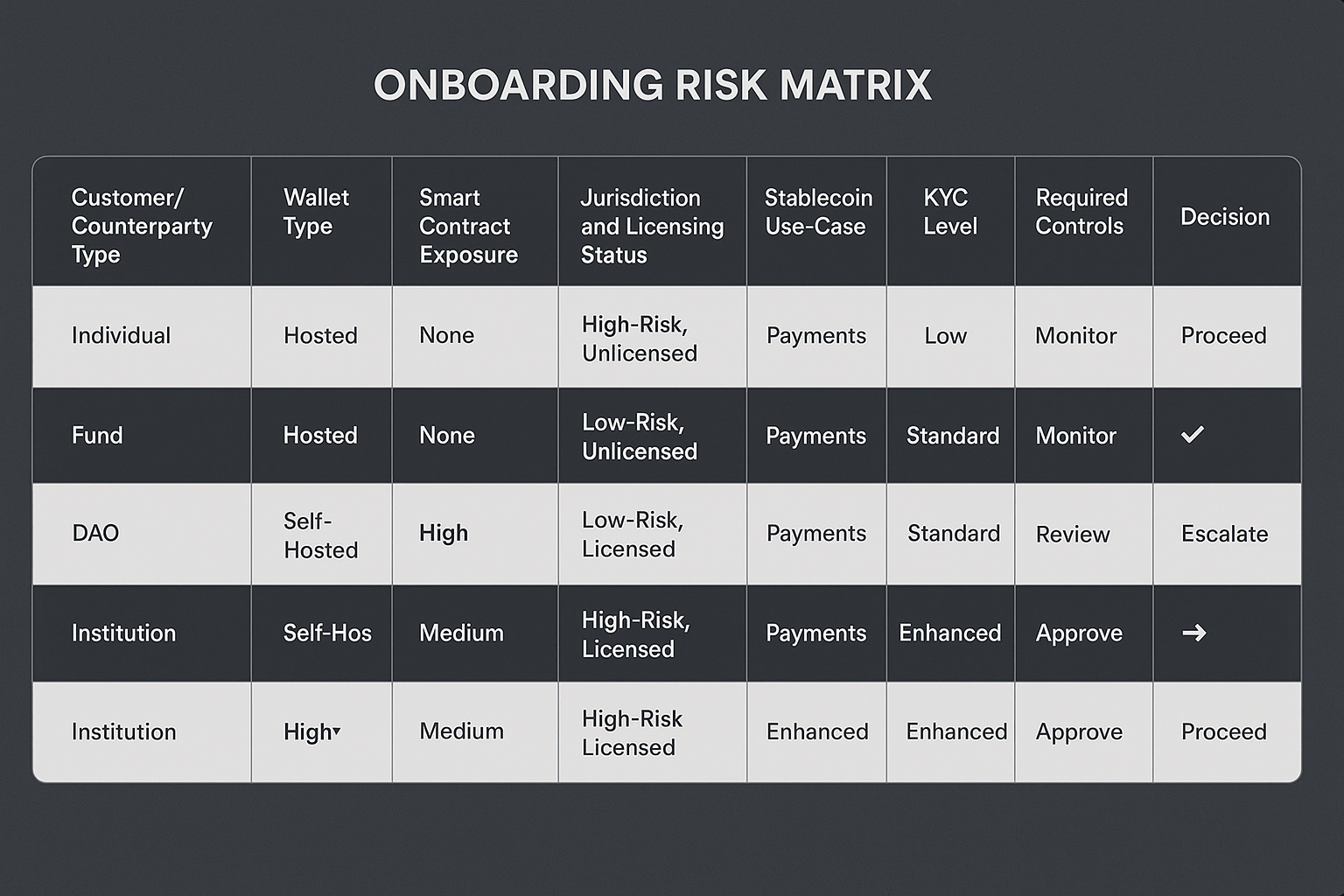
Illustrative scoring (marking clearly as illustrative):
- +2 if unhosted wallet interacting with upgradeable contracts where admin keys are undisclosed.
- +1 if custodial wallet provider is not subject to AML/CFT supervision.
- +1 if stablecoin redemption is involved without clear issuer KYC data fields.
- −1 if the contract has a recent third-party audit and verified source code with no criticals.
Unhosted and custodial wallets: what HKMA expects in practice
- Classification is hard: HKMA notes current tech limits. Don’t over-promise. Document the criteria you use and their constraints.
- Still, screen: When wallets are unhosted — or when due diligence on a custodial provider is unsatisfactory — licensees must screen the wallet addresses using appropriate technological solutions and mitigate any higher ML/TF risk identified.
- Adopt analytics: The custody regime consultation also expects licensees to adopt appropriate technological solutions (e.g., blockchain analytics) to track VAs, associated wallet addresses, and identify potentially suspicious transactions.
What to do this quarter
- Tie audits to onboarding: Require counterparties to provide latest audit reports, admin-key disclosures, and contract addresses. Map these to your onboarding matrix and limit tiers.
- Build an “audit-aware” rule set: Example controls — block deposits to unaudited upgradeable contracts; set lower velocity limits for admin-key-controlled tokens; require named signers for multisigs holding redemption rights.
- Wallet screening policy: Define unhosted vs custodial indicators (e.g., exchange deposit tags, VASP attestations, Travel Rule data). Where uncertain, default to higher-risk treatment with address screening and enhanced monitoring.
- Evidence your tech: Keep vendor due diligence for blockchain analytics tools, model thresholds, and tuning logs. Regulators will ask how you calibrated alerts.
- Stablecoin redemption playbook: If you facilitate redemption, ensure due diligence on the custodial wallet provider and capture issuer-provided KYC/sanctions data fields for monitoring. Where gaps persist, escalate to EDD or set transaction caps.
Compliance references and links
- HKMA AML/CFT resources and virtual assets guidance: https://www.hkma.gov.hk/eng/key-functions/banking/anti-money-laundering-and-counter-financing-of-terrorism/
- HKMA updates on virtual assets and stablecoins: https://www.hkma.gov.hk/eng/key-functions/international-financial-centre/virtual-assets-and-stablecoins/
- FSTB consultations (including VA custodian services): https://www.fstb.gov.hk/en/publications/consultation.html
Final thought Smart contract audits don’t sit on a shelf anymore. In Hong Kong’s regime, they feed your onboarding matrix, power wallet screening decisions, and justify stablecoin flows. Build that linkage now — and keep receipts.


